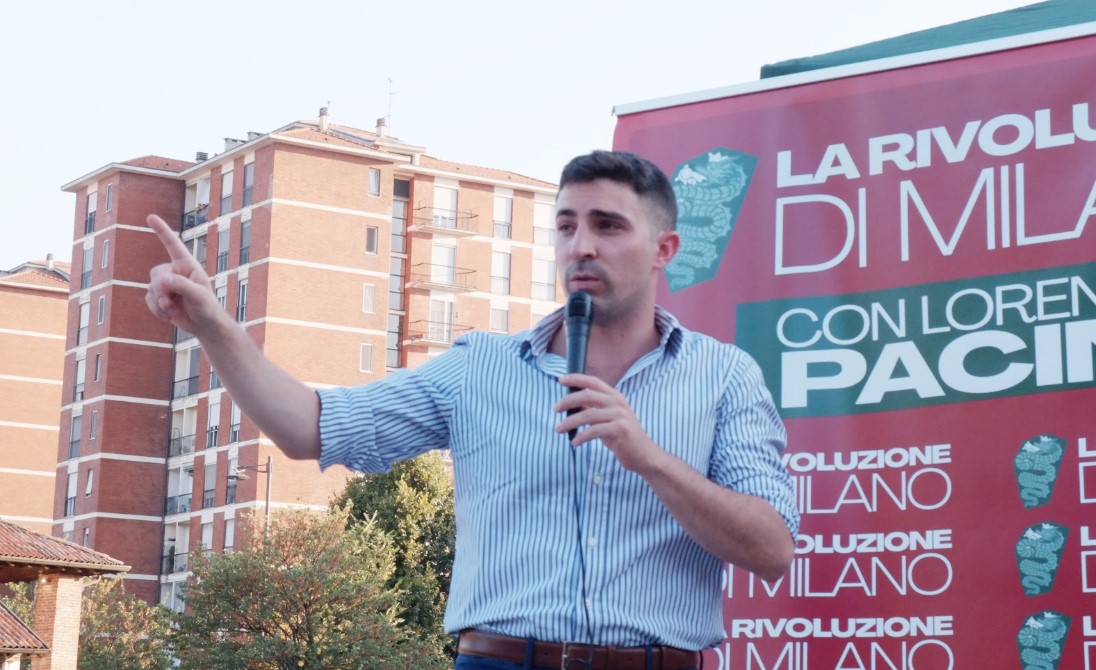
While talk is sparked by the resignation of journalist Mario Calabresi from Chora & Will—the former director of La Stampa and Repubblica—in view of a possible candidacy for mayor of Milan, and as we wait to understand if, how, and when the primaries will be held to choose the centre-left’s candidate in the post-Sala race, Lorenzo Pacini, who has long announced his own bid, has already declared his candidacy.
Nato e cresciuto a Milano, laureato in Giurisprudenza, ha lavorato come lavapiatti, stagista, venditore di fragole e comunicatore per campagne elettorali, conciliando il lavoro con l’impegno politico.
Born and raised in Milan, with a degree in Law, he has held jobs ranging from dishwasher, intern, strawberry seller, to a communications role for electoral campaigns, balancing work with political engagement.
Classe 1996, dopo l’esperienza nei movimenti studenteschi, Pacini è stato eletto consigliere municipale e oggi è assessore del Municipio 1 di Milano, con deleghe al verde, alle case popolari e ai lavori pubblici.
Born in 1996, after his involvement with student movements, Pacini was elected municipal councilor and today serves as the administrator for Municipio 1 in Milan, with responsibilities for green spaces, social housing, and public works.
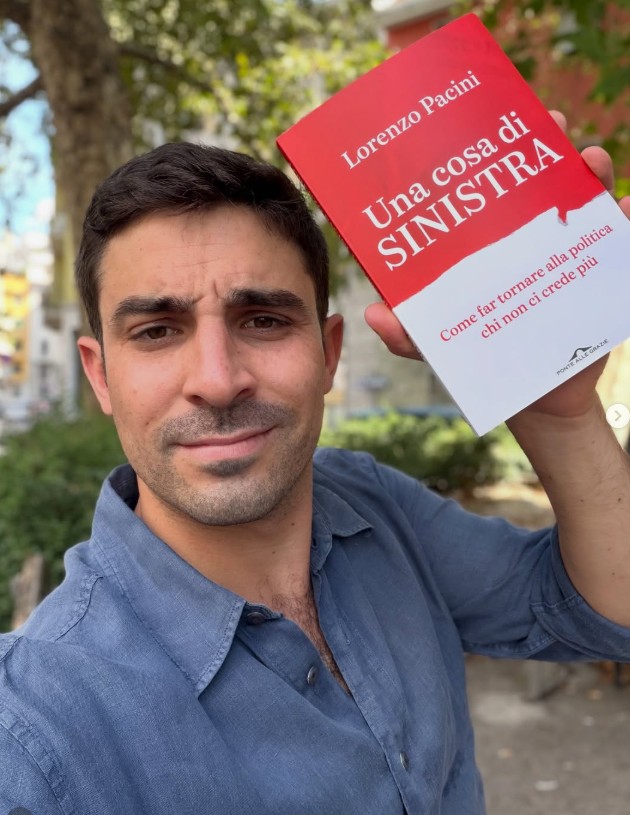
Ora in libreria per Ponte alle Grazie arriva Una cosa di sinistra – Come far tornare alla politica chi non ci crede più, il suo saggio-manifesto, in cui propone una riflessione su come riportare al centro della politica le persone e i loro bisogni, partendo da Milano.
Now in bookstores from Ponte alle Grazie is available A Left Thing – How to Bring People Back to Politics Who No Longer Believe, his manifesto-essay, in which he offers a reflection on how to place people and their needs at the center of politics, starting with Milan.
The Social Emergency, Between Low Wages, Dignity-Lacking Work, and Untreated Care Needs
Per Pacini, militante del Partito Democratico molto attivo sui social, c’è una sola, vera emergenza in Italia, ed è quella sociale: salari poveri, lavoro senza dignità, bisogni di cura disattesi. Per l’autore, la sicurezza, gli sbarchi, i “maranza” sono tutti diversivi, perché il nemico del popolo non arriva su un gommone, ma con lo yacht o il jet privato. Eppure da 30 anni la sinistra ha smesso di dirlo, ha abbandonato la lotta di classe e si è fatta custode dello status quo, lasciando che fosse la destra a spostare la rabbia della gente sugli ultimi anziché sui privilegiati. Dati alla mano, nel libro Pacini racconta un Paese in cui il lavoro non garantisce più né salari dignitosi né pensioni, in cui i giovani emigrano in massa ogni anno, in cui gli evasori sono celebrati e le grandi eredità quasi non vengono tassate.
The Left Has Abandoned the Class Struggle
At the center of A Left Thing is Milan, “a laboratory for a model that must be overcome”: a city that is “attractive yet unwelcoming,” where multimillionaires arrive with the flat tax and workers end up leaving. Yet for Pacini the Lombard capital is also the place to imagine the alternative: municipal socialism made of mutualism, bottom-up cooperation, and a quality of life for those who truly make the city function.

(…)
“We Must Talk About Money Again”
The left, on the other hand, cannot be reduced to an agency representing minorities that must be linked and kept together with effort, but must be capable of addressing everyone, starting with the majority of Italians, who today are no longer prosperous and are increasingly struggling. We must give this majority the opportunity to redeem themselves and come together through a reform, a concrete fact: a fair wage. The left, essentially, must not measure itself only by work, but by income. In other words: by money. We must return to talking about money, because it is the instrument of emancipation for all, the engine of social mobility. The historic task of the left is to make opportunities and chances more equal, overturning the pyramid of inequalities. If society has returned to defending inheritance, rents and speculation more than it defends work and income, then a fair wage for everyone is needed.
(…)
“Return to the Class Struggle to Defeat the Social Emergency”
Until we propose a different and more effective development model than the hypocritical and false ‘happy growth’ that is fed to us today, the social emergency will remain the natural product of this economic system. In fact, today we could call it ‘unhappy growth,’ because it is in the hands of a few, it is determined solely by the value of production, and it is still based on environmental destruction (GDP continues to rise with every environmental disaster) or on social exclusion. In university textbooks, economics is defined as the science of choices: the way individuals, the state, and businesses choose to use scarce resources, applying them to alternative uses, to satisfy unlimited needs. And here, ‘unlimited needs’ and ‘alternative uses’ have become needs of a few for private purposes. A Left Thing, therefore, is returning to the class struggle to defeat the social emergency. The good news is that it’s much simpler than you might imagine: start by honestly recognizing to which class we belong and ally ourselves to improve our condition, with a clear realization. Then acknowledge the need for a fair wage and a reduction of the enormous gap between those with more than a hundred lifetimes to live and everyone else, that is, us. And act accordingly.
(…)
“Intervening in the Real Estate Market”
The risk is that Milan becomes a tourist dormitory, perhaps luxurious, but still a dormitory. For this reason one should use the city’s limited levers to intervene in the real estate market. The opposite, for instance, of how Milan’s largest real estate operation was managed, namely the rail-yard redevelopment: the Municipality kept for itself, as the sole real public intervention, the green space, leaving private parties with all planning and development of residential areas, in exchange for quotas of social housing. Those areas immediately became the engine of speculation in the surrounding zones. And here too the Porta Romana and Olympic intervention example is textbook: the same groups that won the contracts for the area around the former railway station went on to buy lands and buildings nearby, increasing their value even before the Olympic site opened. Nothing illegal and nothing to do with investigations by the Prosecutor’s Office into construction permits for the so-called urban regeneration. But it’s a faulty mechanism, where the public yields everything to the private sector and is left only with good intentions. What could be done? Return to being a participant in the process, an operator, and promote public housing, in alliance with cooperative development. It would have taken just one area, one, to prove that the public could restart promoting its own housing in cooperation, to show attention to residents and, at the same time, to issue a warning to the market. In Milan, good deals are made, but the Municipality must guarantee the sustainability of market prices. There are tools to intervene: the planning lever, the valorization and use of public assets, regulation, and agreements with associations to reduce the burden of rents on families. The case of urbanization charges, not updated from 1997 to 2024 and the subject of a Court of Auditors inquiry, as well as investigations by the Prosecutor’s Office, again serves as an example. Charges are paid to valorize and harmonize new constructions with services and quality of life; they should be a tool in the hands of public authorities to guide planning. Over time, however, they have become a burden: the private sector was entrusted with carrying out the works, with a series of discounts, and significant reductions were granted for every type of ‘social’ ancillary work—a student housing project saved 60% on charges, and a swimming pool up to 80%. In short, a discount system for private stakeholders and a retreat from public responsibility by decision-makers. In these years, moreover, the message has always been the same: public-private partnership, with the public defining the framework and the private filling it in. Perhaps it works for events, fairs, real estate projects where the private sector owns the area and its destiny. It cannot work if the area, or the purpose, is public.
(continua in libreria…)