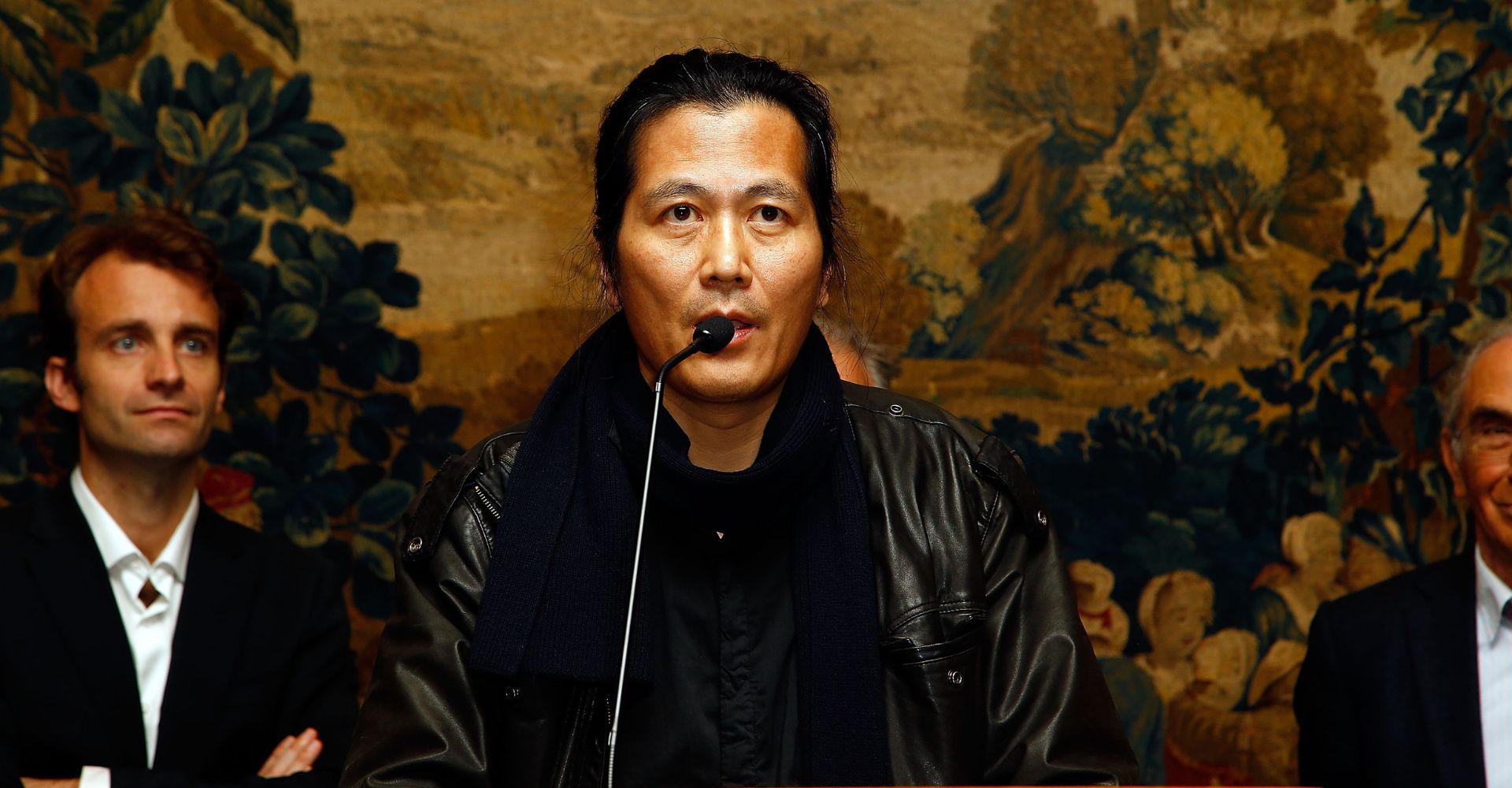
Byung-Chul Han is a contemporary philosopher of South Korean origin who lives and teaches in Germany. Han was born in Seoul in 1959, and in his early academic path he pursued metallurgy. In 1980, however, Han chose to change course and moved to Germany; there he began studying philosophy, which culminated in 1994 with a doctoral thesis on Martin Heidegger.
Subsequently Han obtained the habilitation for teaching. During his career he has taught primarily at the Academy of Art and Design in Karlsruhe and at the Universität der Künste in Berlin; among his numerous philosophical interests one that he has pursued most intensely, also through teaching, is the theory of culture.
A thinker and writer of eclectic range, Han strays from the traditional academic profile focused on delving into a single theme. His essays are often short yet rich in insights, and they aim to introduce into contemporary dialogue a new concept or a novel philosophical interpretation.
Byung-Chul Han today has more than 20 publications written in German, many of which have been translated and published in Italian by nottetempo and Einaudi.
The philosopher, who at conferences and public engagements often presents himself in a white T-shirt, a black leather jacket, and a dark scarf around his neck, is also known for his reserved personality: reluctant to grant interviews; when he does, he asks that the recorder be switched off; he also dislikes being asked about his age, a habit he regards as a Western vice linked to the obsession with interpreting events through their beginning and end.
Given the growing success of his publications, capable of observing the contradictions of contemporary life with a keen and stimulating gaze, here is a brief deeper look into the thought and books of the philosopher.
Byung-Chul Han: The Thought
The philosopher Byung-Chul Han has dedicated himself to, and continues to dedicate himself to, a variety of topics, approaching them from a philosophical vantage point. Yet there are some throughlines that connect many of his most celebrated works, such as his critical view of the influence of the digital realm on our lives. Some of the themes that have made him particularly renowned are his reflections on specific aspects of modern society inevitably shaped by technology. Here are three ideas (here simplified for brevity) on which the thought of Byung-Chul Han dwells:
- Müdigkeitsgesellschaft, the German term that can be rendered as “the society of fatigue” (the title of the work exploring this idea). Contemporary society is marked by fatigue because a surplus of positivity leads us to exalt extreme productivity as a value and to fear failure. This condition thus causes weariness, but not only that: according to the philosopher it can be traced as the primary cause of modern disorders such as depression and burnout.
- Transparenzgesellschaft, i.e., the “society of transparency” (this idea is also the title of the book in which it is explored). Transparency, taken as an absolute value by today’s society, is in fact a value imposed by the neoliberal market, expressed as the voluntary sharing of every aspect of one’s experience. Transparency has established itself at the expense of values like privacy, shame, and trust, which in reality are necessary at both political and interpersonal levels.
- Shanzhai, a concept particularly evident in Chinese culture, which appears as a style characterized by imitation, and which rejects the Western distinction between original and fake. Imitation travels from a deconstruction that does not necessarily lead to a worse result than the original, and for this reason it does not deserve to bear a solely negative connotation.
The Books of Byung-Chul Han
The thought of this philosopher can be best understood through his publications. Here are some of the main books by Byung-Chul Han available in Italy:
The Society Without Respect – How We Have Lost Touch, Regard and Courtesy

As of September 2026, Einaudi Stile Libero published the essay by philosopher Byung-Chul Han The Society Without Respect – How We Have Lost Touch, Regard and Courtesy (translated by Armando Canzonieri). The work, as the title already hints, is a reflection on the changes of modern society which, in the pursuit of performance and profit, has neglected some fundamental values once considered relics of the past. Yet according to Han, today more than ever a “politics of friendship” is needed…
Speaking of God – A Dialogue with Simone Weil
We continue with the latest book by the prolific philosopher and essayist of South Korean origin published, instead, by nottetempo. In the volume Speaking of God – A Dialogue with Simone Weil (translated by Simone Aglan-Buttazzi), the author engages with the thought of philosopher Simone Weil (1909–1943) to address the question of the absence of God – and transcendence – in our society, of consumption and production. Weil, in Han’s view, “shows us that ultimately it is God who grants us a blessed fullness of being…”. And living precisely according to the “model” of the French thinker would bring more “peace and beauty into the world.”
Topology of Violence
In 2025 nottetempo decided to reissue in a new edition the essay Topology of Violence (translated by Simone Aglan-Buttazzi) in which Byung-Chul Han analyses the protean nature of violence. In the modern era, the philosopher contends, although violence seems to fade in its most explicit forms, it shifts onto a psychic plane: it “manifests in terms of over-eagerness, overproduction and over-communication, hyper-attention and hyperactivity.”
The Salvation of the Beautiful
The Salvation of the Beautiful (translated by Vittorio Tamaro) is a short and timely essay by Byung-Chul Han, first published in 2019 and later in 2025 by nottetempo. A text that summons a few great thinkers of the past, from Plato to Nietzsche, to describe how today, due to increasingly polished images delivered to consumption, art has become merely an occasion for transient excitation. The German philosopher thus cheers the power of the beautiful, not as a mere sensation of pleasure, but as an experience of truth capable of extending into political life.
Against the Society of Anxiety – Hope and Information
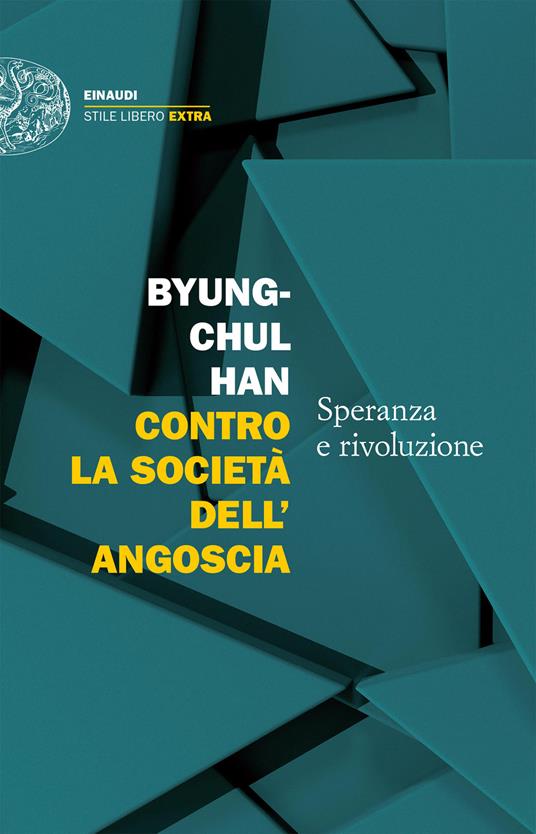
Contro la società dell’angoscia (Einaudi Stile Libero, translation by Armando Canzonieri) is one of Han’s more recent books: in this essay the philosopher tackles the theme of hope and its salvific power by engaging with some of the most important 20th-century thinkers. Han reflects on today’s society—with empathy and solidarity traded for performance anxiety and loneliness—and emphasizes that only with trust and hope can a revolution begin.
The Crisis of Narrative – Information, Politics and Everyday Life
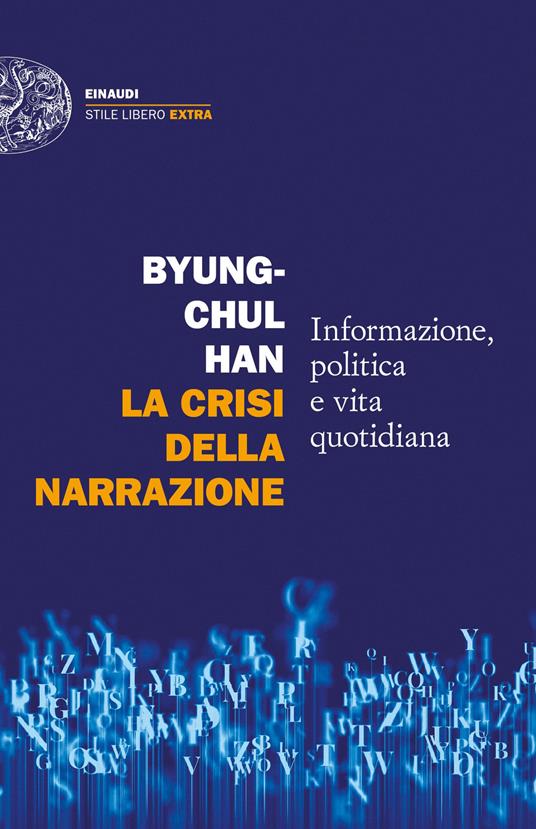
The Crisis of Narrative – Information, Politics and Daily Life (Einaudi Stile Libero, translation by Armando Canzonieri) is a timely book by Byung-Chul Han, a good starting point to get to know the thoughts of the renowned philosopher of South Korean origin. Han centers this essay on narratives, long in crisis and turned into a commodity like any other. Reduced to handmaids of capitalism, they become storytelling, and storytelling becomes mere advertisement, or the consumption of information. In this concise work Han suggests that life encounters true fullness only when it can be shared and transmitted within a collective narrative.
Contemplative Life or Inactivity
In Vita contemplativa o dell’inazione (notte tempo, translation by Simone Aglan-Buttazzi), Byung-Chul Han proposes a new vision of inactivity: not a negation, a refusal, or a mere absence of activity, but an autonomous capacity for understanding and contemplation of the world. In this essay we witness a stimulating dialogue with Vita Activa by Hannah Arendt, during which the philosopher—who now lives in Germany—emphasizes the importance of contemplation.
Why Today It Is Not Possible to Bring About a Revolution
Among Han’s books one can also find a collection of interviews and brief essays, Why Today It Is Not Possible to Revolutionize (notte tempo, translation by Simone Aglan-Buttazzi). In this work the philosopher outlines his view of capitalism and its devastating effects. Han sees the frenetic productivity typical of modern society as a destructive capacity not only ecologically and socially but also mentally. Man thus appears driven to sacrifice his life, in a spiraling descent of self-destruction.
The Burnout Society
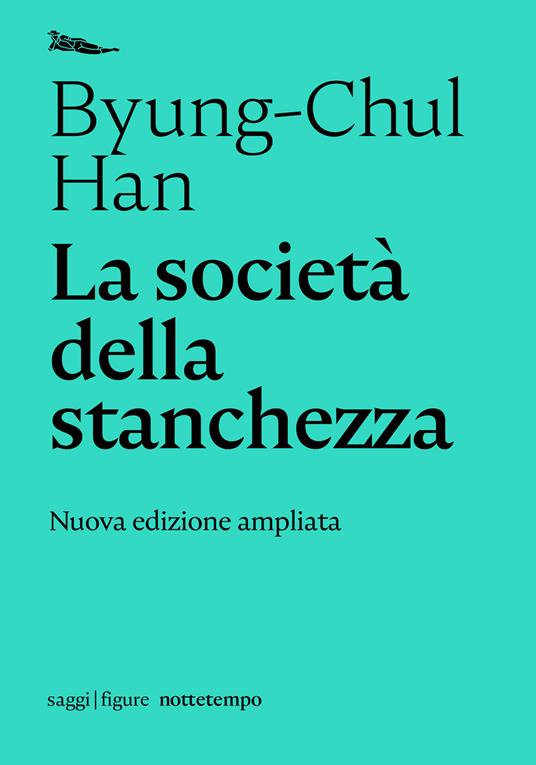
Byung-Chul Han in the essay The Burnout Society (notte tempo, translation by Federica Buongiorno) starts from the premise that if the last century was characterized by epidemics of disease, this century is marked by psychological disorders such as depression, burnout, and attention deficit. These conditions are caused by an excess of positivity, a positivity which compels us to always say yes, embodying in us the slave–master duality: we are at once masters of ourselves, imposing things on ourselves, and slaves forced to carry them out. The result is a performance-based society that can no longer attribute value to contemplative life.
The Society Without Pain
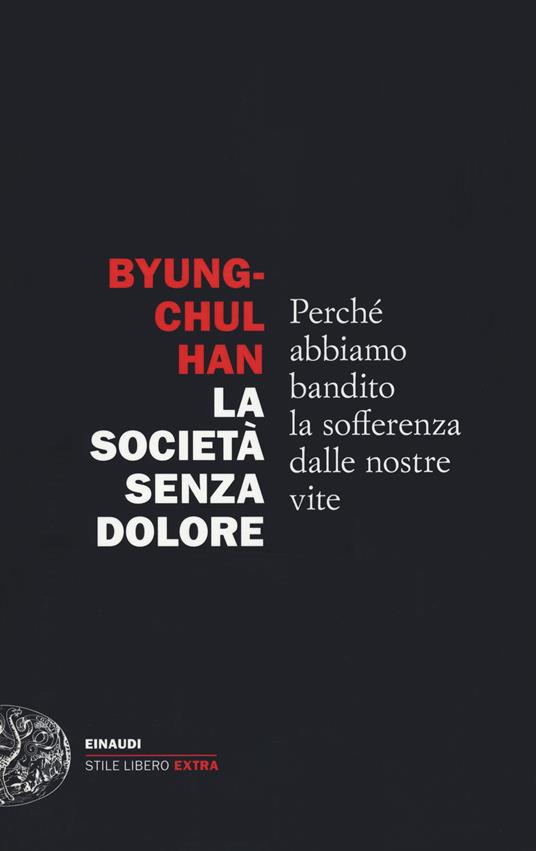
In the book The Society Without Pain (Einaudi Stile Libero, translation by Simone Aglan-Buttazzi) Byung-Chul Han turns to the controversial relationship contemporary society has with suffering. The fear of pain manifests in many ways: in avoiding disputes that could lead to conflict, in disinterest toward political reforms that would be useful but would require sacrifices, and, as the pandemic has shown us, in a self-imposed limitation of freedom aimed at avoiding pain and delaying death as long as possible. A pattern of behavior that, if taken to extremes, ends up replacing all that is worth living for.
Iper Culturality – Culture and Globalization
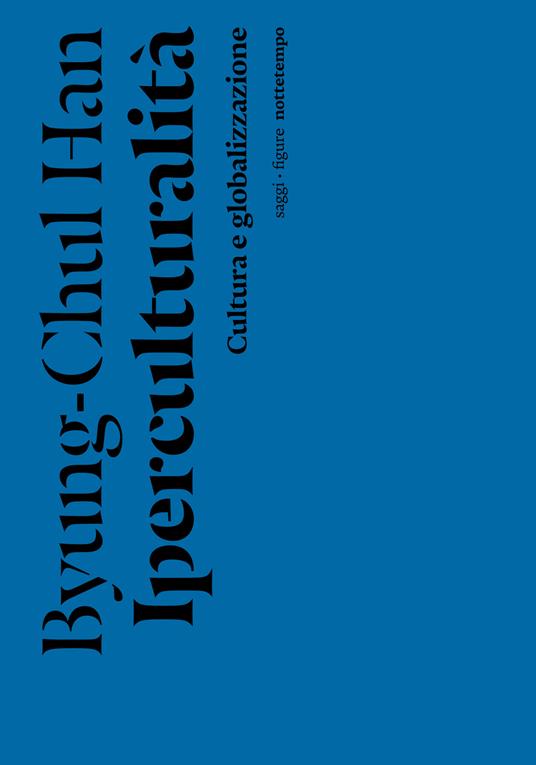
In today’s world, marked by globalization, there no longer exists a clear difference between near and far, familiar and exotic, self and other. A culture without constraints, brakes, and limits thus becomes hyperculture. This is what Han believes and analyzes in the essay published by nottetempo Iperculturalità – Cultura e globalizzazione (notte tempo, translation by Simone Aglan-Buttazzi). Perhaps, he suggests, this is the first step toward a new here and now devoid of aura but possessing its own splendor.
Psychopolitics
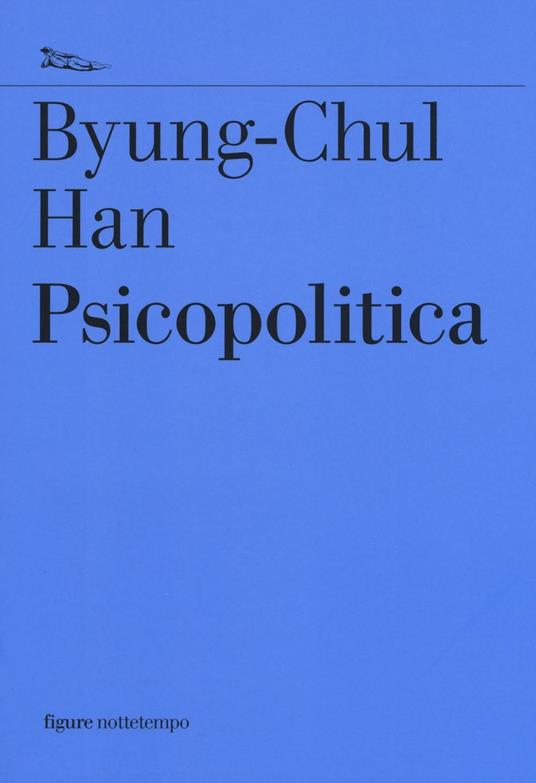
In Psychopolitics (notte tempo, translation by Federica Buongiorno) Han reflects on the hyper-connected world of today, and in particular on how, through digital devices (desirable tools rather than top-down imposed), we increasingly reveal information about ourselves via social media, creating data quantities that constitute the new commodity on which capitalism rests. Contemporary politics, which has thus discovered the power of control over the psyche instead of control over bodies (embodied in Foucault’s biopolitics), wins consent by offering the illusion of boundless freedom. Psychopolitics thus makes people believe they wish to continually improve and optimize themselves, while in reality they are transforming into better workers.
Nello sciame
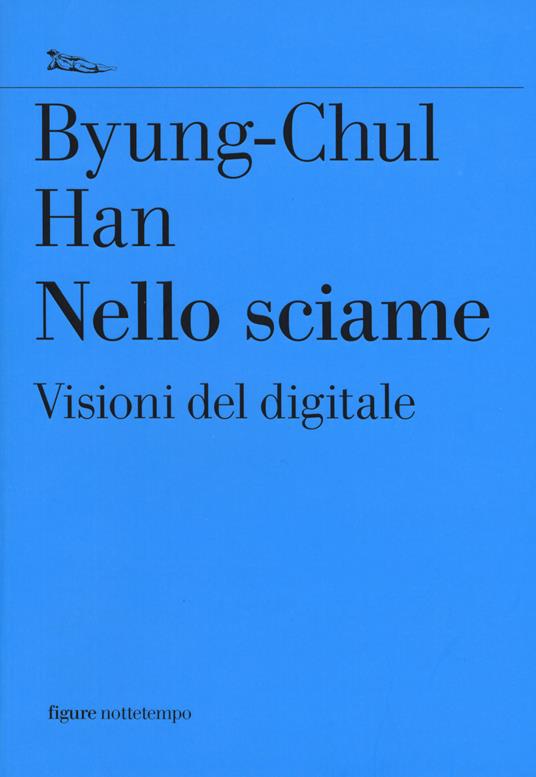
A work published by nottetempo (translated by Federica Buongiorno), Nello sciame (In the Swarm) outlines a shift from naming large crowds as “the masses” to the more accurate term “the swarm,” as individuals become interconnected through the digital network. The book sketches the idea that the swarm amplifies narcissism and erodes the sense of community and citizenship, and thus the possibility of democratic discussion (which has increasingly given way to the perpetual present of screens).
Elogio della terra
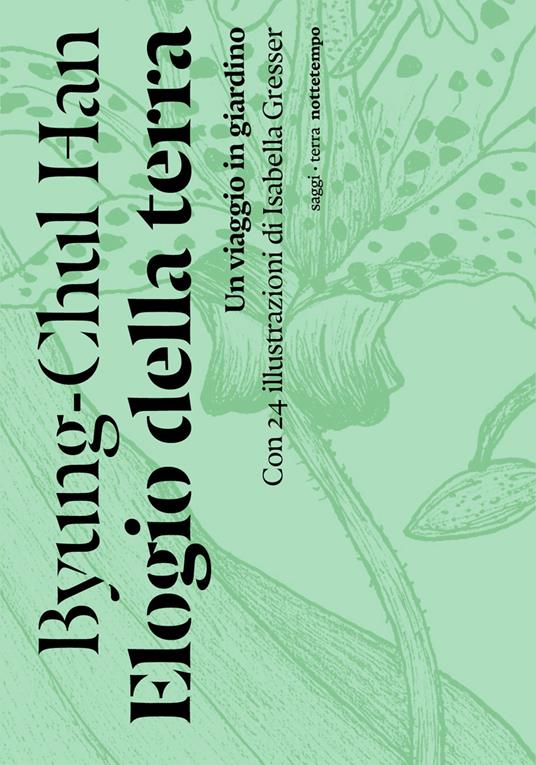
In Elogio della terra (nottetempo, translation by Simone Aglan-Buttazzi and illustrations by Isabella Gresser) Byung-Chul Han briefly steps away from the digital theme and, drawing from reflections arising from garden care, intertwined with the thoughts of Goethe, Schubert and D’Annunzio, guides us back to the beauty of the earth and thus to the importance of taking care of it and of our planet. It is essential to reconnect with nature, to rediscover the three-dimensionality of time.
The Society of Transparency
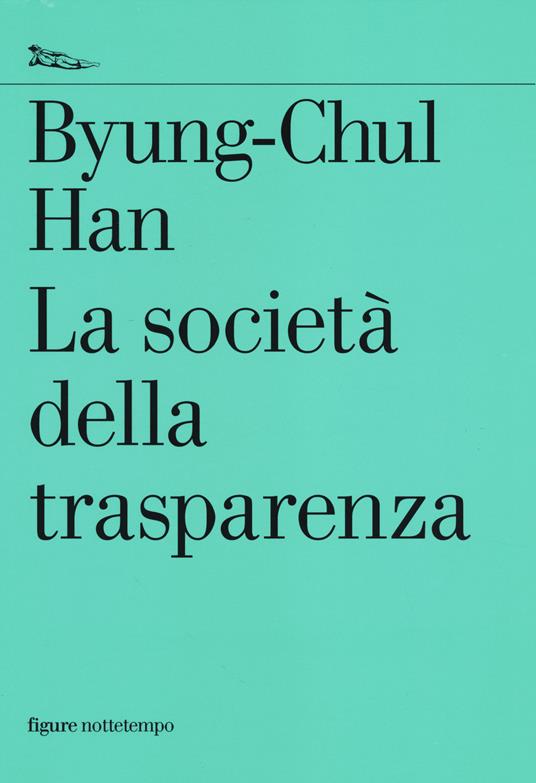
In the essay The Society of Transparency (notte tempo, translation by Federica Buongiorno) Han argues that another intrinsic feature of contemporary society is an obsession with transparency, which, treated as a universal positive value, conceals a dangerous erosion of privacy. This ever-easier access to sensitive and personal information (which does not equate to greater knowledge) merely gives the impression of freedom, but in reality lays the groundwork for a politics based on surveillance and control.
The Non-Things – How We Have Stopped Living the Real
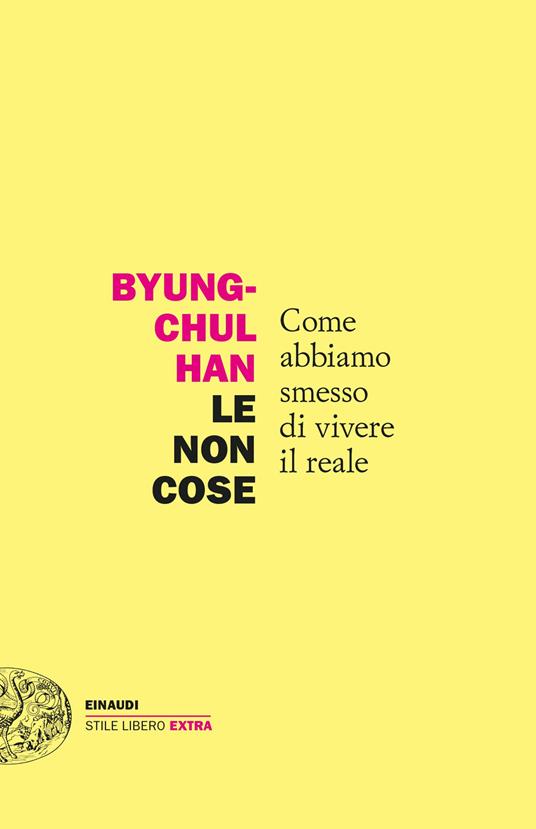
In the book Le non cose – How We Have Stopped Living the Real (Einaudi Stile Libero, translation by Simone Aglan-Buttazzi) Han reflects on the dematerialization of life in today’s world, where what influences our lives are no longer objects but dematerialized information in a process that is bringing the non-real to surpass the real. This carries a whole set of implications, such as the loss of temporality and the demand for constant attention to keep pace with a continual stream of new information. Han’s message is thus an invitation to reclaim tangible experience, to fill the void created by immateriality and the absence of the Other that triggers a deep sense of loneliness.
Infocracy – Our Lives Manipulated by the Net
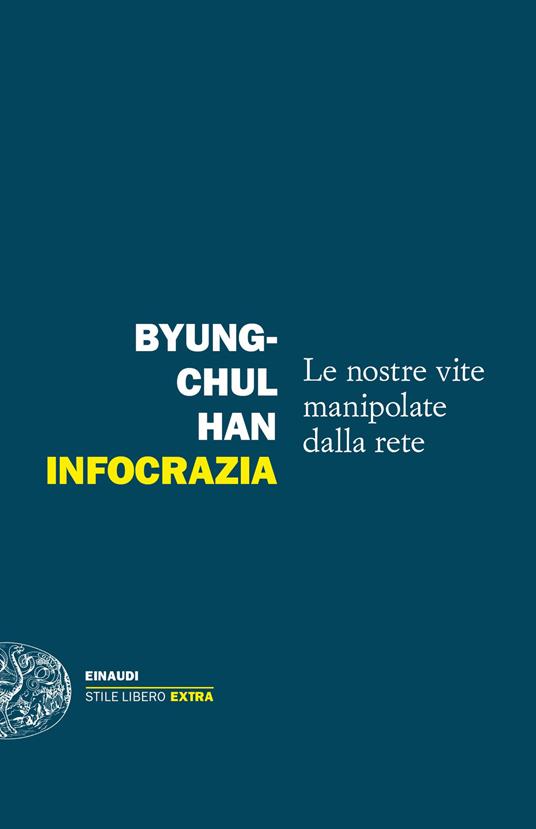
One of Han’s latest books is Infocrazia – Le nostre vite manipolate dalla rete (Einaudi Stile Libero, translation by Federica Buongiorno), in which he ponders the effects of digitalization on both daily life and the political sphere. Han reflects on the feeling of powerlessness that people experience when faced with a system that turns the human being into a mine of data to extract. The essay is a well-argued yet unyielding portrait of the era in which we live, useful for understanding what is happening.
Del vuoto – Sulla cultura e filosofia dell’Estremo Oriente
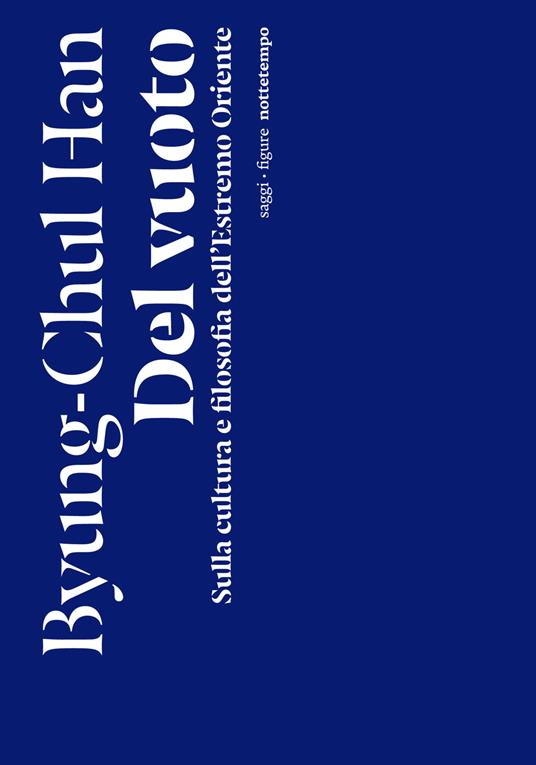
We return to nottetempo to discuss Del vuoto – Sulla cultura e filosofia dell’Estremo Oriente, scheduled for late October 2024 in the translation by Simone Aglan-Buttazzi: For Byung-Chul Han, the West often faces the Other in a confrontational and aggressive manner; the tendency to exclude or absorb the Other precludes any openness, any friendliness toward the Other, and any possibility of an evolution understood as becoming other than oneself. This, according to the author, stems from the dichotomous framework underlying the Western worldview—an incessant need to identify a subject opposed to an object, and the centrality of concepts such as essence, substance, truth, and stability. We encounter this model in the theories of Europe’s great thinkers—from Parmenides and Plato to Leibniz, Hegel, Nietzsche and Heidegger—but also in language, literature, the arts, and everyday life. The philosophies, practices, and customs common in East Asia seem to be driven by a fundamentally different impulse: instead of being, there is merely a path; and absence, emptiness, replaces essence. A culture of immanence develops, oriented toward openness rather than closing, toward indifference rather than analysis, toward acceptance of “it is so” rather than functional action…