Laurence Denooz and Christelle Schreiber-Di Cesare (eds.), Exile and Migration of Women to and from Spain (20th–21st centuries), University of Lorraine Press, 16/04/2026, 266 pages, 24€
February 1939. Trains bound for the north of France carry Spanish women and children, and at each stop a wagon is detached. Those stepping off onto the platform understand that they will live there, in a city whose name they do not know. Laurence Denooz and Christelle Schreiber-Di Cesare assemble fourteen contributions around this scene and its extensions all the way to the strawberry fields of Huelva. A volume that gives weight to trajectories that historiography has long placed behind those of men.
1937-1975. What the Republican Women Did with Their Hands
The first chapter opens with numbers, moves through a song, and ends in letters. Olivia Salmon Monviola follows, at the departmental archives of the Puy-de-Dôme, three convoys that arrived at the Clermont-Ferrand station, five hundred twelve people from Bilbao, then three hundred six on June 25, 1937 and one hundred thirty-six on July 24. She champions Carlo Ginzburg’s micro-history, and the gamble pays off. Behind the bombings of Durango on March 31 and Guernica on April 26, roughly one hundred twenty thousand people were evacuated between June and October 1937, and the Basque government undertook and financed the departure of women, children, and the elderly, whose arrival records survive in the archives.
Rocío Negrete Peña takes up the thread in the French camps, where more than one hundred thousand women, children, and the elderly remained interned as of October 1, 1939. Her lexical choice deserves attention: she writes “camp de concentration” according to contemporary sources, the term “internment” only becoming common under the Vichy regime. The women sew, tend to the sick, open makeshift schools, establish “white corners” where nursing mothers are cared for, and eighty percent of the camp’s medical staff were themselves refugees by April 1939. They repurpose, with a mocking tone, a comic song from the 1910s, “Bataillon de couturières… nous sommes toutes prêtes à coudre avec enthousiasme… un franc, deux francs, trois francs, nous voulons plus.” Nieves Castro would say that it was necessary to “distract from our memory the desire to be free.” Rocío Negrete Peña reads a performativity, a making of the livable within deprivation, and this reading alters the status of women’s work in internment.
Christelle Schreiber-Di Cesare closes this segment with the thirty letters exchanged between Gabriela Mistral and ten exiled Republican women. The Chilean poet, Nobel Prize in 1945, the first writer from Latin America—and the first poet, of all nationalities combined—to receive the honor, served as Madrid’s consul from 1933 to 1935 and hosted, from 1935 onward, the Círculo Sáfico. She contributes to refugee aid the proceeds from some of her books, calls the dictator “joli Franco”, reproaches America for having welcomed migrations deemed dubious without offering a pier for waifs, and a solidarity network takes shape, which Christelle Schreiber-Di Cesare calls an affirmed sisterhood and ties to the feminism pioneers.
2007-2018. Red Gold and the Fiction of Circularity
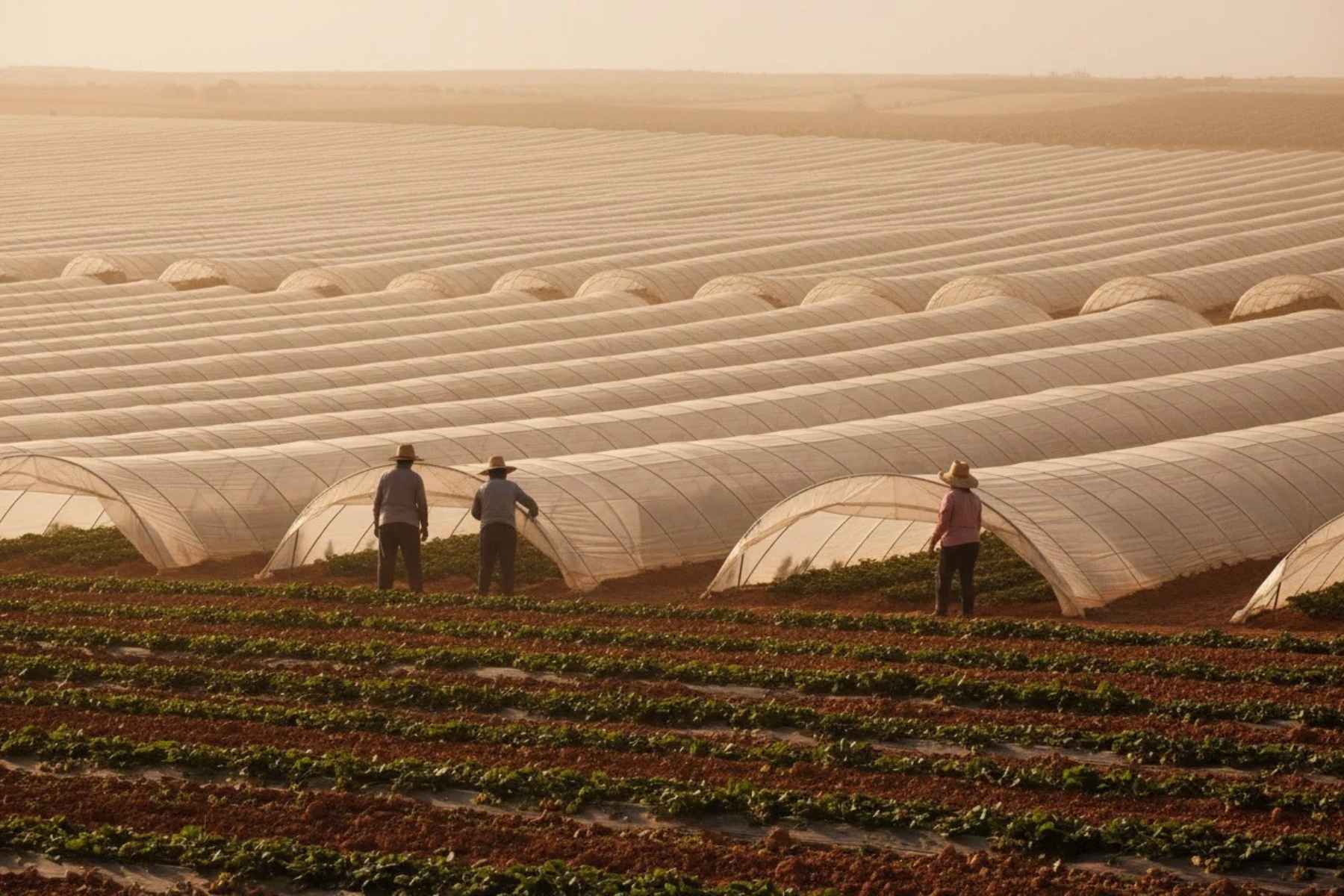
The second chapter shifts to a different era and a different method, delivering the sharpest section. Chadia Arab dismantles the Programme de gestion éthique de l’immigration saisonnière, launched within the European framework of Aeneas, endowed with one and a half million euros, signed between the Cartaya town hall and Morocco’s ANAPEC. The recruitment targeted rural, modest women, often illiterate, and required them to have children left behind in the homeland, guaranteeing their return. The researcher names the mechanism plainly—a doubly discriminatory policy, gendered since it excludes men, social since it selects vulnerability.
What should have remained quiet exploded in 2018. Ten women filed complaints against their employer for mistreatment and harassment at work, some for harassment and sexual assault. Thousands marched in Huelva on June 17; the accused would never be charged. Chadia Arab traces the consequences to Morocco, three divorces within the group of ten, a complainant threatened with death by her husband if she returned, another woman’s daughter running away in the face of sarcasm. Her “ethnic enclave”, a notion borrowed from migration sociology and placed “in the middle of an ocean of plastics,” condenses a geography and a power dynamic. Bernadette Rey Mimoso-Ruiz opens the chapter by reading Dames de fraises, doigts de fée, the book Chadia Arab drew from the same terrain, and this mirror illuminates the making of knowledge more effectively than many pages of methodology.
The Artistic Side. Theater, Cinema, and Narrative
The second part leaves the archive for performances, where nine contributions examine what fiction shows about what statistics record.
Marie-Élisa Franceschini-Toussaint analyzes ¡Por familia y trabajo! by César López Llera, in which a police officer with a tanned complexion heaps stereotypes on a light-skinned Moroccan woman in the police station cell. The final reversal, which makes the officer feel the injustice of racial prejudice, is felt beat after beat. Nicolas Blayo Ricardou uncovers a paradox: Spain records an annual immigration rate more than twice the European average, and its cinema has long looked away. He recalls that Suspiros de España, shot in 1938 at the UFA studios in Berlin for the insurgent troops, charged the exile with proving the incomparable value of the country left behind.
Florence Serrano offers the most unexpected piece. She reads the posthumous writings of María Dolores González Katarain, Yoyes, former ETA leader who had abandoned the organization and renounced armed struggle, exiled in France then in Mexico, returned to Ordizia in 1985 and killed the following year on orders of the ETA, in front of her three-year-old son. The analysis sets aside the militant and focuses on the exile, and discovers in this diary an intersectional thought ahead of its time. Yannick Llored foregrounds, in his reading of Najat El Hachmi’s El lunes nos querrán, the line that refuses the assignment, “I had hated the expression of being from two worlds. We were only from the neighborhood…,” and conducts a sociological analysis of the second generation linked to Abdelmalek Sayad’s “illegitimate children.” Émilie Delafosse closes the whole with micro-Hispanic narratives and a distinction borrowed from Marianne Bessy and Catherine Khordoc, migrant literature written by those who have lived uprooting in their flesh, the aesthetics of migrancy by those who have not experienced it. Annamaria Bianco and Ibtissam Ouadi-Chouchane hold the Arab facet, from the ḥarrāga that burn their papers to the migrant mothers of Antonia Bueno.
The book’s merit lies in never forcing unity. From its first pages it asserts that exile is political when migration is economic, and that it would be mistaken to treat the two as a single homogeneous whole. Few scholarly anthologies achieve such coherence, where each contribution works from firsthand sources—archives, correspondence, field interviews—without succumbing to commentary on commentary, and thus, on exile and migration of women in the Hispanic sphere, this volume stands as a reference in French. The word that threads through the book is the one Chadia Arab used as the subtitle of her own work: the invisibles. The general conclusion surveys the professions that presently sustain these lives in Spain—care aides, domestic workers, housemaids, agricultural workers, restaurant dishwashers—and the word recurs. These invisibles are indispensable, and they are now speaking for themselves.
The article Exil et migration au féminin depuis et vers l’Espagne (20-21e siècles) est apparu en premier sur Lythrum Press.