Eva Bonato is fifty, with a rising Cancer that softens the Aries she was born with, and a leather notebook tucked away in a box of mismatched socks—the one place in the house where she knows her daughter will never look, because Agata hates socks. Within that notebook, once the child is asleep, Eva transcribes her sisters: those who are alive and those who have passed, those she has never met and therefore cannot judge her. She calls them the unfit mothers.
“A mother must think first of her children”
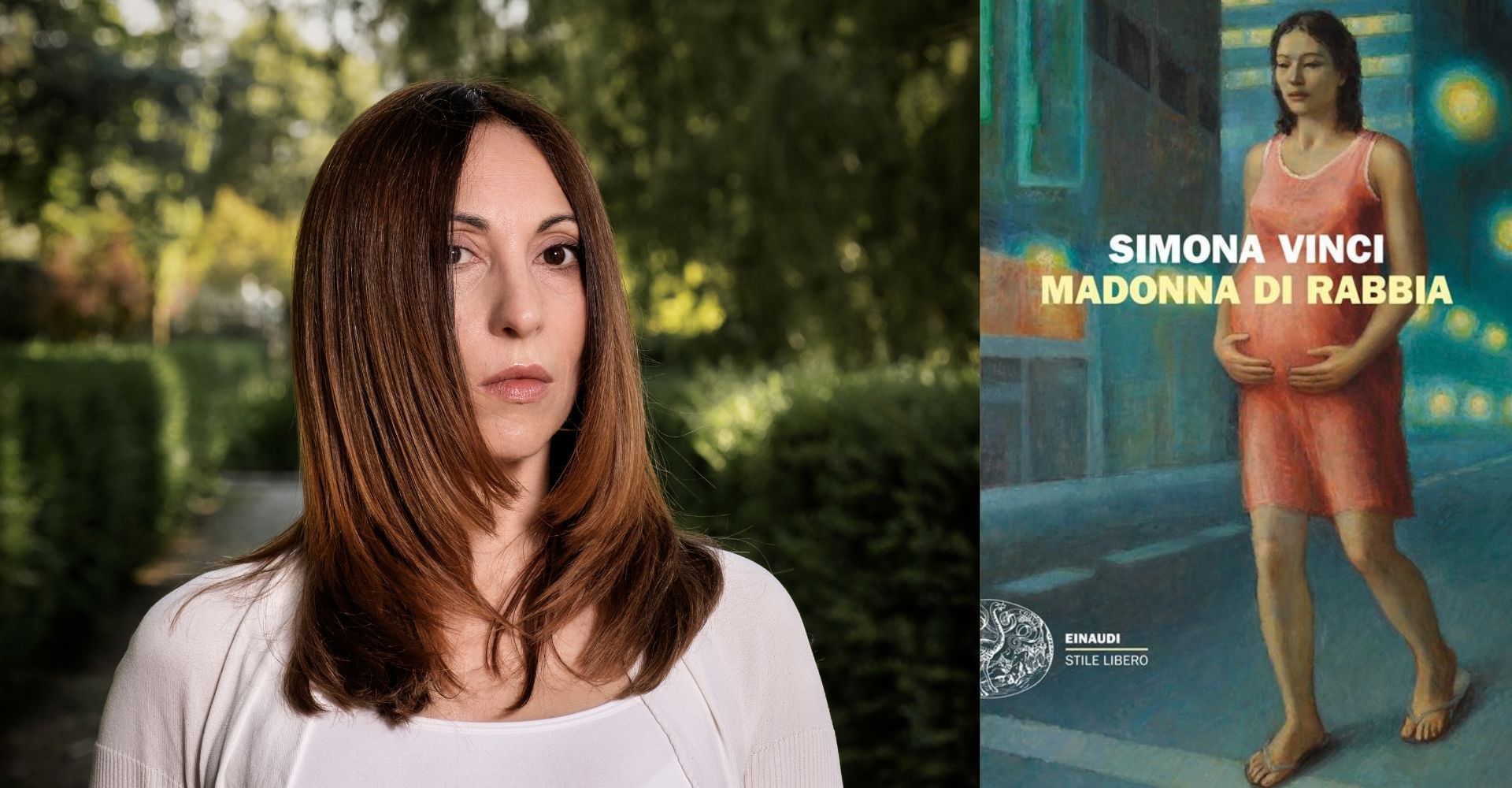
From here, one must begin to tell Madonna di rabbia (Einaudi Stile Libero), Simona Vinci’s new novel: starting from a hidden physical object and from a title Eva herself gives it on the opening page—a mother must think first of her children—as if it were a magic formula repeated in order to believe it remains worthy of reverence.

Eva also has a second refuge, even more secret: a profile on a dating app with the avatar of a Banksy Madonna nursing while clutching a bottle with a skull and crossed bones, and for a nickname the title of the work itself, Toxic Mary. She will not be judged there. She will not be called by Agata’s father, who from afar continues to monitor her. Writing, Eva says, is the free realm of hatred: perhaps there, by burning that hatred down to its core, she can be reborn.
The novel, however, does not need particular symbols to strike; a simple, ordinary afternoon is enough. At four thirty in the winter, when darkness already portends night, Eva locks herself in the bathroom with an almost empty glass of wine and stares at Amy Winehouse on her phone, in her most heart-wrenching performances, the ones where she could barely stand.
Outside, Agata knocks and calls—mom, mommy, mother, mother, come, give, look, listen, feel!—and Eva, leaning against the cold wall, grants herself a moment of pleasure that is hers alone: stolen from work, from fatigue, above all from the scrutiny of the child, that boundary between two bodies that would otherwise cease to exist. Vinci calls this the moment in which a mother feels like “the monster she truly is”.
A pregnancy that was “long and fought”
Vinci faced that fear, but with a certain disregard for danger: she invokes Lalla Romano and the The Words Between Us Lightly, a novel so close to her own motherhood that, for the author, it marked the end of her relationship with her real son. “In the end, perhaps, for every writer a book is like a child,” she tells us, finalist several times for the Campiello Prize with In tutti i sensi come l’amore and Come prima delle madri. “For me my child is my child. But I had to come to terms with it anyway.”
From the pregnancy, Vinci says, there is nothing she hides. Eighteen hours of labor, useless baths, an epidural, a Kristeller maneuver, and a dry episiotomy. A distressing Apgar score, the baby immediately taken to a thermal cradle, there is no time to decide whether to breastfeed, and not a single nurse willing to listen.
The first night, alone with a newborn crying and a bottle left by a nurse who only says: “the daughter is yours, not mine.” It has never been, for Eva, the most beautiful day of her life—and every time she hears another mother utter that sentence, her eyes fill with tears.
In that respect Vinci asserts that that experience comes from personal history—but “not every pregnancy is so painful,” she emphasizes: “The bigger issue is that childbirth has long ceased to be treated as something natural and sacred, a moment that should remain powerful precisely in its ambivalence, between the marvelous and the horrific, as is always the case in the passages of our existence.” One ends up giving birth in a cold, hostile environment, “in the hands of people you don’t know and who sometimes decide over your body,” without even asking for consent.
The “husband’s knot”
She recounts what is still today called—euphemistically, which is already a violence—“the husband’s knot”: an extra stitch added during the suturing of the episiotomy, not for medical reasons but to tighten the vagina for the future benefit of the partner, without ever asking the patient if she agreed. It takes a lot of patience, she says, to return to one’s life—even sexually—after such an experience.
In the novel one remains with a detail that never resolves, recurring like an obsession: your aborted children live somewhere inside you. Maternal fetal microchimerism, science calls it. Eva feels it as a body that cannot forget anything.
And there are the moneys, which occupy almost all of the mental space left to Eva.
Two thousand four hundred euros a month as a writer for a travel agency—not creative writing, but an intellectual job still precarious, still needing to be defended within a house where remote workers are always perceived as available—three hundred euros from Agata’s father, five hundred for rent. At the discount, in front of the frozen foods aisle, she is tempted to cry for a filet of sea bream she cannot afford.
Vinci admits that she did not want to build a protagonist too similar to herself, but she has calculated how to physically organize the space and time of a single mother: “I did what I could, at least until my child was eight years old. There was a husband before, and therefore a fairer distribution of tasks. It is a daily battle and there must always be someone around, but family relationships don’t always work. And that is precisely the case with Eva.”
A discourse on the social and economic organization of care
From this starting point, the novel broadens its horizon and becomes also a discourse on the social and economic organization of care. Mothers like Eva, without family behind them, without a partner with whom to truly share the burdens, remain alone in front of services and schools that do not forgive fragilities. To construct Eva with honesty, Vinci listened to single mothers (and even single fathers), gathering their feelings, the need to vent, to find a community of people to network with.
“I live in a small town, Eva lives in Milan,” Vinci notes, “but the theme remains identical: a mother feels guilty for not being perfect, for not having a situation organized in the right way. She often blushes and does not ask for help. And yet we should all learn, everyone, to ask for help.”
The theme that mattered most to her is precisely the gaze: the one with which others judge a single mother, and the one a single mother learns—with difficulty, late, almost never completely—to rest on herself: “We live in a moment when people tend to shut themselves into their own nucleus. I instead dream of a more open, more generous society. We should start again from a community. The famous village.” For often it is isolation, more than motherhood itself, that is the true source of the anger that gives the book its title.
And it is precisely a community—this time literary—that takes refuge in the heart of the novel: that notebook where Eva gathers her “sisters” to build a proof of innocence.
Vinci pairs analogous and emblematic figures (from Sylvia Plath to Muriel Spark, up to Nina Simone) to show that none of them can judge the protagonist: knowing that others have failed at the same point makes Eva “less monstrous.” It is the most authentic function of literature, according to the author: “a community of living and dead who hold hands, a lifeline that saves you from the abyss.”
The books become protagonists of the narration
Thus the books themselves become protagonists of the narrative, reflecting Vinci’s readings. She tells us she does not favor family sagas with the mother in the background, sanctified and glorified, but she has deeply loved The Monstrous Feminine by Jude Ellison S. Doyle (Tlon) and Motherhood by Sheila Heti (Sellerio); she considers Sibilla Aleramo the first Italian writer to truly risk something, in the first person, writing about herself—“unforgettable,” she describes it.
Among contemporary references, Ave Mary by Michela Murgia (Einaudi): a book that managed to give the Madonna figure a real, lived body, “telling what is not told” — and the fact that Murgia had no biological children and yet fought, with that book and with her whole oeuvre, to open a public discussion on motherhood, remains for Vinci a fundamental path. She finally cites Arkansas – Storia di mia figlia by Chiara Tagliaferri (Mondadori), the memoir in which the author recounts her experience with gestational surrogacy in the United States, after early menopause, as an important confrontation precisely because it arose from a vision opposite to her own: “I have many doubts about surrogacy,” she admits, “but that book helped me discover and enter a different, true and loving dimension.”
Between prayer and blasphemy
There remains an ambivalence that the novel does not resolve and does not wish to resolve, crystallizing as a cry of about three hundred pages, suspended between prayer and blasphemy. The Madonnas in this book never smile—those of Christian tradition, the Matauta of the Etruscans, the black Madonnas, the Orthodox icons—and even Eva herself cannot forgive her own serious face, her unbridled anger.
She defines herself as an heretic, a liar, a false Madonna. Her daughter calls her mother. She, in the end, is not so sure anymore.
Through a Gothic, dark atmosphere in writing, faithful to the author’s deepest and most unsettling style, this novel exists precisely to float within that doubt, without offering anyone the consolation of getting out.