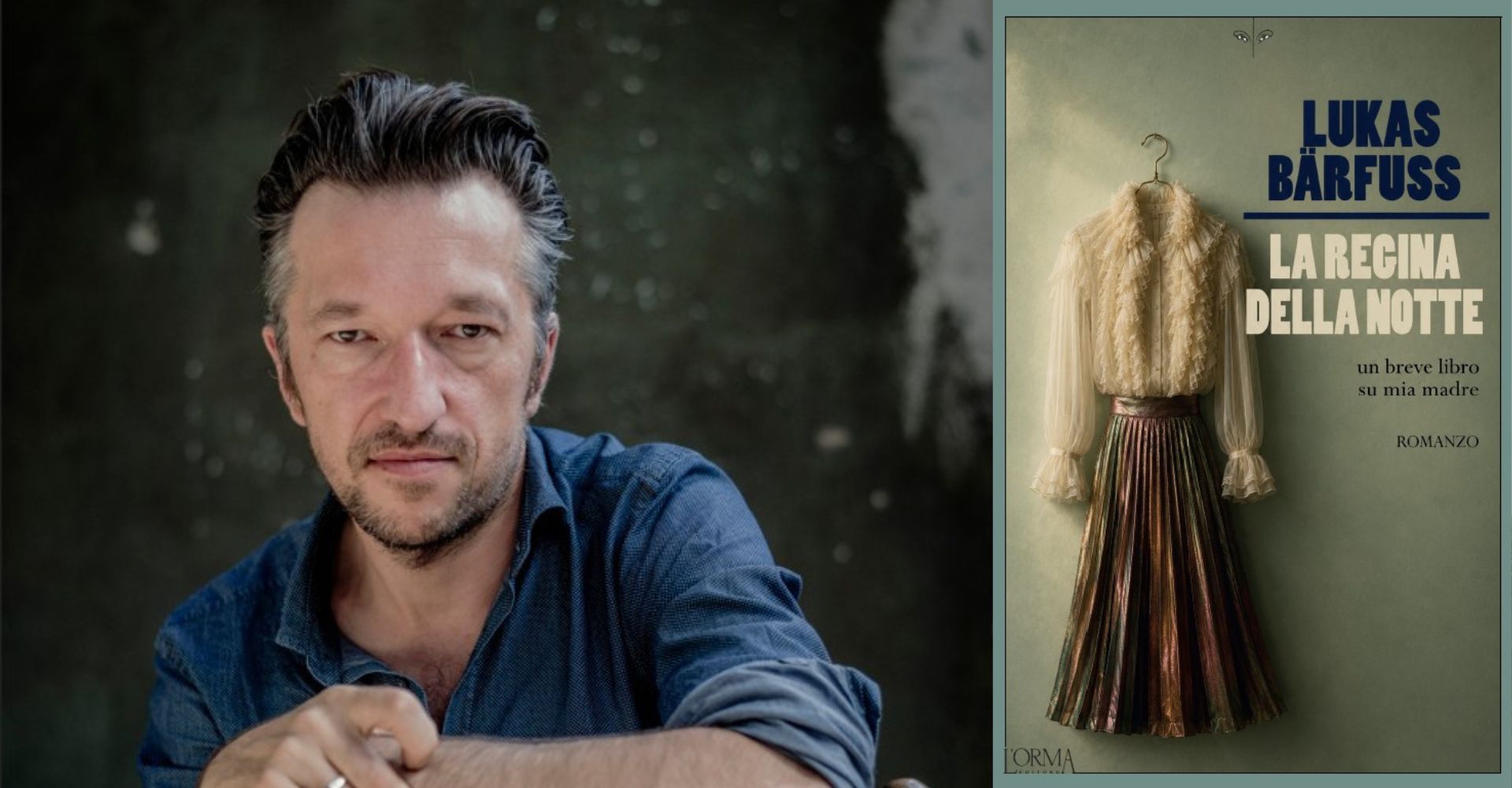
The Queen of the Night (translated by Marco Federici Solari for L’orma editore) opens with the death of a mother and with the story of the son, driven more by social conventions than by a real bond of affection, who goes to the place where she had chosen to live and to die. An island in the Caribbean, as far from the son’s character and inclinations as could be.
The Tale of a Disaffection
Thus begins the long tale of a disaffection, which becomes an opportunity for the author, Lukas Bärfuss, to pose a crucial question.
How much does the presence of a mother, or her absence, shape our adult lives? How does one live when empathy from childhood experiences is missing?

Lukas Bärfuss, already the author of Hagard, Koala, The Carton of My Father and winner of numerous literary prizes (including the Berliner Literaturpreis, the Swiss Book Prize, and the Georg-Büchner-Preis), does not pull any punches in this memoir and recounts a childhood spent waiting for a little kindness from the one who brought him into the world. The father, a criminal behind bars, the stepfather, a figure that heightens the unstable entropy of the family, and the mother, a woman poor in means, but also in spirit.
Raised in Switzerland, amid abandonment and violence, he learned very early what it means to be a beast of burden. Forced into incidental jobs, he always kept his gaze fixed on that one mother who by day works in a factory, or in car washing, and by night vents his frustrations in a life that, even if unruly, is at least lived without any form of parental responsibility.
“The Queen of the Night,” a sinister character in Mozart’s The Magic Flute. The role demands a considerable technical heft, with sudden leaps to astonishing highs. Just so is the life of this woman, unable to soar toward a stability that could be a comfort to others.
Yet the protagonist achieves the improbable. He does not accept the constraints imposed by his social status, he does not yield to violence or to easy shortcuts. He studies, and becomes a successful writer.
And it is here, in this deviation at the intersection of experience and culture, that the formation, the cradle of existence, takes shape—the existential search of Bärfuss.
The Inheritance of a Mother Is Impossible to Ignore
Absent or present, the inheritance of a mother is impossible to ignore. An adult will always have to reckon with her conditioning, hatred, resentment, and the fear of an obstinate hereditary lack of compassion.
But there is also the possibility of redemption, which his life bears witness to, challenging what decades of psychology have taught us. The protagonist stands as a clear testament to the fact that the absence of a mother can also fail to impair an adult’s functionality.
There are exquisite and sharply drawn pages that delve with mastery into the thought that has forged our contemporary cultural codes of reference, even in literature.
Bärfuss writes:
How many things did Sigmund Freud associate with the mother–child relationship! He described the nursing mother, the erotic one, the perturbing one, and the consequences that the different types had on the child’s later sexual development. An extraordinary work, but my case was not accounted for. I was his blind spot. My sexuality, like anyone’s, gave me some trouble, but for the most part I lived it with satisfaction and serenity. In any case I did not suffer from any of the perversions listed under the ICD-10 code F65. I wasn’t even a hypochondriac. I visited my doctor only when necessary. I wanted my apartment clean and in order, but no one had ever accused me of being a hygiene maniac. My neuroses had never impacted my daily life. I had only encountered grave mental illnesses, depressions and psychoses through friends and partners.
But even more the passage dedicated to the archetypes of the mother in Jungian psychology, all aimed at demonstrating how the “ethnopsychological figure of the mother” can be considered universal.
A Mother Who Chooses Not to Be One
Then there is the deviation, this mother of the story who simply chooses not to be a mother. And it is here that the novel links to sociopolitical analysis.
What is missing in psychology when analyzing the maternal figure? The consideration of the social conditions of motherhood. It is possible, and this is the real question that emerges from this reading, that instinct be overridden by the struggle to live?
In a broad sense, then, the mother is not only the person who brings you into the world, but also the place where you live, for example. This gives Bärfuss the opportunity to stage his homeland as well, Switzerland, a place just as cruel that built its fortune on warfare against the marginalized, the outcasts, the poor.
A novel is born that, at times, is a vertigo of poetry, with sentences that are dense, meaningful, and always pointed. An investigation that, even though it does not arrive at final conclusions, but rather proceeds progressively (the sense of moving forward is the very act of moving forward), marks a notable point of reflection in contemporary literature.