A Few Things I Can Say About This Novel From Afar
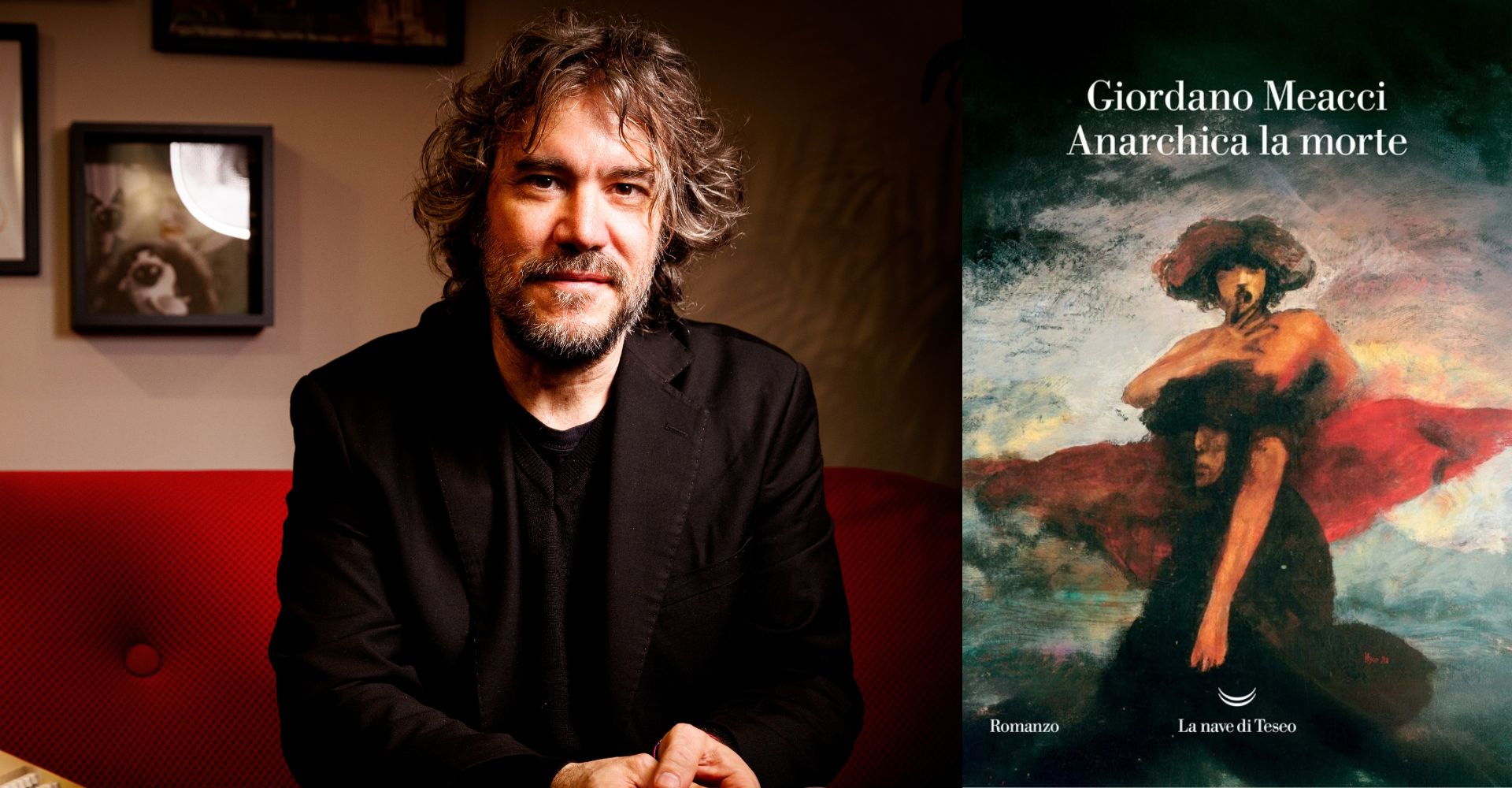
That it is titled Anarchica la morte, of course. As is evident from the cover. And that I wrote it imagining another author, an Argentine, from the early twentieth century. Pre-contemporary, I would say; more than postmodern. Balthazar Páramo. A strange ally, I would call it, more than a pseudonym or heteronym: it allowed me to tell of an apocalypse already taken place through a formal music of syntax. A music of form as I felt it.

An Apocalypse Already Happened
Why.
It is as if I’d found, within the Library I carry in my head, a novel titled Anarchica la morte (I can see the shelf, the binding); and then from there, after reading it, captivated by the style and the author, I would have decided to seize all the works described in the “Chronology” prepared by its curator. That equally imagined Roberto Dalcò whom I had already met, a poet and devotee of Bob Dylan when I had used some of his verses for the premiere of a theatrical reading of mine.
An apocalypse already happened; yes. Like in the enacted act of Lorenzaccio, or in Pablo Vicario’s realization in Gabriel García Márquez’s Cronaca di una morte annunciata: “it’s as if it had already happened to us.”
And in the end, however, possessed by the score of Páramo and guided by the fictitious care of Roberto Dalcò.
Irony, the final awareness of a laugh that once seemed impossible
I simply wrote what I wanted: how I wanted it.
Even though I knew, from the start, that the irony could only be a suspended component and often apparently absent (as a sharper presence, conversely); and incarnate, given the premises, only in the final awareness of a laugh that was once impossible.
A laughter in which absence of irony, precisely, fed on certain hidden folds in the parchment of Rabelais, in some evasions of Giordano Bruno (or of Schopenhauer, paradoxically): in the eternal lessons of certain buffooneries in negative of the Don Quixote; in Mercutio—if not exactly in the formal witticisms of Puck or Queen Mab.
I wanted an author who would tell an apocalypse eternally past and in progress
In short, I wanted a writer who, alien to me insofar as he is human with me, would deem it possible to narrate an apocalypse eternally past and in progress (in progress, perhaps) because it is eternally present.
And who nonetheless would remind me of the scattered (and lost) ache of certain loves.
The Straight Story and The Seventh Seal; The Tree of Life and The Elephant Man and Brazil: Ghosts in Rome and 8 ½ and La Dolce Vita and A New World and Brigadoon. And The Road.
And that images would fuse with pages of William Butler Yeats and Jorge Luis Borges; Stephen King and Toni Morrison, Salman Rushdie and James Joyce and Gabriel García Márquez; Robert Graves and Olga Tokarczuk and Jon Kalman Stefánsson and William Shakespeare.
And then the digressive precision of Javier Cercas, the polycentric swagger of Pennac. And the philological rigor of Folena; and of Contini re-read by Carmelo Bene in a silent dialogue with Carlo Emilio Gadda. Cortázar; and Bolaño.
And Don Quixote together with Don Quixote (it goes without saying).
In Anarchica la morte I poured the memory and the recollection of every line that has made me fall in love
This is what I wanted and what I asked of Páramo. What came of it, then: this, rather, concerns me.
Which, in the object, is also the incipit of my surname.
A sound.
It is a music; and a game, Anarchica la morte.
In which I poured the memory and recollection of every line that has made me fall in love – as I remember it.
The verses of Dante, the tercets beneath the Majesty of Simone Martini, Salgàri; the spiral prose of Bouvard et Pécuchet, the historical genius of The Name of the Rose and of The Betrothed, T. S. Eliot, Orlando, The Hare and Caproni. Pavese and Pasolini. Oscar Wilde.
In the idea of the translating (more than the translation) into prose lines of their music.
Do not speak, sing: thus Zarathustra speaks; and it is a bit what Balthazar Páramo did as well.
With the same reckless and infantile rigor of a Joyce who, according to legend, proclaims, “look, war breaks out: no one will read Finnegans.”
Besides – as Einstein apparently said – everyone is sure that something is impossible. Until an ignorant person arrives who doesn’t know it and invents it.
Etymologically: he finds it. He stumbles upon it. He steps from one universe to another.
Perhaps nourishing himself on all the music that Balthazar Páramo could have listened to while writing. Thus Wagner’s Parsifal fused with Domenico Scarlatti; and with Mozart: and with medieval music (which accompanied in writing the navigations of Saint Brendan and the reditus of Rutilius Namazianus that intertwine in the novel).
And then, of course, Carlos Gardel’s tango.
Anarchica la morte is a game and a bet
Here it is.
Anarchica la morte is a game. And a bet; a roll of the dice that will never abolish chance.
The idea that all the art loved through time might be danced in a music of words. Secret, perhaps; but also universal for whoever wants to waltz through page after page.
The idea that one might fall in love with a dream of another universe; and listen to it until the end.
As something that until it appeared did not exist; and as soon as it is read it is as if it had existed forever.
At least: from that distant, non-existent yet alive 1937 in which Balthazar Páramo published his novel.
This one which now – if you wish – you can read as well.
In fact. You can read even you. (Whenever you want, of course).
Giordano Meacci
(also in the name and on behalf of his alienonym
Balthazar Páramo)
THE AUTHOR* AND THE BOOK – Giordano Meacci was born in Rome in 1971. He has written, among others, The Boar Who Killed Liberty Valance (a finalist for the Strega Prize 2016, published by minimum fax), Citizen Dog (Industria & Letteratura, 2022) and Ghost Catcher (minimum fax, 2023). With Einaudi he published in 2018 Lui, io, noi together with Dori Ghezzi (Fabrizio De André’s longtime partner) and Francesca Serafini; he also contributed to the screenplay of Fabrizio De André – Principe libero (2018).
Anarchica è la morte is his new novel (published by La Nave di Teseo). While a woman walks in the far south of the world, a man, Vasco Natal Montero, awaits her in a strange inn where he lives among ruins, books, paintings and memories. But who is the woman really? And what is the relation between the two?
Their story seems to have already been told in a dream far away by a rebellious and romantic Argentine poet, Balthazar Páramo, in the 1930s of the twentieth century…