
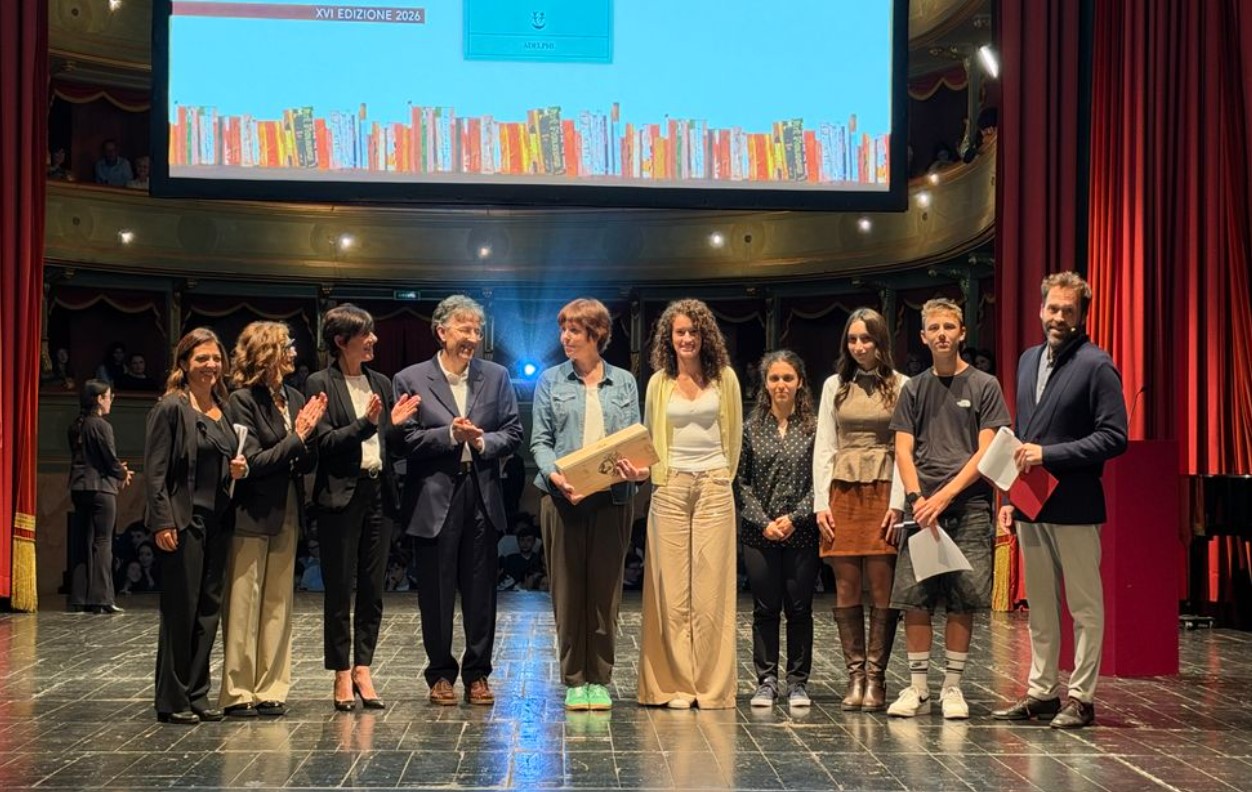
Julia Deck with Ann d’Inghilterra, edited by Adelphi, is the winner of the 16th edition of the Premio Lattes Grinzane, an international recognition named after Mario Lattes and organized by the Fondazione Bottari Lattes, which brings together Italian and foreign authors and is dedicated to the best works of fiction published in the last year.
The other finalists of this edition (here described by Laura Pariani) were Mathias Enard with Disertare (and/or, translation by Yasmina Melaouah), Andrew Miller with La terra d’inverno (NNE, translation by Ada Arduini), Andrew Porter with La vita immaginata (Feltrinelli, translation by Ada Arduini) and Clara Usón with Le belve (Sellerio, translation by Silvia Sichel).

The Technical Jury of the Prize, which last April had named Deck’s work among the finalists, explained its decision as follows: “The book opens with a meaningful epigraph by Doris Lessing: ‘I have spent my life in search,’ which suggests the method and the reason behind an unusual novel that moves along the border between biographical fiction and biography. For precise and easily verifiable references, the autodiegetic “I” who narrates can be traced to the author, but then, ultimately, even the I—what does it truly know about its own story, in the specific case of its mother, the reasons for her distance, the ambivalent feelings that, despite everything, linked and continue to link to her? And isn’t it true that every writing entails a distortion of reality, just as memory does, which must note the gaps, the misunderstandings of the past, or life, rich in omissions, in questions that one did not have the lucidity or courage to formulate? In weaving the events and emotions of two characters (Ann d’Inghilterra – a name that is already a tribute of respect and a recognition of dignity – and her daughter, who becomes a writer) Julia Deck bravely offers readers, long accustomed to “novel-novels,” the path of a private inquiry, the attempt at a delayed understanding, while showing how fragility, old age, and illness—marginalized in the consumerist and indifferent society in which we live—can become moments in which human relationships regain meaning, emotion takes the place of prejudice and resentment, and tenderly reveals the need to ‘care for others’ and the late necessity to understand.”
The event opened in the memory of the founder Caterina Bottari Lattes, who passed away last August. Thus she was remembered by Elena Bottari, who succeeded her as the new president: “Living, for Caterina, was a mastodon verb. It summarized a symphony of actions that made this word always transitive. To live a life meant living a thousand adventures, a thousand misfortunes, a thousand projects with unusual intensity. Caterina lived like acrobats, without a safety net. Living also meant creating new paths of cultural expression, inaugurating new spaces, new occasions, new friendships, keeping together the past and the present, acting so that the future would be marked by art, pluralism, and sharing.”
Also this year the ceremony was integrated into the cultural program of the Alba White Truffle International Fair, and it was precisely from reflections on this product that the Special Amitav Ghosh’s lecture developed: “Through food, humans relate to the surrounding environment and to the places where they live,” he said, drawing a parallel between the white truffle and nutmeg, which for centuries has been considered the most prized food product in the world. During the lecture, Ghosh explored themes of colonialism, capitalism, and the climate crisis, explaining how the value of certain foods is intrinsically tied to their place of origin, but also how such ties are fragile, asking: “What is the meaning of place in human culture, and how can humans relate to the places where they live, especially in times like ours, when all living beings are uprooted, displaced, and driven away by the multiple factors of today’s planetary crisis?”
Domani, domenica 18 ottobre, si rinnova per il terzo anno la collaborazione tra la Fondazione e la rassegna Cervo in Blu d’inchiostro, appuntamento che dal 2012 porta i grandi protagonisti della letteratura contemporanea nello splendido borgo di Cervo, con il finalista Andrew Miller ospite all’Oratorio di Santa Caterina. L’evento sarà condotto da Walter Scavello, docente di Inglese del Liceo Cassini di Sanremo.
