
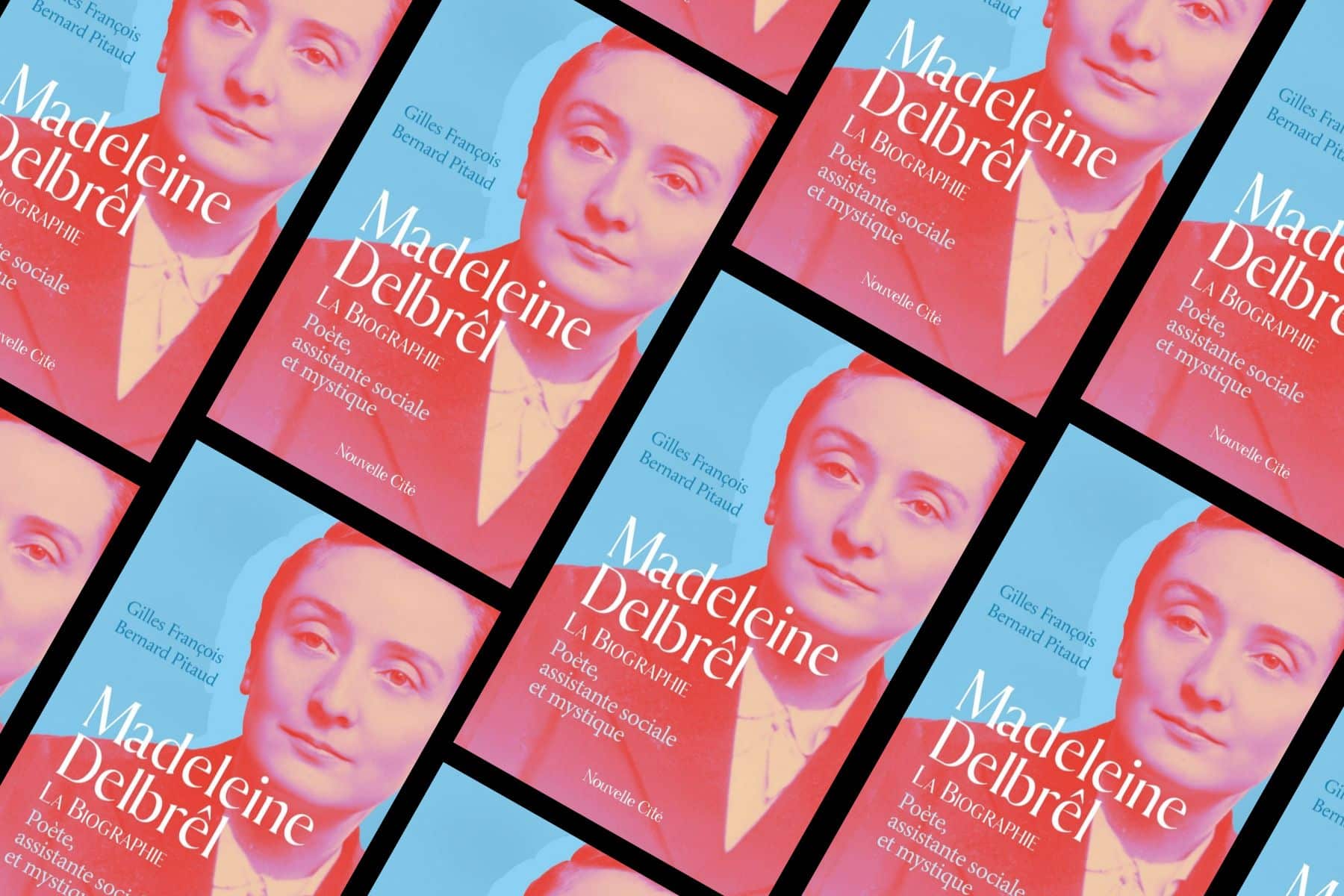
Bernard Pitaud and Gilles François. Madeleine Delbrêl, poet, social worker and mystic. Éditions Nouvelle Cité, July 8, 2026. 324 pages, €20.90
The biography of Madeleine Delbrêl offered by Bernard Pitaud and Gilles François is more than a simple life story. It seeks to understand a singular existence, located at the crossroads of poetry, social work, and mysticism. Madeleine Delbrêl (1904-1964), a laywoman, poet and social worker, spent a large part of her life in Ivry-sur-Seine, in a working-class milieu deeply marked by communism and atheism. It is at the heart of this world, distant from Christian culture, that she chose to live her faith in one of the cities of the Parisian Red Suburb (Banlieue rouge).
A path that begins with a period of atheism and radical questioning
Her conversion represents both a rupture and a discovery. Faith for her is not merely handed down within family lines or cultural tradition; it becomes an experience that gradually reorients her entire life. This conversion, far from isolating her from the world, pulls her more deeply into it. For her, God is not to be sought in a protected space separate from ordinary life, but in the streets, in human relationships, in work, in poverty, and in unforeseen encounters. Her spirituality thus becomes a way of inhabiting the world. Her settlement in Ivry-sur-Seine in 1933 marks a decisive moment. She chooses to live in a working-class, Communist town rather than in a sheltered Christian milieu. This choice expresses a genuine missionary instinct: to be Christian where Christianity is no longer culturally dominant. She takes on the “shoulder to shoulder” stance with non-believers and the poor. Yet this proximity is not a conquest strategy. Madeleine does not meet non-believers with the primary aim of converting them. The encounter holds an Evangelical value in itself. It requires presence, listening, proximity, and recognition of the other.
A testimony that remains timely
In a secularized society, she offers neither apologetic confrontation nor withdrawal into a closed community. She demonstrates that one can live out one’s faith fully among people who do not share it. Her dialogue with atheism does not rely on erasing her Christian identity. On the contrary, the more seriously she takes the atheism of those she meets, the more deeply she nourishes her own faith. True dialogue does not require the disappearance of differences, but the capacity to inhabit them without hostility.
Madeleine Delbrêl thus sits at the border between several worlds. She is deeply Catholic, yet also fully engaged with the social realities of her era. She knows poverty, the world of work, political and social transformations, and the debates that traverse the Church. She associates with the Communist Party in her daily life without becoming a communist. She remains Catholic without reducing Christianity to a political or social identity. This position allows her to distinguish people from ideologies. She can recognize in certain Communist commitments a longing for justice or solidarity without subscribing to their ideological presuppositions. The Communist, for her, is above all a person, not a category. There exists in her life an integration as poet, social worker, and mystic. These three dimensions are not three separate activities. Poetry expresses her relation to the world and to God. Social work situates her in the concrete reality of people; mysticism endows this presence with spiritual depth. Her spirituality is thus a mysticism of the Incarnation. God is encountered in daily life: in streets, encounters, work, fatigue, responsibilities, and unforeseen events. The everyday, far from hindering spiritual life, becomes her privileged place.
A conception that articulates prayer and action
Madeleine Delbrêl is not only a committed social worker. She is also a woman of prayer, meditation, and discernment. Yet her prayer never distances her from reality. She refuses to choose between contemplation and action. True contemplation leads to greater availability toward others, while Christian action must remain nourished by an inner source. She thus offers a path between the exhausting activism and an incarnational spirituality that risks becoming a flight from the world: a presence in the world nourished by a presence of God. Her status as a laywoman is also a significant dimension of her testimony. She is neither a religious nor a professional theologian by vocation. Yet her life concretely embodies an intuition that Vatican II would develop: the vocation of the laity to live the Gospel at the heart of ordinary realities. Her apostolate does not consist of reproducing clerical presence in society, but of fully living her Christian vocation in work, in popular neighborhoods, and in everyday relationships. In this way she helps shift the center of gravity of mission: the Church is not only present in parishes, convents, or institutions, but also in the streets and in places where men and women live.
However, one cannot turn Madeleine Delbrêl into a strictly preconciliar theologian. The authors instead reveal a spiritual affinity with directions that would become central in Vatican II: attention to the modern world, dialogue, the vocation of the laity, Christian presence in society, and the refusal to separate the Church from the world. Madeleine did not build a theory of dialogue or a systematic ecclesiology of the laity. She lived these realities concretely. This existential dimension gives her testimony its force. Her relation to the poor also leads to a concrete spirituality of charity and mercy. Poverty is not an abstraction for her. It has faces, stories, wounds, and social responsibilities. This attention to the dignity of people still lends her testimony a particular resonance today in the face of various contemporary forms of precarity, loneliness, exclusion, and fragility. Christian mission begins less with doctrine imposed than with the ability to stand beside the other.
The recognition of Madeleine Delbrêl as venerable in 2018 and the ongoing beatification process give this biography a distinctive dimension. But the authors avoid turning their subject into a icon. Holiness remains a path, marked by tensions, discernments, relationships, and difficulties. She is not presented as a woman who has always understood everything. Holiness appears instead as the capacity to let the Gospel gradually transform human situations, including crises and conflicts.
It is in the context of contemporary secularization that Madeleine Delbrêl’s relevance shines most strongly
The Western Church today faces the loss of a shared Christian culture, the pluralism of beliefs, religious indifference, and a certain mistrust of institutions. Madeleine offers no pastoral recipe, but she presents a way of being: not primarily to protect oneself from the world, but to love it. Secularization can even become, from this perspective, a place of purification of faith. When Christianity no longer enjoys an obvious cultural certainty, believers are invited to rediscover what lies at the heart of their faith. The word that perhaps best sums up her insight is presence: to be there, to share life, to listen, to love, to pray, to serve, and to bear witness, but without seeking to conquer. Mission begins before speech, in the ability to be present with the other. This intuition is particularly fruitful for interreligious and inter-conviction dialogue: it is not about waiting for the other to come to the Church, but about choosing to go to them.
This biography shows why Madeleine Delbrêl remains an especially relevant figure. Her life gathers questions that are at the heart of contemporary ecclesial reflection: secularization, poverty, mission, the place of the laity, dialogue with non-believers, and the articulation between contemplation and engagement. Her conversion sends her into the world, her love of God toward the poor, her faith toward those who do not believe, her prayer into action, and her action into prayer. The deepest originality of her testimony lies in the conviction that God is already at work in the world the Church encounters. The Christian thus does not go toward a world devoid of God, but toward a world where God is already at work, sometimes through those who do not name Him. The Other is not merely a recipient of evangelization. He can become a brother or sister, or even a conversational partner capable of moving the believer’s certainties.
The work stands as a meditation on how to be Christian “after Christendom”
Madeleine Delbrêl does not invite nostalgia, nor retreat, nor the dilution of faith. She proposes a presence that is humble, joyful, prayerful, and service-minded, always in dialogue and capable of bearing witness without conquering. Her question remains deeply timely. How can one love those who do not believe without ceasing to believe oneself? Perhaps it is in this fruitful tension between fidelity and encounter that the strength of her testimony lies today. Should this extraordinary figure be confined to the Communist milieu of a perhaps bygone era, to Social Catholicism, or to the Church’s Social Doctrine? Recent commemorations of her life have not been marked by pronounced enthusiasm from either the Catholic Church, or the City of Ivry, or the Communist Party; yet her book We, the People of the Streets continues to make its way. It remains profoundly timely and straightforward. The text highlights the novelty Madeleine Delbrêl brings to a Church facing secularization; that is, a shift from a logic of conquest to a logic of presence, encounter, and proximity, without renouncing Christian identity. Madeleine Delbrêl remains a Christian mystic at the heart of secularization
The article Madeleine Delbrêl: when faith meets the working-class milieus first appeared on Lythrum Press.
