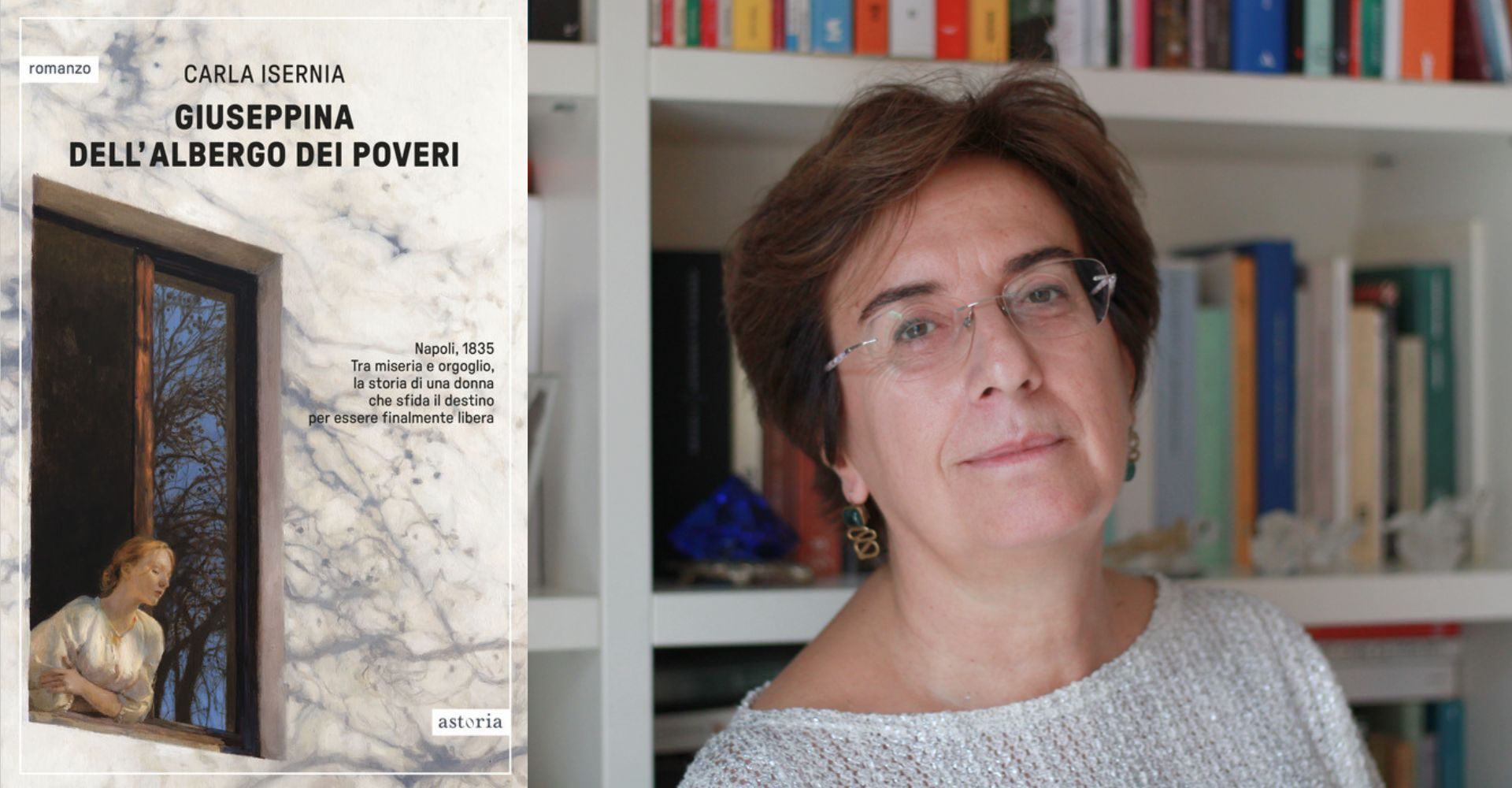
The story of Giuseppina begins at the end.
In an experience of post-mortem depersonalization, defenseless before the misfortune that struck her, her soul circles the ceiling.
She watches her body, still young, laid out in the infirmary of the Real Albergo dei Poveri, the home envisioned by Carlo di Borbone to shelter orphans, the elderly, and the needy, where she spent her life and died there.
Overseeing her body, the few figures who marked Giuseppina’s path: her children, her best friend, the laundry workers, the nuns. Surrounding her spirit, on the ceiling, the other souls, urging her to tell her story from the very beginning.

Thus comes to life Giuseppina dell’Albergo dei Poveri, the novel by Carla Isernia published by Astoria, a debut in narrative born from a pen accustomed to scientific rigor: the author, in fact, is a professor of General and Inorganic Chemistry at the University of Campania “Luigi Vanvitelli.”
Giuseppina dell’Albergo dei Poveri
A life at the “Serraglio” (or the “Reclusorio”)
It is the first half of the 1800s and just under a century has passed since the Albergo was built. From it, as if trapped in a Stockholm syndrome that prevents escape, Giuseppina seems unable to move away, torn between the wish to return to the everyday life of a past time and the frustrating awareness that her being is now built inside it.
I would like to show you everything that is not within here, I would like you to try the freedom of feeling the air on your face, a sweet little breeze, that warms you and refreshes you, with your eyes closed and hope in your heart.
Le persone che ci trascorrono pochi giorni o tutta la vita lo chiamano “Serraglio,” “Reclusorio,” affibbiandogli soprannomi in un gioco di prosopopee che trasforma l’Albergo in una presenza quasi umana, come un custode che stringe nel suo abbraccio tutti coloro che gli appartengono, senza mai distogliere lo sguardo.
The space for the heart grows a little tighter
The Reclusorio becomes, therefore, a place where the space for the heart grows a little tighter: people learn trades, children are raised, bonds are formed and one looks at the sea with the intensity of someone who has entered on tiptoe and now knows every corner of it, while the outside world watches from afar.

The relationship with men, from a despotic father to an absent husband
On the streets of Naples, Giuseppina took her first steps and grew up in a house steeped in tension, with two older brothers distant and a dependent mother to care for. None of them ever learned to stand up to the despotic father, who always decided for everyone: he would be merely the first of the male figures who, openly or subtly, would demand from Giuseppina only subordination and silence.
She discovers it when, still a child, she is forced into a marriage arranged with a man much older than her, whom she opposes with the blind, youthful force of someone who cannot see reason and justice.
She will realize over the years that the disrespect from men does not come only in the form of leering looks and outstretched hands, but also in mood swings, scant consideration, and unreciprocated demands for fidelity.
And if in the institution she had been locked up for refusing a man she did not deem suitable, she returns there precisely in the attempt to win over the one who in the “Reclusorio” has the reputation of the most fascinating: Giacomo is handsome, yes, but also far too reluctant to married life and unable to set a limit to his actions.
The consequences will echo strongly in Giuseppina’s life, finding her, once again, alone, forced to accept a life whose reins she could only partially steer.
The only man who does not impose himself on Giuseppina, but rather offers her a simple new vision of life, is the Professor. He, who “speaks everything good,” offers her an education that had been denied so far and teaches her that there really are men who are not here in the world to harm others.
Working alongside women who know solidarity and respect
Meanwhile, however, Giuseppina, gazing at the sea from behind a small window, grows. Her elastic curiosity, typical of someone who still has much to learn, quickly makes her the best laundress in the institution, and then she moves to the tailoring department, taking on a role that requires not only skill but also precision and meticulousness.
Beside her, facing the men and their ongoing dominance, are the women raised in the Albergo, who have learned to reckon with a life that has traced unbreachable boundaries to their freedom. They more than anyone know the values of solidarity, respect, and the importance of passing on lessons to the newest arrival.
Through Giuseppina’s timid eyes, we discover Naples and its sea with its majestic, aloof charm, to which she has always felt drawn, the neighborhood habits that come to life in a dark “ground floor” in the Vergini district, the art of learning a craft simply by watching how others perform it.
I would like to speak to you again about what lies outside this place, I would like to tell you about Naples that is not only what is inside here. Of course, there are scoundrels outside too, but there is Vesuvius, there are beautiful carriages, the palaces, certain castles and the sea.