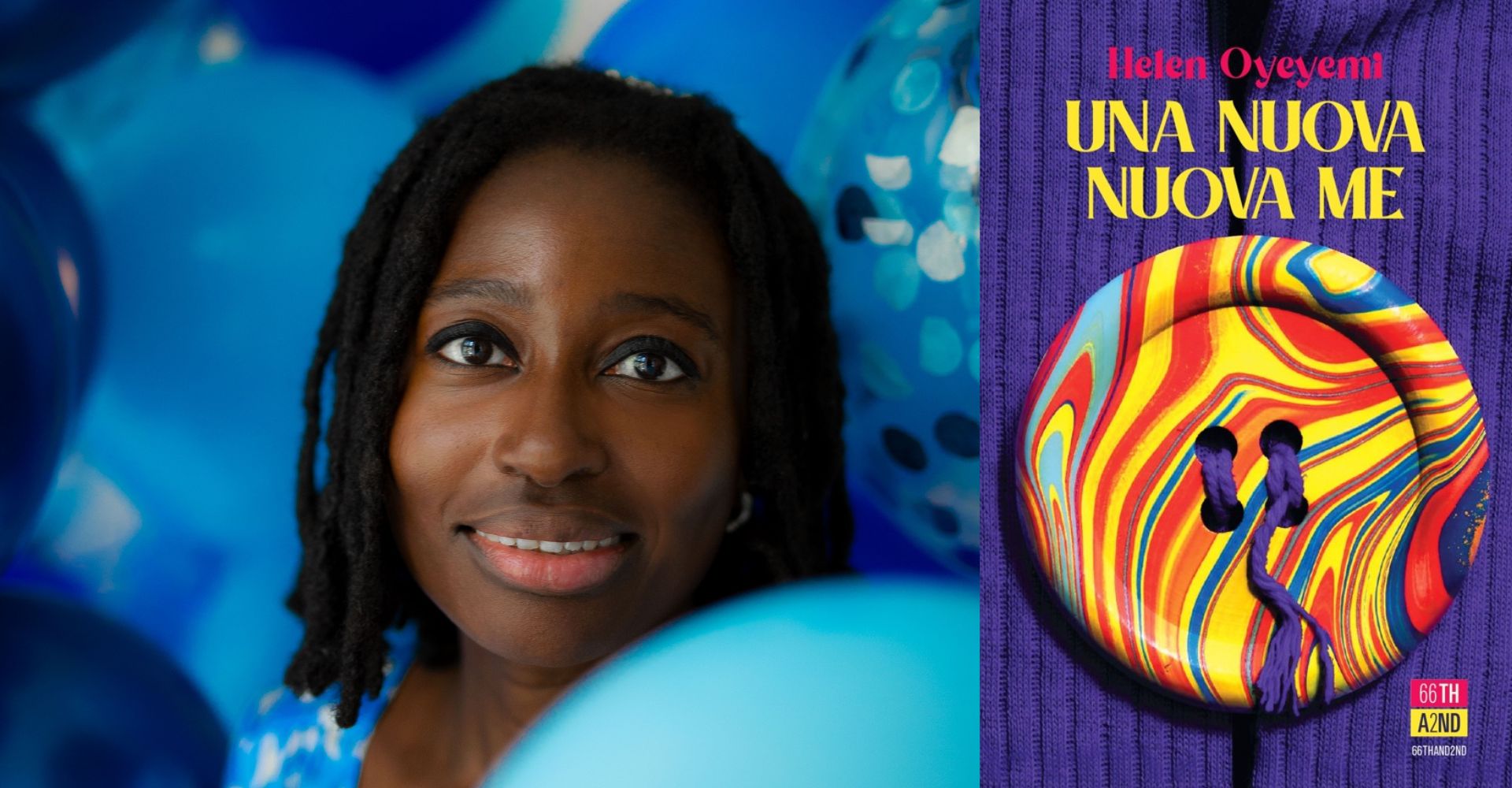
“Hi girls, Kinga-A reports. It’s almost bedtime and I’m sitting at the kitchen table as I begin our diary for the week of February 26, 2024.”
This is how A New Me by Helen Oyeyemi (66thand2nd, translated by Marina Calvaresi) opens and continues with a mysterious trigger: it’s Monday and the Polish protagonist, Kinga Sikora, finds a man named Jarda bound and gagged in the pantry of her Prague apartment. However, those hoping for a conventional mystery will be puzzled: the kidnapping soon reveals itself to be a farce, partly orchestrated by the victim herself, and slides quickly into the background. The true enigma, in fact, does not lie in the pantry, but in the mind of the protagonist.

Kinga makes herself seven, like the days of the week: there is one for every morning, which shares everything with the one before and the one after, except memories. Each one, in fact, keeps a diary of what happens to her and of what she thinks, to share with the others, and each Kinga can return backward at will, to read even what did not happen exactly the day before.
A Novel of Doubles, Mirrors, and Inventions
The beginning of the story requires a minimum of trust: you cannot enter the pages without testing yourself, without imagining the possibility that Kinga-A, the Monday Kinga, is present to herself and that we are not facing a pathological case of dissociative identity disorder. In sharing, she speaks to the other Kingas and implicitly, therefore, to the reader, in a relationship that is immediately clear and, above all, indispensable to continue: she exists, she has a precise agreement with other versions of herself, and everything works (almost) wonderfully. There is a purpose, even if it is not obvious what it is.
There is the sense of being in the middle of a novel of doubles, mirrors, and inventions; above all, there is the perception that the plot—what the Kingas are telling—has a different meaning, hidden somewhere. The shift of the little mystery from the home pantry to the mind of the protagonist is very fluid: when it happens, it seems entirely normal. The unspoken words of Kinga are already an integral part of the novel, and so here we are, following her in her revelations, in her misunderstandings, in her need not to trust the others. Each of them has a purpose within the overall design, as if, at some point, Kinga found herself facing her own monster that walks on its own.
The heart of the book is Kinga’s psychological deconstruction
The heart of the novel is the psychological deconstruction of Kinga. Her mind is split into seven distinct personalities: ranging from the methodical Monday leader (Kinga-A) to the mysterious Sunday entity (Kinga-G), passing through the cynical Kinga-B, the impetuous Kinga-C, the queen of equanimity Kinga-D, the dreamer Kinga-E, and the Saturday party girl Kinga-F. They are mental affiliates, who, to express themselves, can only try to explain themselves. And in trying to say something about themselves, by writing the diary, none of them feels the need to resolve themselves; indeed, each one’s daily life is the only possible one, at least for twenty-four hours. Oyeyemi does not normalize Kinga, nor does she try to fuse her, instead transforming her fragmentation, but opening a door every day and simply telling us what we find.
What happened to Kinga Sikora? Why does she end up living this way? Perhaps the real question this novel asks—and tries to answer—is what happens when we let our different worlds live without us, while we are turned in another direction. If there are personalities that are on our side, following a generally positive purpose, and if, on the other hand, there are others that push back against us. What would happen if that were so? And what if an opposing personality gained the upper hand?
A book that leaves many doors open
This novel leaves many doors open, but it is not a drawback, on the contrary: one can recognize a literary tradition made up of names well known to many (Fernando Pessoa, Shirley Jackson, Virginia Woolf), albeit with the appropriate differences in treatment: Oyeyemi leaves little room for doubt about the deconstruction of identity, because her Kingas are there, live, speak, move, and create upheaval; Kinga concretely hosts her personalities and they appear less as a question of whether such worlds exist and more as an answer to how the worlds we are made of operate. The Kingas are real; we should not have to question whether they are possible.
As a response mechanism to survival, Kinga is also akin to Fleabag, the lead character of Phoebe Waller-Bridge’s eponymous TV series, who, while seeking her identity, tries to live a fragmented and chaotic reality with ironic distance. The experience of feeling defenseless in the face of something that happens and is not fully understood is a common trait, as is the use of quips, sarcasm, as a counterbalance to difficult situations.
Kinga-A, for example, writes: “Kinga-Blažena, as you will soon learn after you take control tomorrow, I have decided to refuse. While I was telling Dr. Holý that I would call him back, I sat on the floor. Not close enough to the chair for my guest to gain anything from a lightning snap, but close enough to study him well and reflect not only on his intentions, but also on those of the person who had tied him. He knew our name and knew of our frequent contacts with a certain Dr. Holý. He might even know that Dr. H is a psychiatrist.”
The Kingas face the emergency and the oppressive presence of the hostage with apathy and sarcasm, weaving between reflections clumsy wordplay, bickering among themselves, creating a sometimes funny and highly successful short circuit: the quip pushes terror to the side, until the ending dissolves into a solution far less absurd than the process that produced it.
The new me of the title is realized, in some sense, and the way it happens makes all the difference.
The ending takes us back directly to the moment Kinga-A notes at the end of her Monday, which at first glance could be read as a simple day’s closing. Kinga-A, indeed, has taken us through the day and shown us what is to come: who the others are, what they do, which traits they possess.
We have met the hostage and Dr. H. We have all the elements and learn that the day was full of surprises: “This was a day packed with events I hadn’t anticipated, so nothing is obvious.”
And then she leaves us with a message, only apparently open: “It’s been about six months that I have kept a broken candle in the last drawer of our nightstand. I don’t know if you’ve noticed; it’s a tapered gold cylinder that seems whole only if handled with care. When I placed it upright in the candlestick, it wobbled. Once standing, the candle tended to crumble along the crack that clearly divides the tapered portion from the base. It wobbled, but held. I lit it; it’s something I do in case I don’t reach the next Monday. It’s the scene I wanted to see. At the moment I lie here, contemplating the flame that trembles and stretches, now toward me, now in the opposite direction, spilling gold. I wonder how this candle will burn; I wonder if it will continue to forge this dazzling trajectory even when I close my eyes; I wonder who will wake up to discover what remains after a broken candle has burned all night long.”