

Following the success of Miss Bee and the Corpse in the Library, Miss Bee and the Winter Prince, Miss Bee and the Embassy Ghost and Miss Bee and the Poisoned Garden, Alessia Gazzola returns to bookshelves with a new novel in her bestselling series published by Longanesi (evoking the atmospheres of Agatha Christie, Downton Abbey and Bridgerton…): Miss Bee and the Deception in First Class.

The Plot of Miss Bee and the Deception in First Class
The plot of the new book by the Sicilian author, due for release on November 24, transports us to August 1925: a sea crossing from Dover to Calais and from there by train to Gare du Nord in Paris; a journey undertaken to rescue her sister Clara from an untenable situation: Miss Bee, born Beatrice Bernabò, prepares her suitcases without imagining that she will soon find herself at the heart of an enigma.
Her heart, in fact, is weighed down by romantic anxieties, because the shadows between her and Archer Blackburn, Chief Inspector of Scotland Yard and her husband, show no signs of fading, and the aftereffects of seasickness do not help matters.
While the train on which the Bernabò sisters travel reaches the City of Light, another train, departing from London and bound for Paris, becomes the scene of a murder. But why is the victim’s luggage delivered to Beatrice a few hours later, under circumstances that are nothing short of bizarre?
Curious coincidences lead Miss Bee to a mystery that will challenge not only her intellect but also her ability to stay lucid while everything inside and outside of her seems to falter.
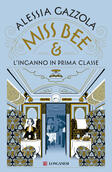
Miss Bee e l’inganno in prima classe

Miss Bee e il principe d’inverno

Miss Bee e il giardino avvelenato

Miss Bee e il fantasma dell’ambasciata

Miss Bee e il cadavere in biblioteca
The Other Books by Alessia Gazzola
Born in Messina in 1982, Alessia Gazzola holds a degree in Medicine and Surgery, with a specialization in Forensic Medicine.
She made her literary debut in 2011 with The Pupil, which was adapted into a cult TV series starring Alessandra Mastronardi as the protagonist Alice Allevi. Followed by A Secret Is Not Forever, Heart Syndrome on Hold, The Princess’s Bones, A Cruel Summer, A Bit of Madness in Spring, Arabesque, The Gentleman Thief (with which she won the Bancarella Prize in 2019) and The Schoolgirl.
Gazzola is also the author of a trilogy centered on the paleopathologist Constanza Macallè, the protagonist of Constanza’s Question, Constanza and Good Intentions and Constancy Is an Exception, which became a TV series produced by Rai Fictions and Banijay Studios.

With the publisher’s kind permission, we present an excerpt from the new book:
A Train of the Compagnie Internationale des Wagons-Lits
Disembarked from the Canterbury, at the port of Calais, Beatrice and Clara walked the quay to reach the passenger terminal, cleared all customs controls, and finally boarded the first-class carriage.
The interior of the carriage was paneled in polished wood, with Art Deco brass and frosted glass lamps already lit, and symmetric mirrors multiplying the light.
A porter helped them stack their luggage on the metal rack, and while Clara was bent on going straight to the dining car, Beatrice was still reeling from the crossing. She nevertheless resolved to accompany her sister, because staying busy was better than dwelling on her thoughts. The train pulled away, and Beatrice and Clara found seats just before other travelers swarmed in.
Beatrice fought off nausea and refused even a glass of water. Clara placed her order as if nothing were amiss, and soon a hot tea steamed above the gilded rim of the cup in which she had just dipped a honeyed butter biscuit. It was so good that Clara closed her eyes gratefully, as if living in a world where she could enjoy that small pleasure.
“Would you like one too?” she asked her sister.
“For heaven’s sake,” Beatrice replied, her cheeks a ghastly greenish tint.
“I didn’t recall that you suffered seasickness. Lucilla did—she vomited the hot chocolate, remember?”
Beatrice slumped onto the seat opposite her sister with a deep sigh.
Clara alluded to the journey five years earlier, when Leonida had obtained the role of professor of Italian Studies at the University, which had carried the Bernabò family from Florence to London.
Beatrice nodded: how could she forget. The soap she had used to wash had left her hands rough for weeks. She began to study the bedside lamp on the table, which wore a small tafted lampshade with beaded fringe and crystals that she regarded in awe. She would miss her own lampshades.
Clara looked around warily, as if the room were full of potential enemies. It was not an entirely improbable hypothesis, since her husband had kept a private detective on her trail that she hadn’t noticed.
“Last night I dreamt that Hugh was following me to Paris,” she finally whispered.
Beatrice reluctantly left the lampshade, leaned toward her sister over the table, and took her hand. “It will end well.” But she didn’t even know if that would be true. Nor could she dare to forecast such an outcome for herself. Clara set the biscuit aside, as if she had lost the desire to eat it. From her expression it was clear she would never surrender, and indeed she said: “I only wanted a quiet life.”
“If Hugh hadn’t found you, would you really have managed to return to what you call a ‘quiet life’?”
Clara hesitated. “There’s no point in thinking about it.”
“It can help you understand. To accept with greater serenity what has happened to you.”
“Then yes, I would have returned to a quiet life.”
Beatrice looked at her skeptically. “And would you have given up Federico?” Clara reddened. “I don’t know if I could have managed. My will hasn’t proven so strong.” She lowered her head, resigned and aware. “I feel so… dishonest.”
Beatrice could not judge her; not because it was not in her nature, but because of the affection she bore for her sister, but above all because she believed that, in the adverse circumstances life had placed her in, Clara was merely trying to take all she could. Among a thousand desires denied her, she had believed she could have the respectability of marriage on one side and the passion for Federico on the other. If, unlike a man, a woman was still forced to choose between the one or the other, it was not Clara’s fault.
Beatrice looked at her with understanding. “You are not.”
“I’m horrified by what I’ve become,” the sister continued, not complaining but merely stating the fact.
Beatrice tried to lighten the matter. “People in America divorce without problems.”
“America is a place of absolute perdition. Here in Italy it’s not even possible to think about it.”
“And at this rate, it never will be!” Beatrice exclaimed bitterly. “I’m convinced that in England, sooner or later, it won’t be so scandalous. Once you obtain a divorce from Hugh, you and Scandiani will be free to marry and you’ll have such a quiet life that you’ll regret these adventures.”
Clara widened her eyes. “A quiet life? With Scandiani?” A smile escaped the prison of her sorrow. “I swear!” Beatrice continued, pretending to be serious. “He will reform from his most licentious habits, put on some weight, become a country doctor, and then you’ll become Madame Bovary in reverse. Lust? Pleasure? Thrills? For heaven’s sake, I crave dullness!” “What a clown you are.”
Yet, faced with that vision of herself married in a second wedding to a paunchy, aging Scandiani, lost somewhere in a cottage full of dogs in the greenest English countryside, Clara had found a glimmer of hope and brought the biscuit to her lips.
“In the meantime,” Beatrice continued, who had finally shaken off her own discomfort, “there’s a drunk boy at a table behind you.”
“And it’s just as well we spent every last penny on first class,” Clara remarked indignantly.
The aforementioned boy, about twenty, stood up from his table and, made even more wobbly by the train’s motion, sought support on Beatrice and Clara’s table, tipping a silver teapot that was still half full.
“Forgive him,” said a man who followed him and who was twice his age, wearing a medium-brim felt hat with a central crease and a face that could not go unnoticed because of his eyes—the darkest Beatrice had ever seen.
The two sisters both offered a courteous smile but soon discreetly looked away.
When the time came to pay, the waiter told them the refreshment had been offered by Mr. McNeal, and pointed to the man with the hat.
“We cannot accept that,” Clara asserted, authoritatively.
“What do you care,” replied Beatrice, “we’ll never see him again and we saved a few shillings.”
“If that’s the case we should thank him, and I have no desire to,” objected Clara.
“And we’ll do so. We will still have to pass by him to reach our carriage.”
“But that will force us to exchange a few words…”
“We’ll do that too.”
Compete, the two rose from the armchairs, gathering their handbags and straightening the clutch. Upon reaching the adjacent carriage, they found Mr. McNeal intent on smoking an ivory pipe carved with the three Japanese monkeys—the one who sees nothing, the one who hears nothing, the one who speaks nothing. At the same table, the boy was sipping a hot beverage.
Seeing them, they both rose, and when Clara thanked him, the man replied: “It was the least I could do to bother you. Broadbent McNeal,” he added with a bow, setting the pipe down on the table. The boy, in turn, made a remark in an utterly incomprehensible language before introducing himself in English marked by a strong accent: “Giorgi Gogolashvili, honored to make your acquaintance.” Hearing him speak, he did not seem so drunk after all.
Clara and Beatrice introduced themselves, then Clara said: “In any case, it was not necessary.”
McNeal showed a crooked but easygoing smile. “Are you bound for Paris?”
“Yes,” Clara replied, still in a firm tone.
“And you?” asked Beatrice.
“We will stop in Paris for just a few days. Then we will return to Constantinople, where Mr. Gogolashvili lives, like many other Georgian exiles after the October Revolution. I am English, but I work for him and therefore travel with him.”
“Constantinople,” Beatrice repeated, dreamy.
“Indeed. A wonderful place to go,” McNeal said, with practiced ease.
“Safe travels, gentlemen,” Clara concluded, signaling for them to move on.
Mr. McNeal did not bat an eye and replied: “And to you too!”
As they settled into their carriage, Clara did not fail to chide her sister. “They’re clearly two shady individuals looking for easy company.”
“I don’t think so,” Beatrice replied, seating herself. She regretted not having taken those biscuits that she longed for, now that she felt better.
The journey continued, enjoying the luxuries of such a high-standard service. The trees’ branches in the French countryside cast changing shadows in the sunlit slivers, and the edge of the water rippled in the crystal glasses, just as the small folds of the velvet drapes. In the background, there was the soft murmur of well-mannered chatter. Clara spent the time reading.
Beyond the window, the landscape began to change as they neared the urban scenery of Paris, arriving in the late afternoon, the sky already streaked with the pink glow of sunset.
Steping off the train, in a lively Gare du Nord teeming with elegant travelers and porters in livery, Beatrice crossed paths again with Broadbent McNeal.
“Would you like a young man to help you with your luggage, Miss?”
“You would be very kind.”
He offered her a reassuring smile and soon thereafter a boy appeared to help Clara and Beatrice with their suitcases. As for Mr. McNeal and Giorgi, they were never seen again, not even for a farewell, to the relief of Beatrice, who was not in the mood for pleasantries.
Without waiting too long, they hailed a taxi just outside the station, and Clara dictated to the driver the address of the lodging Federico Scandiani had secured for them.
It was a chic Liberty-style building in the Montmartre area where, on the top floor at the end of an endless marble staircase, together with a white Persian cat named Carabas, resided Lady Ciompi. She was Florence-born and a distant relative on Federico’s mother’s side. She had been widowed for a few years and was a person of unimpeachable reputation, perfectly suited to host Mrs. Blunt and Mrs. Blackburn.
Lady Ciompi gave the guests time to refresh themselves and then awaited them in the small dining room lined with bourgeois wallpaper. There they drank a comforting onion soup, because although it was the end of August, the Parisian evening air was as cool as in London.
At the end of the dinner, the two girls felt refreshed by the chocolate praline the lady offered them as they settled in the parlor, on a mustard-colored canapé as hard as stone. A little later, their nerves relaxed completely thanks to a small glass of Pernod that Mrs. Ciompi served them as a digestif. It had been her husband’s habit, she explained, and even though he was now gone, repeating it comforted her in his absence.
Apart from a brief memory of him, who in 1897 there in Paris had begun working as a music master, Mrs. Ciompi seemed to find no topic of conversation other than Federico Scandiani, who, after all, was the link between them. She recalled in great detail the infamous baptism in which the cries of the newborn Federico had caused the church’s plaster to crack, and the girls giggled, even though they were well aware of the anecdote that had earned Federico the nickname of the Antichrist.
Finally, holding Carabas in her arms, Mrs. Ciompi escorted them to the attic, into a narrow room with an oval window overlooking the city. Far away, the silhouette of the Eiffel Tower with the illuminated Citroën sign. It was an incredible sight for Beatrice, who, though used to the dazzling lights of Piccadilly, found that glowing tower cleaving the evening clouds like an apocalyptic flash of modernity.
“I almost forgot!” exclaimed Mrs. Ciompi, pulling Beatrice away from the view. She reached into the dress pocket to pull out a note. “This afternoon this telegram arrived for you, Beatrice.”
Perplexed, Beatrice took it. Only Leonida knew Mrs. Ciompi’s address, for obvious reasons. And Archer, of course. Beatrice had left it on the table, written on a note that contained nothing but that address. Could it be him, her husband, with the love declaration he had never made and with the remorse he had not been able to express?
“What’s the matter?” asked Clara, immediately alarmed: she feared the message contained bad news about Hugh or Federico.
“Nothing, just Lady Charteris’s nonsense,” Beatrice hurriedly replied.
Nonsense that did not involve her, not anymore, but which nonetheless stirred a subtle discontent.
(continues in bookstores…)
