
“We had been together for half of life. For all those mornings we sat close to breakfast. It was so intimate, and I didn’t know it. Now if I prepare myself a coffee I drink it standing up”.
There is no precise moment of rupture in the separation. There is the phrase “then I go” that marks a break and renders the distance definitive, but the drift away begins much earlier, without us noticing.
A Contiguity of Solitudes
It begins when spontaneity is lost, when eyes no longer seek one another, when one forgets to extend a hand to help, when a song ceases to be a moment to share, and even a long-desired and carefully planned trip becomes a contiguity of solitudes. People part ways before the words express it, with the unspoken, the irritations, the frustrations, sometimes envy. And then comes the moment when it is too late.
“I’m leaving” Libero simply said, opening the door and stepping out, a simple and ordinary gesture to feel truly free, to affirm himself, and to withdraw from a dimension in which he no longer recognizes himself, a prisoner of a life not his. He makes do with little—a cot in the theater, two cardboard boxes—and it is a Franciscan freedom that truly belongs to him, in which he finds himself again, while he keeps working, among his actors, in his show, and a voice that he feels once more is his.

The Timings of Separation Are Never in Sync
But the timings of separation are never in sync. For the protagonist remains the shock, the discovery that he had adapted to a comfortable life that wasn’t his. It is a blow that travels through the body, saps health, and even sours the house where they had lived together and where she finds herself alone: this very house goes wild without him, the space once tended becomes inaccessible, foreign, out of control, with weeds flooding the garden and a snake taking shelter in the living room.
“In the dark I am more vulnerable, I do not know how to stand on my own. In the fragmented sleep I still reach out for him, toward his body. Libero has always protected me from my fears.”
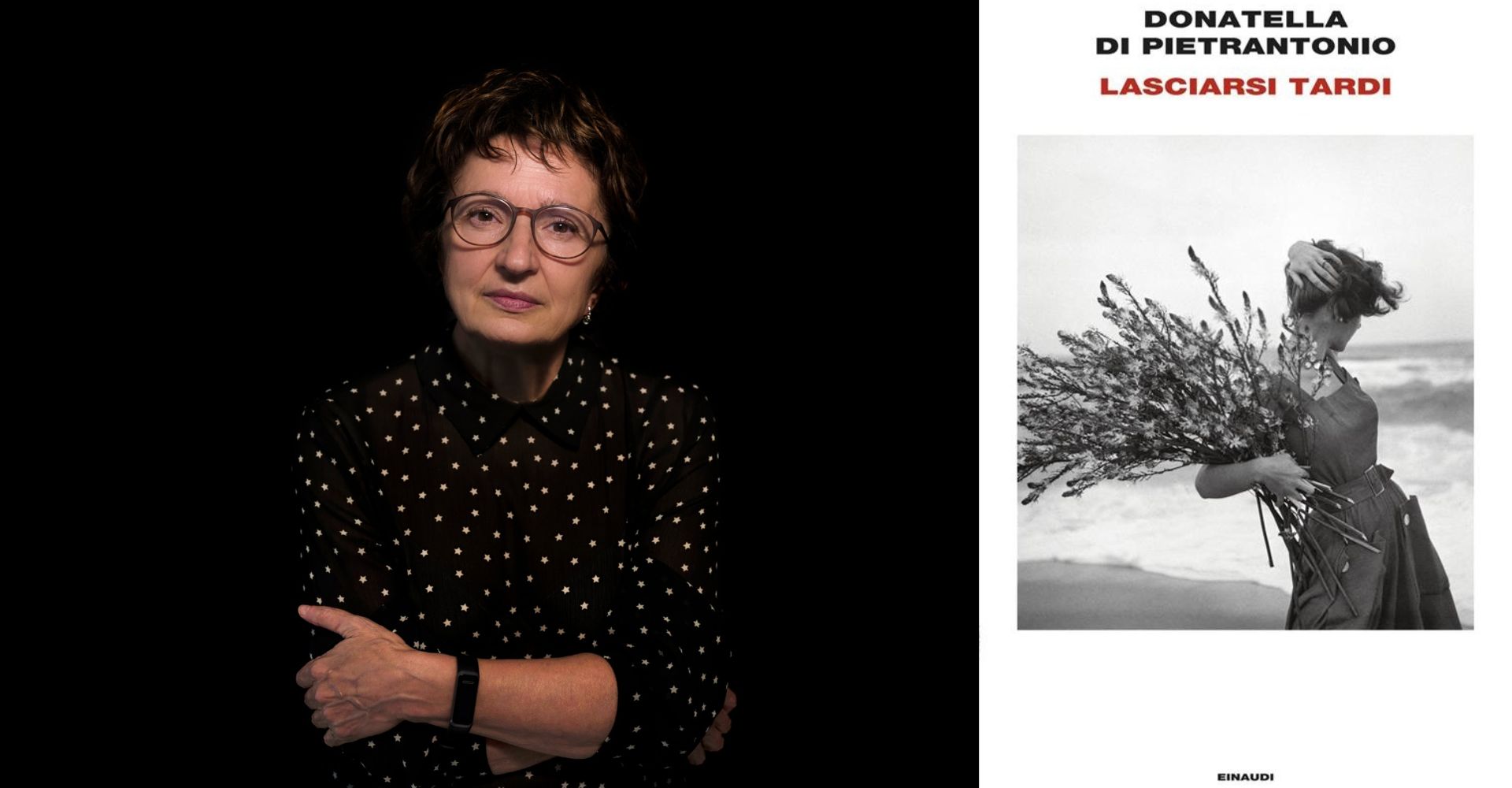
Letting Go Late by Donatella Di Pietrantonio (Einaudi) is not the story of a love, but of a language of life to relearn.
For the protagonist, a writer who lives by words, it is about discovering that she is illiterate without a reference point, unable to name her new condition, to reconstruct an alphabet for the day, which remains suspended, waiting. She clings to social media, to spy on Libero, obsessive in a painful routine, which sifts through episodes and gestures, seeks culprits and rereads the past. The new life hardens without direction and the rest is archaeology.
“Abandonment is not a moment, it is a process. Not only in duration. Everything the other has done, said, and been is processed. It is placed in a different category, which is no longer beauty.”
A Story of Absence
While Libero begins to live again, the protagonist coils back upon herself, like the snake that has taken up residence in her living room, and there she lives hidden, a presence that unsettles her: she feels judged, superficially judged, discarded; she lingers in her thoughts but is incapable of shedding her old skin, abandoning the old, brittle exoskeleton and resuming the road. Letting go late is also a story of absence, of that interval between remaining alone and understanding what to do, how to fill that void, how to discover new desires, how to learn new words to define herself and her own space.
To do this, and to find answers, she looks back, to her own childhood. The protagonist’s childhood was an upbringing deprived of desire: a girl who could not ask, express her dreams, in a family poor in possibilities and in languages, becomes a woman who does not know how to stand on her own.
A Chronicle of News that Brings Memories to the Surface…
In this wounded past the protagonist recognizes a visceral bond with a missing girl, the central figure of the early pages of the newspapers: a difficult, troubled life, a childhood denied education and the schooling she should have had. The case of this girl, deprived of instruction and relationships, touches a nerve in the protagonist, who feels she never had the chance to dream and to long for something beyond the daily life her family offered, amid all the hardships of a farmer’s existence. This chronicle story brings back memories and a growing awareness that solitude born from emotional abandonment had been buried.
“Is love also a struggle?”
Illiteracy does not concern only words, it is a condition that breeds insecurity, the impossibility of naming things and feelings. The protagonist becomes aware of how much she has left behind, and how much is already late, not everything can be recovered, because this illiteracy has to do with the right to ask for love, and with the ability to recognize one’s happiness in the moment, not only after losing it.
Di Pietrantonio narrates the complexity with lucid simplicity, and with a clean narrative that feeds on everyday life, truth, and objects: it is there that the essence of true pain hides, a non-abstract inner space that traverses the things of daily life and knows the nostalgia of lost intimacy but also the possibility of change.
Thus loneliness becomes the alienating condition from which to begin anew, a fragment of time in which one must confront only oneself and a great potential for reconstruction.
We also transform through absence and through the discovery that one must always begin again to learn how to live, to define one’s own existence, to give space to one’s dreams, and to one’s own words. Even as adults.
