Can you get lost even if you believed you knew yourself to the bone?
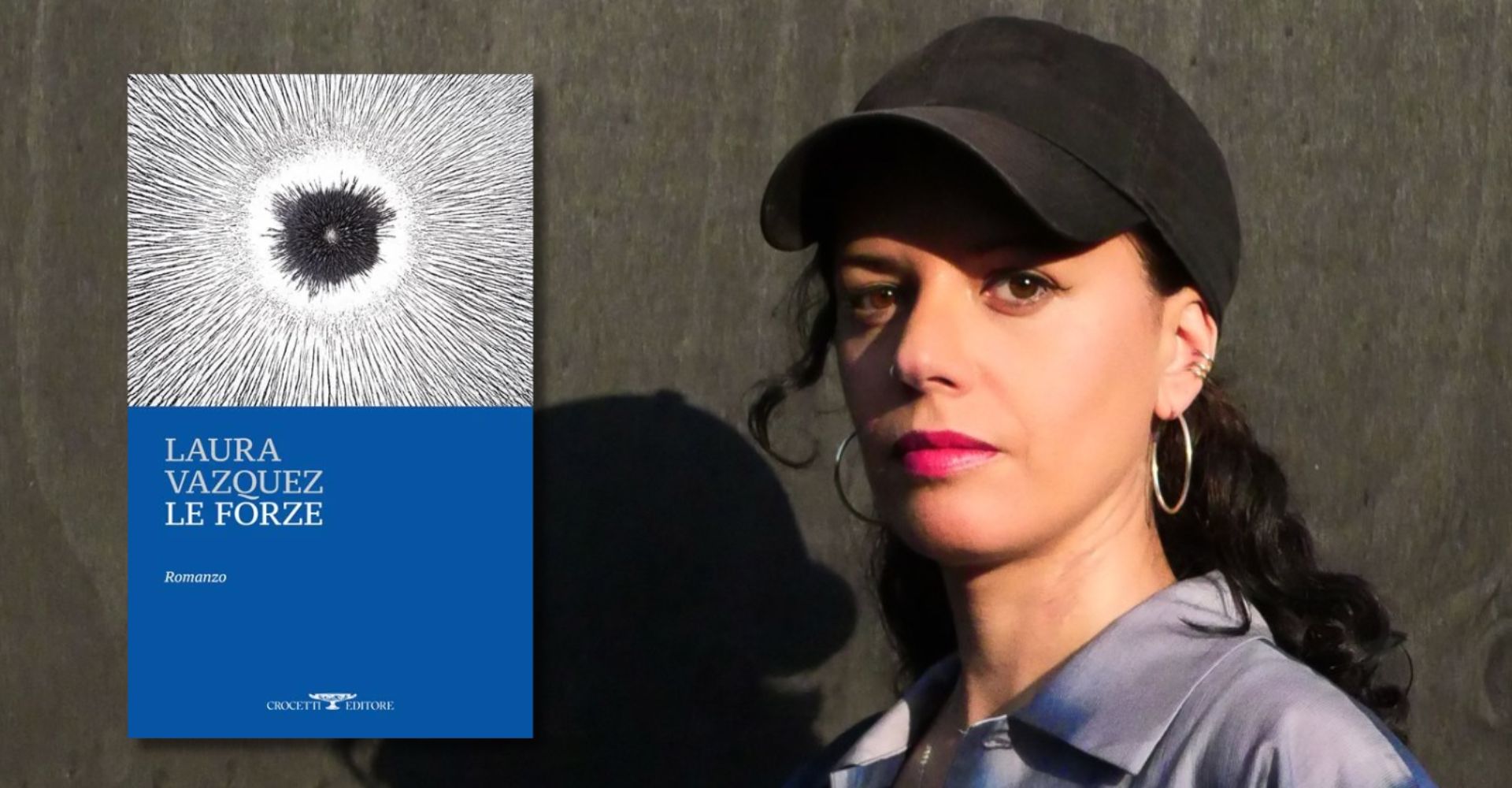
The unnamed protagonist of Le forze (Crocetti, translation by Paolo Bellomo and Luca Bondioli), the second prose work by the French poet and novelist Laura Vazquez, would have no doubts: it might sound absurd, but it happens.
Or at least it happened to her, a young woman who is sensitive and reflective, though often animated by hellish thoughts, and who, looking back, began to realize how little of her own self remains entangled in what anyone would mistake for her identity.
Sure, growing up you change, but are we sure there isn’t something else behind it?
The Forces That Move the Sun and the Other Stars
I sleep, I eat / The cold of the forces is clear / Of the clear and cold forces / The cold of the clear forces

“Separated from life as with a thin diaphragm,” indeed quoting the epigraph of Robert Walser, the narrator’s voice begins to suspect, from the very first pages of this philosophical coming-of-age novel, that what defines her at the same timedefining her, constrains her moods, impulses and the opinions to which she can access.
And that each of us (as if that weren’t enough), even carrying within a seed of irreplaceability, remains the result of a set of forces that act indiscriminately on all creation.
From the forces of language that shape the mind, creating and destroying meanings, to the psychological forces that transform fears, needs and lacks into precarious balancing points; not to forget the social forces based on norms, customs, expectations and principles that feed conformism, alienation and the difficulty of staying true to oneself.
Fragments of an Ingenious Discourse
What guides your judgments, your opinions, your words? Are they not the most banal pulsations of motive? A simple search for narcissistic satisfaction? The survival instinct of a body whose function is to endure?
A increasingly insistent doubt then stuns the protagonist: how to distinguish her true self from what she had merely grown used to calling such? And how to free herself from the confines of the latter, to explore the infinite possibilities of existence?
First of all, one would say, by renouncing telling of herself through a linear plot, and letting the text proceed through encounters, meditations and dialogues apparently uncoupled from each other, from which will emerge a kind of anthology of her existence.
And, secondly, by doubting her own tastes, affections and moral values, in the hope of freeing herself from the superstructures that condition her.
Whom to Meet to (Dis)orient Yourself
I could not tell her: I am searching for what could hook me to something outside of myself, I would like to feel captured and I am not, I don’t believe in anything and I pity those who believe […]
That is how begins a quest for the “self” with an allegorical flavor, which evokes Sartre’s Nausea and Thomas Mann’s The Magic Mountain not only for its streams of consciousness, for its figurative style, and for the fact that the protagonist confronts the reflections of numerous intellectuals of yesterday and today, but also for the places and the characters she encounters.
Think of the bar for lesbians where Nia embodies the fragility of community ties, and “the girl with the pitch-black eyes” the tension between political rebellion and the need for belonging — or the “house of the dead” inhabited by people at the margins of society, where the elderly painter Michel embodies the resilience of creativity and of affections in the face of suffering and decline.
Not to mention the palace that houses several religious sects, from which emerges the multiplicity (and arbitrariness) of our responses to the great questions of existence — such as the sleep sect, which preaches escape from reality through rest, the sect of God’s weakness, which reflects on the impotence of the latter and on the compassion it would deserve from us, or the sect of absolute non-certainty.
The Forces That Make Us Unhappy
This desire is not mine. I don’t know what I want. I haven’t had time to want. I haven’t had the chance.
Watching her waver among so many suggestions, we sense that the forces she has been subjected to for years have driven her toward the usual package of prepackaged dreams (love, home, money, work), with the result that along the way she must have lost sight of her own ideal of happiness — and that now she would feel guilty in pursuing it, given the world’s discouraging conditions.
Perhaps feeling good is either the crime of the selfish or the privilege of the fools, it seems to acknowledge not by accident between the lines, while reveling in discontent would still be akin to a (though vain) test of virtue.
But even this must be one of those impasses she hates lingering on. And so, how to get out of it?
Per aspera ad astra
Everything is possible, open, deep, until one knows.
A response seems to surface during the final leg of her journey, when the young woman is on a mountain and something inside her actually melts, something warm and poetic that from the outside we can only imagine.
Without revealing too many details here, it is nonetheless likely that it has to do with the risk of slipping back into yet another scheme when one tries to break out of them at all costs, whereas it would be much more functional to move toward reality, avoiding fleeing from oneself, and noting that in the equation of the universe the chthonic and the cosmic forces also, and above all, belong.
Those capable of freeing us from the excesses of rationalization, restoring in us the taste of being surprised by what eludes our control — and of rediscovering in an openness to Chaos a more authentic form of self-determination…