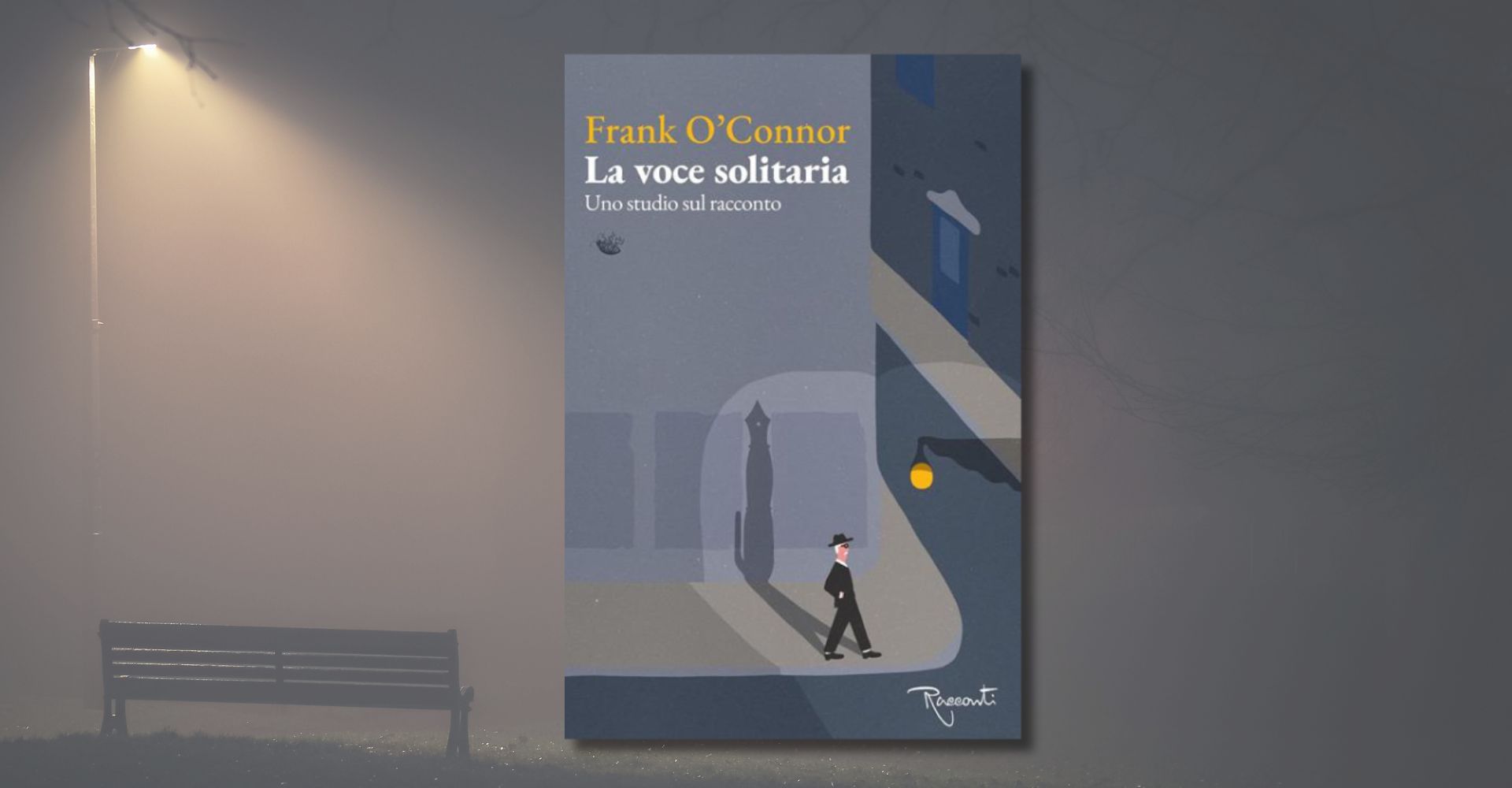
There is a curious red thread that links Blaise Pascal to Nikolaj V. Gogol’ from 1963, the year in which the Irish author and critic Frank O’Connor (1903-1966) published in Cleveland The Lonely Voice, a collection of essays and lessons on the short story unique in its kind, which thanks to the Racconti Edizioni publishing house is now arriving in Italy in Stefano Friani’s translation.
“The eternal silence of these infinite spaces terrifies me,” Pascal indeed noted in his Pensieri.
That phrase, besides serving as the epigraph to O’Connor’s text, the author links to the possibility of the short story to sketch the “intense awareness of human solitude,” as he would put it in what is considered the progenitor work of modern short stories: The Overcoat by Gogol’.
The Lonely Voice of Those Who Do Not Write Novels

A striking parallel, which for O’Connor becomes the reference parameter by which he analyzes the works of some of the most authoritative figures associated with the short story form.
Thus we discover his admiration for Ernest Hemingway, D. H. Lawrence and Anton P. Čechov, whom he regards as “a pure and simple storyteller,” while less flattering words are reserved for Guy de Maupassant, Rudyard Kipling and Katherine Mansfield.
Or rather: it goes without saying that, in a broad sense, they are all prose writers whose talent O’Connor acknowledges and contextualizes (indeed with esteem and intellectual honesty almost of another era), even if their approach to writing might not always have led them to make a story into a good short tale.
After all, we are talking about an expressive form often mistaken for a simplified variant of the long narrative, if not even a preliminary and functional one only for those who intend to later tackle more “articulated” experiments – and which it is understandable was not clearly understood even by some professionals.
The Overcoat

Short Stories
Short Stories and Novellas
Strange Tales in lingua originale

Happiness
The O’Connor Method…
The aim of the Cork-born writer, essayist and man of the theatre is therefore to fill this epistemic gap, offering us an applied theory of the short story that takes into account the structural peculiarities that distinguish it from the novel, from the novella and from the novelette.
Among these, his dramaturgical power to stage symbolic characters who often wander “on the margins of society,” placed in a context “that offers no goals or answers,” and in which it is deliberately unlikely to fully identify with them stands out.
Not to mention the short form’s inability to represent the “totality of life” — not for some reason tied to its length, of which several popular beliefs are actually debunked here, but because writing a story forces the author to “select one point” only, as small as a grape, from which to squeeze the juice of human experience.
Hence, a task far from simple, and in order to shine at it one must banish slip-ups, blunders, hesitation and sentimentality, despite what occasionally is allowed (and favored) in the crafting of other works of fiction.
…between strengths and limits
From this standpoint, The Lonely Voice has the merit of having woven a normative framework from which one can finally assemble a canon of modern and contemporary short stories, even though, as a whole, it remains a work that is as fascinating as it is disorganized.
In the author’s own admission, the text omits several areas of that Western world it aimed to probe: from Germany to Portugal and Italy, with substantial coverage also of Spain and France.
What is present instead is Ireland, though the chapter devoted to it, as well as much of the volume, examines voices that are almost entirely male — partly because O’Connor is legitimately a son of his era, and partly because there were not yet as many female short-story writers who had managed to establish themselves on a world stage.
The Lonely Voice Reheard in Our Days
Could this be one of the reasons why, so far, The Lonely Voice has contributed only partially to returning to the short form and to its individual “narrators” the autonomy, the dignity and the space they would have deserved in the international discourse?
Whatever the answer, the hope is that its return to bookshelves will now encourage a more conscious reflection on the topic, raising awareness if possible among a new generation not only of readers, but especially of authors of short stories.
Indeed, the epilogue of the book is dedicated to the trove of advice shared by O’Connor with his students who loved writing, urging them to break free from previous models and from the temptation of “beautiful writing,” in order to train themselves to convey with their own voice no more than what would fit on the back of a postcard.
For the sake of those who, like us, will approach the current tale in its most concentrated version, yes, but especially given that “in this imperfect world it is the highest degree of approximation we can reach to approach the pleasures of the immortals.”
Word of a true master of brevity.