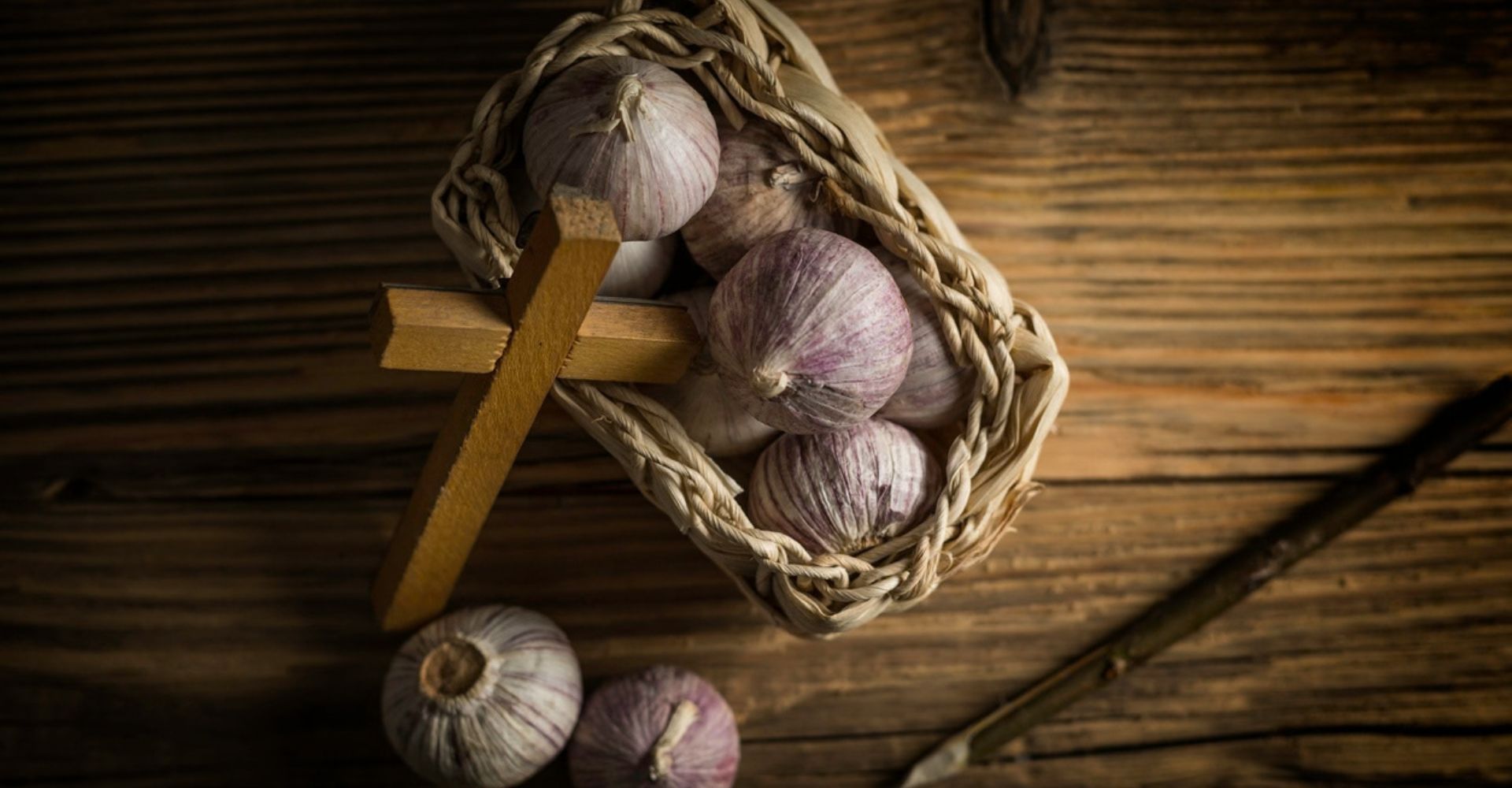
Among the crowd of creatures populating folklore, vampires stand out for a prerogative: they have more peculiarities of their own than all the other monsters put together. Parasitic emanations of a lazy aristocracy of the ancien régime that lives by exploitation, according to an insight by Voltaire that Bram Stoker, with visionary syncretism, has carried forward to us, the vampires dwell in isolated castles or church crypts where nobles were traditionally buried, and lead lives studded with idiosyncrasies: light, and mirrors, and the silver in bullets, and holy water, and the stake that must be made of ash, and the daily intake of fresh blood. And, naturally, garlic; which they do not tolerate, much like bands of humans who detest its pungent, sulfurous aroma. Only, for vampires this is not merely a matter of taste: garlic has a frankly deleterious effect on them.
Horrific Counterfigures of Porphyria Patients
To explain the vampires’ aversion to garlic, scholarly circles mobilized. Years ago the biochemist David Dolphin suggested that the vampires’ peculiarities—light hypersensitivity, bared fangs, hatred of garlic—could be understood as folklore shaping them into grotesque counterfigures of porphyria sufferers: a rare disease that causes photophobia and gum erosion, hence the predatory, smile-like fangs of the vampire. In porphyria patients garlic has a side effect of increasing toxins. This controversial hypothesis, however, does not explain how vampires feed on blood, and it carries another weakness precisely in garlic: the dentulous aristocrats’ intolerance to it is a clue to their belonging not to a merely “human” category of patients, but to the great family of fantastic creatures.
The Sanskrit name for garlic, bhutanga, points to the power to kill monsters. Its amulet-like virtue, which it shares with other underground plants sacred to the gods of the underworld in pre-Christian traditions, doubles in superstition the objective antiseptic properties known since antiquity, which cause it to appear in treatises as a panacea. Herodotus tells us that in Egypt garlic was given to slaves to fortify their immune defenses. Conversely, for a long time it was believed that a head of garlic around the neck protected one from the risk of stumbling upon witches on the road to the great San Giovanni night’s sabbath. The medical properties observed in daylight have a subterranean counterpart in the magical efficacy as an antidote.
Antidote, but potentially also poison…
Indeed, it resembles the mysterious moly herb that the god Hermes hands to Odysseus to ward off Circe’s potion. The moly, which in the Odyssey appears as a pharmakon, thus antidote but potentially poison, is pulled from the ground, has a flower the color of milk and a dark spot at the root. Theophrastus would associate it with an allium that grows precisely in places sacred to Hermes. In this vein, in the eighteenth century Linnaeus gave the name allium moly to a variety of leek. Yet one can also believe another version, suggested by an Homeric scholium, according to which moly would be only a poetic invention: nothing but a quintessence of plant capable of annihilating enchantments. With roots in fairy-tale imagination, it blossoms in the pragmatic reality of nature, and it can neutralize the monsters and the vampires that collective fantasy invents and reinvents from time immemorial.

THE NEW ISSUE OF THE MAGAZINE – L’Integrale (@lintegralerivista) is a magazine-book of gastronomic culture, born in 2020 thanks to the support of the Davide Longoni bakery and published by Iperborea. The magazine aims to rethink food writing, freeing it from the sole niche of enthusiasts and spanning languages and genres, from journalism to literature. Each issue is devoted to a theme and collects essays, stories, reportage, historical and scientific insights to explore, through the lens of what we eat and cook, human stories and relevant events of contemporary life.
Born in 2020, the project has reached its 13th issue, all dedicated to the theme of the night. The collective inquiry carried out in the contributions explores the nocturnal universe, a world “that occupies about a third of our lives and yet holds something exotic, the feeling of a journey we continue to take without ever fully understanding it.”
What happens in a bar when it’s already tomorrow but not yet morning? Who is present in the ovens and on fishing boats before dawn? How do cocktails transform us? What does food taste like when we eat it in the dark? These are some of the themes addressed in the magazine’s contributions, which bear the bylines of Arianna Giorgia Bonazzi, Fabio Deotto, Isaia Invernizzi, Tommaso Melilli, Arianna Montanari, Francesco Pacifico, Angelo Pannofino, Marco Rossari and Giulia Scomazzon. The sections are curated by Fontanesi, Ilaria Gaspari, Davide Longoni, Livia Satriano and Irene Soave. The pieces are, as always, accompanied by drawings by Gianluca Cannizzo and by original images and photographs by Alessio Cancellieri.