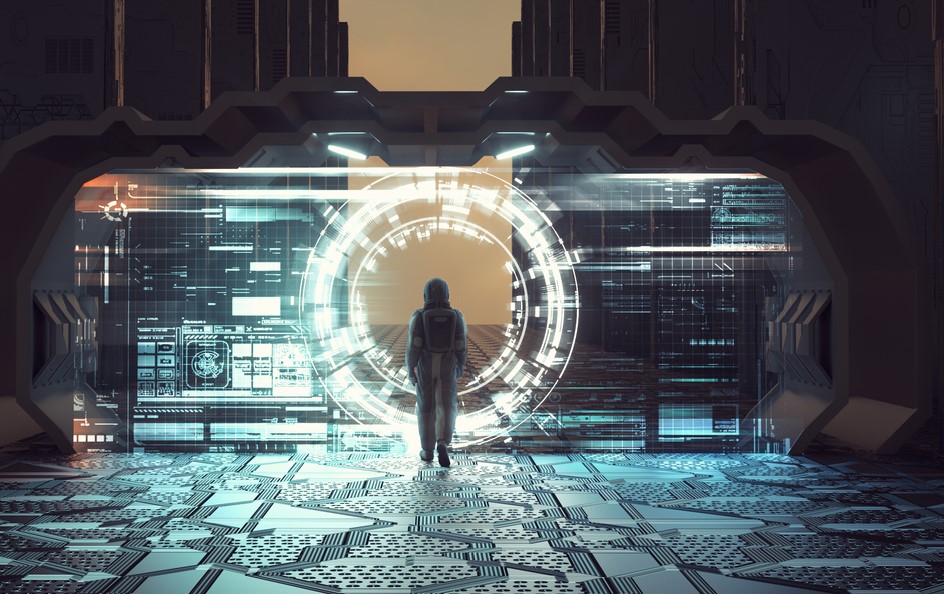
Marie was rather shaken. She closed her eyes and pinched the bridge of her nose with two fingers to gather her thoughts. “Let me understand: we take an object like… like this book, we perform a CT scan on it, set a time, say in two days, and see what will happen around the book for a few minutes from that moment?”
Massimo Ferri, born in Bologna in 1950, has held the chair of Geometry in Naples and in Bologna and is now a Professor at the Alma Mater. With the novel Don’t Call It a Time Machine, now available as an ebook, he was a finalist in the free literary tournament IoScrittore, promoted by the Gruppo GeMS and by its publishing houses.

Ferri gave up the sax in his youth, but not the dream of writing science fiction. And indeed he signs what has been defined as “a story tense as a thriller about the boundaries of science, the price of ambition, and the power of friendship.” A book “in which the beauty of pure mathematics collides with the banality of power, and where the most difficult equation to solve remains always the one of life…”.
The plot of Don’t Call It a Time Machine
The plot of Don’t Call It a Time Machine takes us to Bologna, roughly in the present day. Enrico Mancoverti, the protagonist, is an unconventional mathematician who teaches at the Faculty of Agricultural Sciences, loved by students and hindered by some colleagues.
He has a wife who works for Medici senza frontiere, a Bulgarian saxophonist friend (who seems to be the only one who understands him), and an idea for which the academic world is not ready: a “Laplace machine”, capable of reconstructing the past and glimpsing the future starting from any object. It’s not science fiction: it is pure mathematics, applied to the impossible.
With the help of a heterogeneous team – Isolde, a German expert in neural networks in search of redemption; Marie, a reserved French researcher from CINECA; and Edmondo, a Romagna-born engineer with a lateral-thinking mind – Enrico pushes the boundaries of mathematics, physics and common sense and the machine seems to really work…
But none of them is entirely ready for what is about to happen. And time – the real one, the one that cannot be controlled – waits for no one…
“While I was looking for a publishing house to take me in, I often saw the invitation to enter the tournament. I understood that, if I had participated, finally someone would have read my novel, despite the somewhat unusual genre. In fact, I received very pertinent, loyal and generous comments, but also valuable advice that helped me considerably improve my writing,” the author explained regarding his participation in IoScrittore.