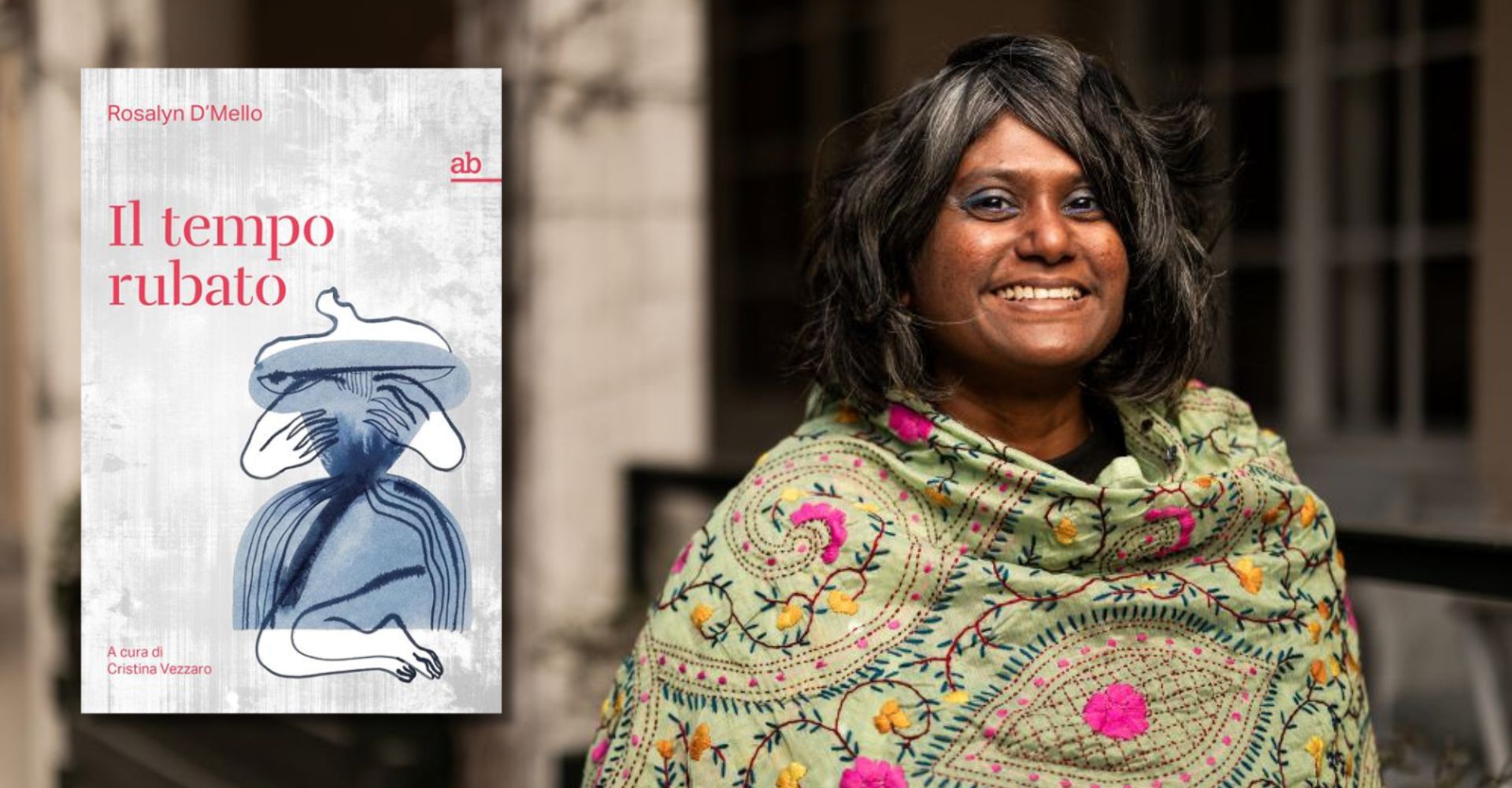
How likely is it that you hail from the Indian state of Goa, teach Design and Arts after having had the opportunity to emigrate to Alto Adige, and are facing your first pregnancy in a country whose language you do not yet know?
We could say almost none.
And yet it is far more probable that you know what it means not to be able to dedicate enough time to your own nourishment, in whatever form it may take. In that case, there is no doubt: The Time Stolen (Alphabeta Verlag, curated by Cristina Vezzaro) by Rosalyn D’Mello speaks about you as well. Or rather, about us.
The Time Stolen from the Formation of the Self
Is the perception of time what distinguishes living beings from the non-living? I used to think of this difference as a contrast between the animated and the inanimate, but it is time that animates by offering finitude?

A vast work, as the author herself calls it, in which writing is seen as a secretion (of ink and ideas) that coexists with trekking, genocides and French cinema.
A Weekly Diary
Although more than a survey, as the subtitle suggests, perhaps it is best defined by its given name: a cherished old weekly diary, compiled during a grueling pregnancy, after a nocturnal breastfeeding session or just before delivering at the last minute an academic article.
After all, Rosalyn D’Mello knows this well, for she is a broadly informed essayist and art critic, and she would read Simone Weil, Jeanette Winterson, Clarice Lispector and Anne Carson even more if time allowed: there is no identity without memory, yet memory cannot exist without attention. And, whether you view it as luck or misfortune, attention demands time.
That is precisely what she lacks not only because of the circumstances that make her life complicated and compressed, but also due to a patriarchal and capitalist culture that still reserves the privilege of freeing oneself from a time conception that is solely productive to a few.
If You Have No Time, You Find No Space
[…] a woman (…) was married to someone famous and spoke of all the poems that came to her mind while she ironed their clothes, never finding the time to record them. But the point is precisely this: she didn’t find the time because it wasn’t meant for her.
We notice this as D’Mello struggles to communicate quickly and well in public offices, fills the gaps of a welfare state with all the love she carries or suffers from not feeling part of a city community that is mindful and supportive.
And then to observe how from her testimony a broader argument unfolds, denouncing the frustration of those, like her, who demand the right to exercise their free time with less effort.
It may seem to us a mere luxury in light of other intersections of feminist struggle, but in truth it suffices to imagine the hours free from obligations as a resource for self-analysis, for study (understood as studium, or a passion for a task), and for sharing, to glimpse the core of the matter.
That is, how would we become aware of our own existential condition without these hours? And how could we plan to change it, both privately and collectively, if we do not even know when we will have the opportunity?
And if You Don’t Find Space, You Do Not Exist
Passing yourself off as a guest was the only way you had to access spaces that were not meant for you. The trick was to pretend to be a guest, confident that you had every right to be present, even though you had not been granted leave.
Taking time away from us, in other words, amounts to depriving ourselves of space for action and interaction in an increasingly digitized world – where for years we have tended to speak less with those around us, while still needing to be available and performative 24/7, and even more strenuously if we are victims of one or more discriminations, if psychophysical, financial or relational difficulties arise, or if we act as a caregiver for someone.
“To raise a child you need a whole village,” goes not for nothing a well-known African proverb, even though the truth is that many adults miss that same village of support.
The message is clear, because D’Mello recognizes it as such as she returns to writing. If we keep feeling that we lack time, in order to reclaim it we will need to steal it.
The Intention Makes the Man a “Thief” (and Even More So the Woman)
Simply, I felt the sensation of delighting in truths, that what I was reading came from a space of bold honesty. I was finally allowing myself to let it happen.
And her experiment, at heart, consists in nothing more than this: to commence a patient erosion of the time of commitments, which once it has started on the page allows her to transform it into engaged time — from the minute spent playing with her child’s little hands, to the hour spent preparing cafreal chicken, to mornings split between training and walks, or a day set aside for making love with her husband.
Do not think, however, that The Time Stolen aims to present itself as a universal manifesto. The sole ambition of D’Mello is to reshape and give substance to her own daily life, to re-train her critical spirit so that she can offer her intellectual contribution to others, and to enjoy the countless shades of the hic et nunc if she finds herself in the company of others.
The practical attempts described in the text, together with the most brilliant considerations from those who asked themselves the question before her, are thus “designed” only for herself, and her stance remains sobriety and visceral up to the moving finale of the book, not to mention wonderfully indifferent to who lies beyond the page.
The Time Stolen for (Re)Existence
I have “caught up” with time. I am no longer constantly late, nor chasing dreams or delusions. I am exactly where I need to be, and it is neither a track nor a racing arena. It is an open field with lush mud, fertile ground thanks to the traces of everything that was planted before.
Could this be what it means to “prosper”?
From there, it is precisely this approach that makes The Time Stolen a nearly involuntary political act, which after reading invites us to reframe our own relationship with the time we have borrowed, and to look inward—and especially outward—with new eyes.
Because, upon reflection, the time to claim for ourselves should not be subtracted from introspection or from the world around us tout court, but only from the obligations that threaten to drain us, so that it can be dedicated to the last drop to the causes and the people who instead nourish our humanity.
And forgive me if that is not a small thing…