I did (to do) homework at home…
Anyone my age (sixty-one) has done in their life many, extremely many Latin translation exercises. If they attended a Classical high school they did many (extremely many) Greek as well; if they attended a Scientific high school they did instead many (very many) studies of functions. And then extra assignments, essays, summaries, orthogonal projections, exercises on levers and pulleys and a thousand other activities that filled the afternoons of us high schoolers, stuck for hours doing homework, in addition to all the time spent on school textbooks memorizing dates, battles, and emperors.
The “doing” consolidates the foundations of knowledge
The idea behind these assignments, often handed out with weary monotony by our teachers, was that the “doing” consolidated the foundations of knowledge. In class, in the classroom, the teacher explained the theory and laid the foundations of knowledge; the practical application of what was learned was considered a matter of habit: I taught you the fifth declension, now you do twenty versions with an unusually high number of nouns from the fifth declension to decline and you will be so saturated that from now on you will find it natural to decline dies, diei, diei, diem, dies, die. And somehow it worked, if it’s true that I still remember it by heart.
dies, diei, diei… generation after generation
What we did in the 1970s-1980s had been done, identically, by our parents in the 1940s-1950s and before them our grandparents in the 1910s-1920s: dies, diei, diei… generation after generation.
On closer inspection, the idea behind this practice was that the brain could be likened to a muscle and that habit would shape it, developing it. In a not too dissimilar way, a student pianist endures hours and hours of scale exercises, major and minor, melodic and harmonic, in all possible keys (even the most treacherous, which no composer would ever use), so that in the brain and in the fingers those movements are carved in an indelible way and automatic habits are created that at the right moment can be repeated without even thinking about it, so deeply etched in the mind.
Yet the fact remains that any composition, by any composer, will never contain an entire ascending and descending scale “in pure form”: a scale is a sequence of notes that is too banal, which in itself does not constitute “music”: music (Western tonal modern) is based, of course, on scales, but it reworks them, modifies them, deforms them, contravenes them, and it is precisely this that makes that art so varied and interesting.
The brain is not a muscle
And then there is the fundamental premise that poses a serious problem: the brain is not a muscle. Digging habits into its neural circuits limits, rather than expands, its potential. Instilling obsessively in a young person the fifth declension or the D-flat major scale channels thought into comforting and already explored paths, which from a didactic point of view might not be inherently bad—it is a step that perhaps must be taken—provided that one is aware that creative and original thought consists precisely in breaking those patterns and thereby generating something new.
Then generative artificial intelligence arrived…
Our grandparents, our parents, us and even our children have thus tended to their education in essentially the exact same way: dies, diei, diei. Then generative artificial intelligence arrived. OpenAI put ChatGPT online in November 2022—a blink of an eye ago—based on GPT-3.5, a dinosaur by today’s standards (October 2026). In these four years or so the world has changed radically and school, which is a privileged mirror of the world, too.
Tutta l’impalcatura didattica che aveva resistito a secoli di mutamenti e che si fondava da sempre sulla ripetizione abitudinaria (e quindi sui compiti a casa) è venuta improvvisamente a cadere.

La bolla dell’intelligenza artificiale
L’algoritmo in cattedra
Date a un quindicenne di oggi una versione di latino e lui la passerà immediatamente al suo chatbot preferito, ottenendone una traduzione personalizzata (diversa da quella del suo compagno di classe, perché ogni volta il chatbot riparte da capo) da 8 e mezzo. Se il ragazzo è minimamente astuto, chiederà al chatbot di inserire ad arte un paio di errori, di modo che il professore non si insospettisca, e si accontenterà del 7. Se poi è molto astuto, si farà dire dal chatbot quali sono gli errori inseriti e quale sarebbe stata la traduzione corretta, di modo che all’orale potrà fare bella figura dimostrando di aver capito le proprie manchevolezze. Un figurone.
Now the hard question: by acting this way, has that boy truly learned less than me, than his grandfather and than his great-grandfather?
L’IA a scuola è una novità talmente dirompente che forse è la volta che saremo costretti a ripensare l’intero sistema didattico e porci davvero il problema di cosa significhi apprendere e insegnare.
L’IA, in sé, non è né un bene né un male: è arrivata, questo è quanto, e non se ne andrà. Se non la demonizziamo (né la esaltiamo), forse possiamo usarla per il meglio. E a chi possiamo chiedere un’opinione in merito se non a un professore di Liceo che ogni mattina alle otto si trova a interagire con decine di ragazzi vivaci e curiosi?
L’AUTORE – Michele Luzzatto è il direttore editoriale di Bollati Boringhieri.
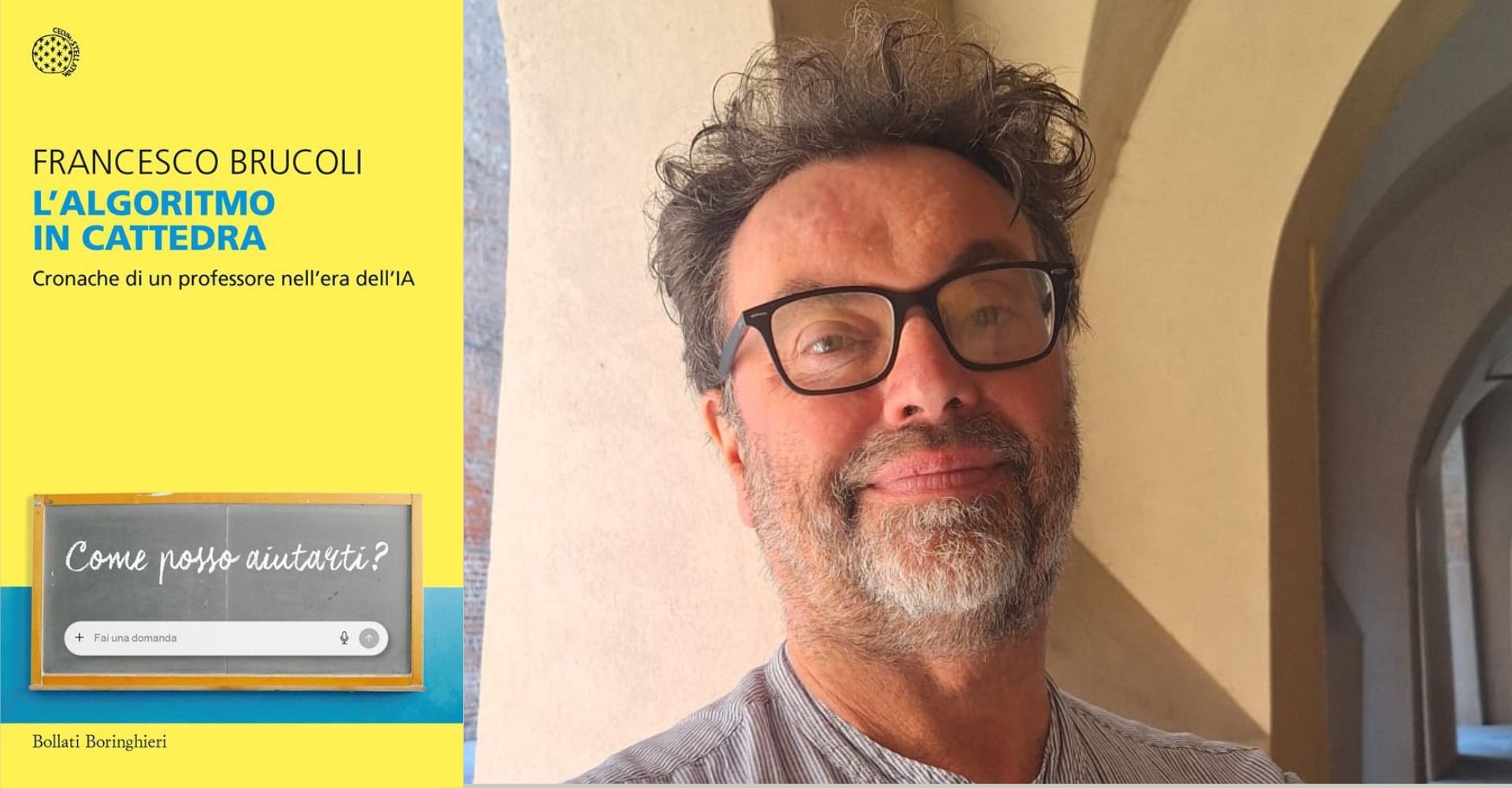
IL LIBRO – L’algoritmo in cattedra – Cronache di un professore nell’era dell’IA è un saggio di Francesco Brucoli, professore di Filosofia e Storia al Liceo Galileo Ferraris di Torino che all’attività di docenza ha affiancato la collaborazione con case editrici per la stesura di diversi manuali scolastici. Nel libro, l’autore si sofferma sulla svolta inevitabile data dall’uso dell’intelligenza artificiale nelle scuole. Mentre gli studenti usano ChatGPT per tradurre le versioni di latino, risolvere problemi di matematica, fare ricerche di storia, cosa resta della lezione frontale, dei compiti a casa, dei voti e delle verifiche?
Partendo da questa domanda, Brucoli affronta l’impatto dell’intelligenza artificiale sull’apprendimento dal punto di vista di chi la scuola la vive ogni giorno. Il professore, vede lo strumento non come una minaccia per il modello di istruzione a cui siamo abituati, ma come un’occasione per ripensare il senso stesso dell’insegnamento: non più semplice trasmissione di nozioni, ma costruzione attiva di conoscenza. È in questo scenario che il ruolo del docente si trasforma, diventando guida e presenza critica che ribadisce una verità semplice e decisiva: la scuola non è un sistema da automatizzare, ma uno spazio in cui si formano cittadini consapevoli.