
Honestly? I don’t know with what spirit I’ll go to school tomorrow morning, right now.
Already before there was a bit of that crowd, a pinch of “hey, what if it happened to me?”. But now.
Maybe it’s just suggestion, maybe. But in the meantime.
In the meantime I have to face the fact that it’s no longer a story you read in the newspaper and think it’s far away, distant, impossible. Now the boy from Trescore, the one from Centocelle, could be mine as well. I know they could be one of mine.
And at that point a question naturally arises: when will we start?
When will we start opening our eyes?
When will we understand that the web is not only a place that miraculously keeps our child calm, but also a dark sea, where in the depths things happen that we will never see?
When will we stop pretending, saying that you’ve always been unwell at thirteen, no, you weren’t always unwell, not like that, I thank God I was 15 in 1992, without the internet, without social media, when you closed your bedroom door and the world stayed outside, no one would come to break that door down, while today there are no doors left, not even walls, nothing of a room, there’s only the world entering your head and you no longer even know where you’ve ended up.
When will we begin to understand that today’s distress is different because it has different tools for growing?
Of course we’ve always felt alone. Of course we’ve always felt angry.
But today if you feel wrong, alone, angry, there’s someone willing to tell you that you’re right. That your anger has a culprit. That your pain can become hate.
Someone who tells him: come, you’re one of us. It’s true, the world wants to hurt you. And you must take your revenge.
When will we stop minimizing, looking at the finger and not the moon, believing it’s normal to go to school with the fear of being stabbed by a fellow student for a bad grade, or for an antipathy, or for who-knows what reason?
When we think about doing something for this infinite distress that’s right in front of us, do we wait until it’s an acquaintance, a friend, our own child?
When will we start giving schools real tools to intercept pain, anger, to see it, because you may be the best teacher in the world but it’s useless—sometimes it passes right in front of you and you still don’t see it; you have twenty-five in the class and it’s incredible, but often the student most at risk isn’t the one with sixes every week, isn’t the one with the disastrous report card, it’s the girl who has all tens, it’s the kid who sits calmly in the last row and never disturbs, how do you notice something so invisible, how?
When will we stop with proclamations and slogans and begin to invest truly in the mental health of this generation?
When will we act, when will we admit, if nothing else, that we have a problem, because as long as people think that the teenagers from Trescore or Centocelle are special cases, deviants and nothing more, that’s where you’re denying the evidence, that’s where you’re truly in danger, because you don’t realize it’s everywhere, that it insinuates itself, that it can strike anyone, even those you least expect. Exactly those you least expect.
When will we start truly talking to these kids, listening to what they have to say, without looking at them with condescension, without judging them, without pointing fingers?
When will we open our eyes to the fact that they feel so lonely as to almost always turn to ChatGPT as a psychologist or friend, and if they do so it’s precisely because at least artificial intelligence does not judge them, does not make them feel wrong, as we too often do?
Perhaps we should simply start from here.
By looking at them a little longer. By asking one more question. By not always having an answer ready before they’ve even finished speaking.
Knowing that many things will continue to elude us, because we cannot see everything, understand everything, reach everywhere.
But at least we shouldn’t convince ourselves that if we don’t see it, then it doesn’t exist.

The Heart Does Not Sleep
That Place You Call Home
A Life Is Not Enough
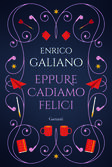
Yet We Fall in Happiness
THE AUTHOR – Enrico Galiano, a Friulian teacher and writer born in 1977, in class as in the social networks, where he has a large following, knows how to speak to young people.
After the success of novels (all published by Garzanti) such as And Yet We Fall Happily, All the Life You Want, Happy Against the World, and Stronger Than Any Goodbye, he published a peculiar book, It Takes Just a Moment to Return to Childhood, illustrated by Sara Di Francescantonio. He then returned to fiction with Sleep Tonight on My Heart, and always for Garzanti his first essay, The Art of Really Screwing Up. With Salani, Galiano published his first story for kids, The Secret Society of Word-Savers. And he released, again for Garzanti, his second essay, School of Happiness for Eternal Repeats.
After the novel Geography of a Perfect Pain, he returned to bookstores with A Life Not Enough, and then published, again with Salani, the second book for young readers, The Incredible Adventure of a Super Mistake. With Garzanti in 2025, the novel The Place You Call Home came out, and with Einaudi Stile Libero, in 2026, The Heart Doesn’t Go to Sleep.
His new book is My Best Friend Is a Ghost (Salani).
Here you can read all the articles written by Galiano for our site, with whom he has been a steady collaborator for several years (also with videos for Instagram and TikTok).

Amelia Hartwell
I write about books the way I read them: slowly, curiously, and with attention to the details that linger after the final page. At Lythrum Press, I cover literary fiction, essays, memoirs and the wider culture of reading, with a particular interest in voices that challenge familiar ways of seeing the world. My work is guided by one simple idea: a good book deserves more than a reaction — it deserves a conversation.