María Sesé Sarvisé, Memories of a Spanish Exile 1936-1975, translated from Spanish by Lauro Del Prado, introduction by Ariane Miéville, Lux Éditeur, 20/04/2026. €14
There are history books that recount wars, political regimes, and social upheavals. And then there are narratives that give this history a face, a voice, a memory. Memories of a Spanish Exile 1936-1975 belongs to the second category. María Sesé Sarvisé’s book is not merely the account of a childhood shattered by the Spanish Civil War. It is the memory of a woman who, growing to adulthood and then aging, makes it her mission to transmit what she saw, endured, and understood of a vanished world.
María was fourteen when the Civil War broke out in 1936
She lives in Angüés, a small village in Aragon, in a modest family. The war does not initially arrive in the form of the grand battles that history will remember. It breaks out in the village streets, in arrests, executions, men leaving, and family anxieties. Two of María’s brothers are executed at the start of the conflict; a third dies shortly after. The young girl thus discovers very early that History can enter a house and permanently upset its balance.
One of the great strengths of the narrative is precisely its “bottom-up” telling of the war. María does not pretend to write a general history of the Spanish War. She tells what she knows: her village, her relatives, the peasants, the workers, the neighbors, the militants, the dead, the refugees. Her testimony thus restores a dimension often absent from sweeping historical syntheses: the daily life of people who do not decide the war but bear its consequences.
In Angüés, the war is also that of immense political hope. Under the impulse of CNT militants, the village experiences land collectivization and a social organization based on sharing, solidarity, and collective participation. María, still an adolescent, observes this transformation and adheres deeply. She discovers another way of conceiving work, property, and the relations among men. Collectivization is thus not presented solely as a political experience. It becomes, in her memory, the embodiment of an ideal of justice and dignity. But hope is quickly confronted with violence. Bombings, shortages, fear, and the advance of Francoist troops force the population to flee. María’s family leaves Angüés and joins the immense flow of the Retirada. The narrative changes in nature. After being a war narrative, it becomes a narrative of exile.
A Text with Great Human Intensity
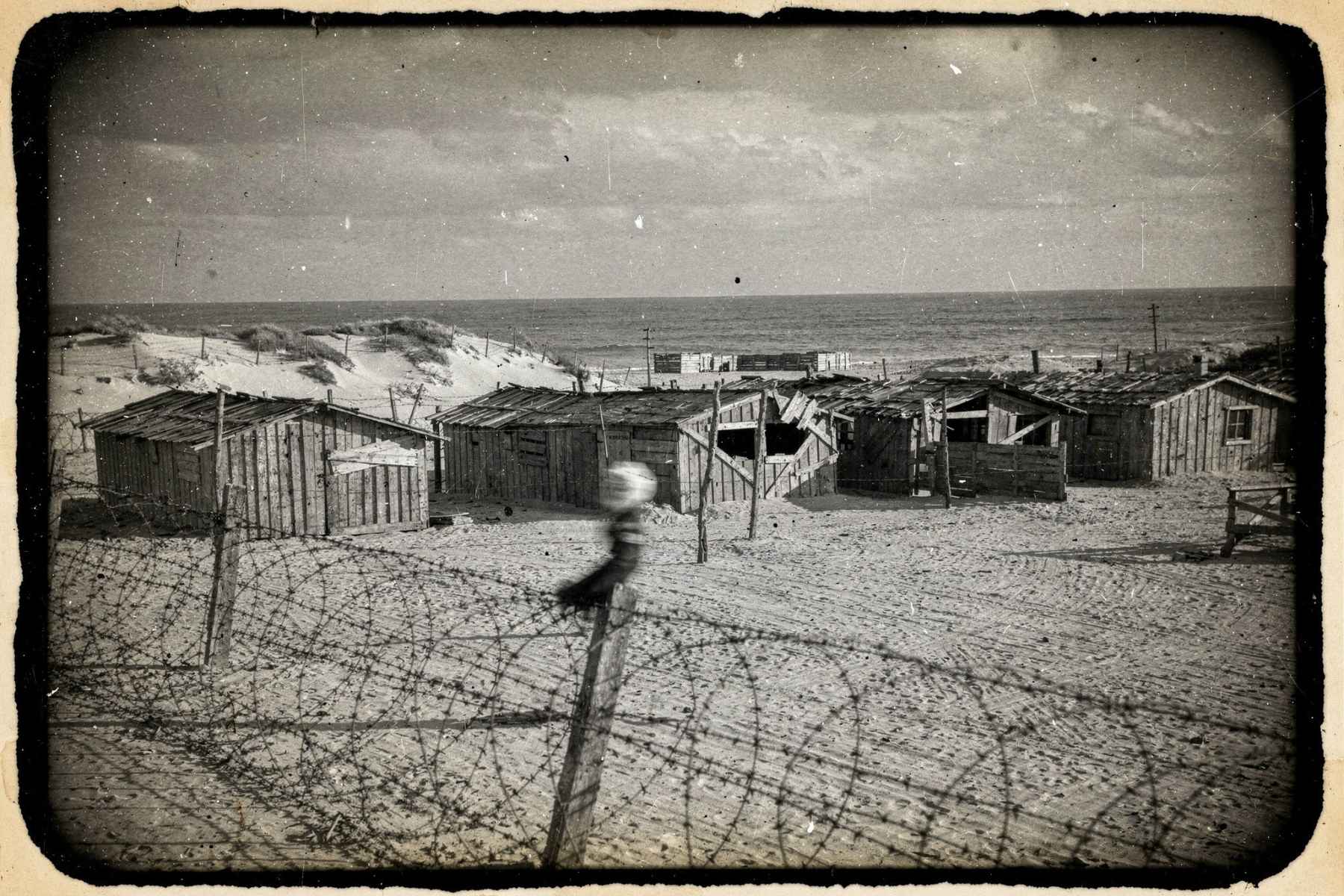
The escape is not abstract. It means fatigue, hunger, cold, family separations, the uncertainty of tomorrow. The routes of the exodus become the site of a gradual disintegration of the old world. Barcelona, Girona, the French border. Each step pulls María further from her village and the life she knew. France does not immediately stand as the hoped-for refuge. It is also a land of camps, waiting, and precariousness. María and her mother find themselves on Belle-Île-en-Mer while her father endures internment on the beaches of southern France before being able to be reunited with his family. Later, the family settles in Sainte-Valière, in the Aude. María works, marries, builds a family and a new life. Exile then becomes less an episode than a lasting condition.
The title is, in this regard, especially revealing: 1936-1975. The tale does not end with the conclusion of the Civil War. It accompanies María for several decades, up to Franco’s death. For the Franco victory does not mean the end of interior and exterior exile. For those who have lost their country, their loved ones and their hopes, the Spanish political era continues to weigh on lives, and this to this day.
María did not turn her story into a personal legend
Her words remain simple, sometimes almost naive, but this simplicity is precisely her strength. She recounts events with the gaze of someone who lived through them, without the distance needed at the moment to grasp their full historical significance. Decades later, that distance exists, but it does not erase the initial emotion.
Thus the book bears a profoundly testamentary dimension. To write is to prevent the deaths, the landscapes, the names, the gestures, and the ideals of a generation from vanishing. It is to pass on to descendants a history that the Franco dictatorship long kept in silence. María’s testimony thus joins a broader collective memory: that of the vanquished of the Spanish Civil War, the Republicans, the Anarchists, the exiles, and all those who had to rebuild their lives far from their homeland.
It is worth underscoring the uniqueness of the female perspective. María was fourteen when the war began. She is neither a fighter nor a political leader. She is a young girl who watches adults act, who sees her brothers disappear, who accompanies her mother, who experiences exile and must later rebuild a life. This position gives the narrative a distinct tone. The grand History appears here at the level of a woman, a family, and a village.
The writing moves forward through memories, names, episodes and images. The book does not always follow the rigorous structure of a historical narrative. This apparent simplicity, even this fragmentation, also constitutes its authenticity. The text resembles a voice saved from oblivion, meant primarily for future generations. That is probably why its emotion remains so direct. It is a modest book in form but important in what it carries. The author does not seek to write the History of Spain. She tells her own story, and that is precisely what allows it to join the stories of thousands of others. Her testimony ultimately recalls that exile is not only the displacement of a people on a map. It is an intimate rupture with a home, a language, a family, the dead, and a future imagined. But the book also says something else. Exile has not managed to destroy María’s convictions. The ideals of solidarity, justice, and freedom she discovered at fourteen endure, across the decades…, a compass.
From this reading we will retain less the tale of a defeat than that of fidelity. Fidelity to those who died, to those who had to leave, to a village vanished behind the borders of History, but also to the hope of a more just world. A world that, today, alas, sees the emergence on the horizon of identitarian and fascist movements. To tell, for María Sesé Sarvisé, is not to disappear. It is to restore to the nameless of the Spanish Civil War their name, their face and their dignity. And, nearly a century after 1936, her voice reminds us that the memory of the vanquished is never permanently vanquished.
The article Memories of a Spanish Exile 1936-1975 first appeared on Lythrum Press.