The Borrowed Measure. From Vitruvius to Skylab
A question runs through the book, that of measurement, and the four chapters unfold it into a form of humanism that is at once measured, emancipated, shattered, and enduring. The essay takes it literally, in the mason’s units just as in the philosopher’s pretensions.
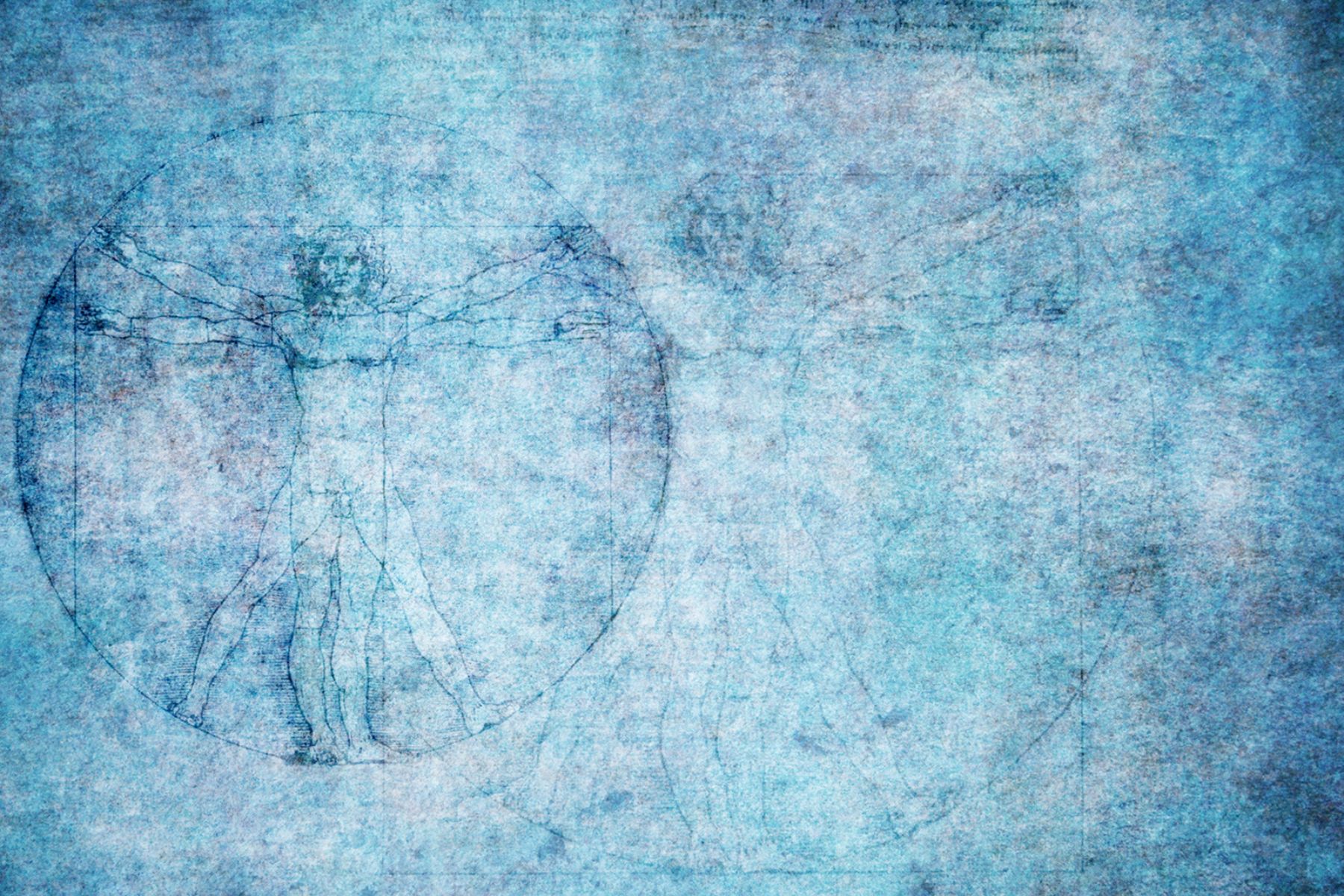
Vitruvius had stated that the art of building must imitate nature, borrowing from the body its sole units—the finger, the hand, the foot. The most famous emblem of humanism thus rests on a treatise that subjects the builder to what surpasses him, and the measurement drawn from the body proves to be borrowed. Jacques Arnould draws from this the consequence Protagoras had left open and that Plato already contested, “man is the measure only of man,” a program more than a finding. The body drawn in 1492 by Leonardo da Vinci, too perfect to be recognized as one’s own, stands as both ideal and limit.
Before him, Hildegard of Bingen had placed a naked man at the center of a cosmic wheel, arms outstretched, infused with divine energies. Our era has turned him into a kind of guru, and the essay returns him to the history of the correspondence between microcosm and macrocosm. Man holds to the circle, and the circle to God. Four and a half centuries later, a badge designed at Hamilton Standard stitched Leonardo da Vinci’s man onto the suits of two Skylab 3 astronauts who went up to repair their station in the summer of 1973. Renaissance humanism shifts into embroidery and crosses the atmosphere; the Cerf Editions’ iconographic notebook allows us to verify the emblem. From the 1492 drawing to this piece of fabric, the line holds; the world around has changed.
The Reconquest of Earth. The Ground Against the Escape
The second focus rests on a paradox that the space age has confirmed. Leaving Earth is equivalent to discovering space.
Astronauts bear witness to it; the Overview Effect, named by Frank White at the end of the 1980s, produces a sense of belonging rather than superiority. Ninety minutes suffice to circumnavigate the planet and measure the fragility of its atmosphere. Salvador Dalí had painted his Christ seen from above, drawing on the downward perspective of John of the Cross, a comparison more illuminating than California poolside imitators in saltwater. The sublime accompanies the movement, which Remo Bodei traced to the collapse of crystal spheres, when nature, silent and infinite, inherits the attributes of the divine. Immanuel Kant experienced it at the foot of a mountain and already housed it in the mind before the rocky mass. Hubble’s images relocate it in the sky, at the cost of colors and framings that bring the Eagle Nebula close to the canyons of the American West. The cosmos we behold is a composition, and the essay shows it while preserving its scientific value.
Edmund Husserl had given the formula as early as 1934: the Earth belongs to the ground rather than the body, experienced as immobile even as it turns, “the primal Earth arch does not move.” From there arises the book’s clearest rejection. The escapism of NewSpace, Planet B, terraforming, and transhumanism grouped in the same family—all stem from a flight, and fleeing Earth is a form of self-evaporation. Pierre Teilhard de Chardin had written about humanity’s solitude in the trenches of 1918, and William Shatner, returning from a suborbital flight in 2021, speaks of funeral rites.
The Other’s Share. From the Robot to the Other
The third focus shifts humanism from its center to its edges. It now identifies itself by the place it accordsto the other than itself.
Karel Čapek set the tone in Prague, in January 1921, by naming after toil, robota, an artificial worker without a soul and thus legitimate. A century of automata later, the question has turned around. Hans Moravec’s paradox tempers fear: machines “shine in what humans find difficult, while they fail in what is easy for us,” and the space rover takes days to do what a human on site would settle in minutes.
The most suggestive hypothesis comes from Jean Baudrillard, and the essay returns to it without cutting it. Animals manage without an unconscious because they possess territory; humans have a territory since they lost it. Deprived of unconscious and imagination, curiosity risks reducing itself to seeking what it already knows. The essayist stops there, dubious about a robot’s capacity to imagine, and frankly acknowledges it. Friedrich Nietzsche provides the counterproof with his “aerialists of the spirit,” that impulse which only consciousness can experience.
Thus emerges a proposition that gives the book its originality: the robot becomes the guardian of human identity, kept away from the responsibilities humans shoulder and tasked with protecting the soils it traverses from our contaminations. The move has a cost, and the author admits it: a statistical finding that machines pollute less than we do becomes, in a few pages, a thesis on guarding our identity.
The Other’s Share is read on the golden plaques of the Pioneer probes, to which Carl Sagan inscribed the message with his wife Linda and the astronomer Frank Drake, a man and a woman who refrain from taking each other’s hand to declare their otherness. The animal, the machine, and the hypothetical inhabitant elsewhere still complete this picture, and the last chapter adds them. In the final pages, the author asks what portion should be allotted to the ultimate Other, transcendence wrapped in the veils of the unknown, with knowledge and belief kept separate from one another.
The book closes with Aleksei Leonov, who emerged from Voskhod 2 in March 1965 on a tether, and with Maurice Blanchot’s phrase, “man, but a man without a horizon.” Once what he can know and do is established, humanity is left with hope and imagination as its only provisions, and here one recognizes Kant’s three questions in their order. The fourth question, which asks what it means to be human, had already opened the book, where Jacques Arnould asks who we are and whom we choose to be.
It required a singular freedom of mind to mine the scrap heap of probes and the embroidery of a badge to elevate the humanism of its argument. Jacques Arnould found it, and Les Éditions du Cerf publish here the book that gives an exterior to humanist thought.
The article The Vitruvian Manifesto, when space saves humanism, first appeared on Mare Nostrums.