
Hello! Would you like a coffee? Some pastries? A bit of naturally leavened bread? All made with my own hands, of course, all organic, all locally sourced. Oh no, don’t mind the camera, please make yourselves comfortable. Welcome to the Yesteryear Ranch.
Let Me Introduce Natalie Heller Mills
If you wander a bit through social media, these few lines will already have painted in your mind a very clear image of a young, probably very young American woman, with a dazzling smile, a somewhat vintage hairstyle, a puff of flour on one cheek perhaps retouched, surrounded by her offspring.
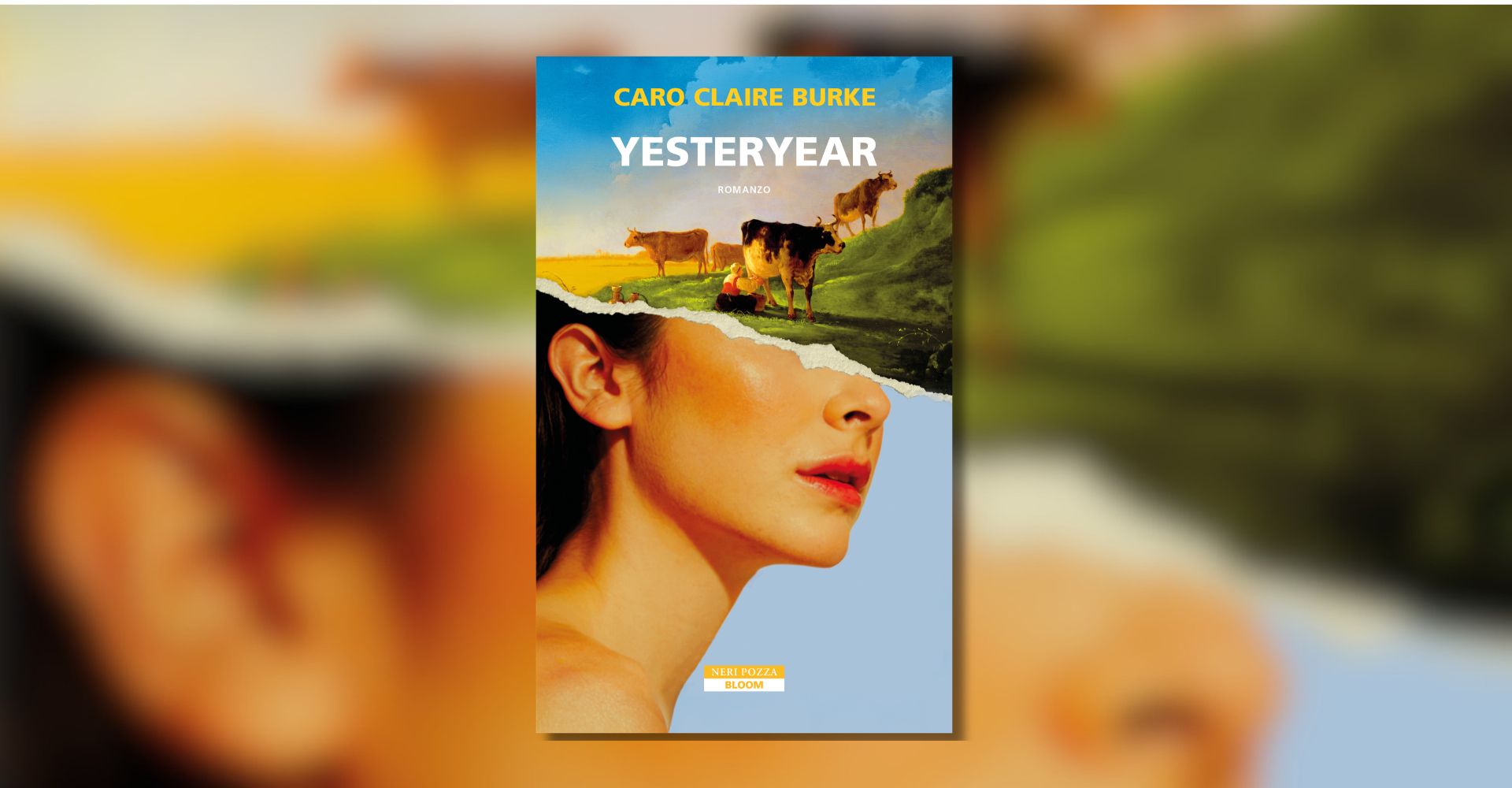
It is thus with Natalie Heller Mills, the protagonist of Yesteryear by Caro Claire Burke, a book that has not only been a publishing sensation at home, but whose anticipation in Italy led the publisher Neri Pozza to advance the publication (on the publisher’s profiles you can recover the emails exchanged with the translator, the capable Simona Fefé, in which she reassured readers, step by step, that she was well on track with the work).
“Mom, what is a tradwife?”
Natalie is a tradwife, which is the abbreviation for “traditional wife.” As the author herself states in this interview with the Late Night, the term “refers to a woman who adopts an attitude of submission in every aspect of her life. Submission to one’s husband, but not only: she also embraces the power dynamics tied to the domestic life, betting everything on the idea, namely, submission.”

But not only that, Natalie is also an influencer, moreover very popular: her followers reach seven figures.
A paradox with the values she professes? Sure, and yet the tradwife-influencer trend has surged in the United States and perhaps is only now waning. These are women who show on social media their lives devoted to “traditional values” – home and family care, cooking dinner entirely from ingredients that are traditionally natural – but who, ironically, all have an affiliate link that leads straight to their online shop.
Even Natalie, naturally, promotes her products, between a recipe video and footage of the army of children crowding around her home: a ranch in Idaho, where she lives with her husband, the son of a powerful politician, two nannies, 5-6 children (readers will forgive the inaccuracy, but Natalie herself sometimes seems to forget the exact number, or, indeed, their names), a producer for social content and workers who till the fields without the followers knowing.
A life that glitters, but it is only a spotlight for the lure. Behind the screen hides a miserable marriage – the two hardly seem to know each other and far from tolerate each other – and a farm that does not advance only with love and passion – animals that keep dying, pesticides hidden behind dark tarps – just to name a few examples.
Welcome to the Time Machine
And then, here is the turning point, right in the early chapters of the novel: the woman wakes up, but the blanket she touches is not hers: instead of the blend of flannel and linen there is a rigid, thin quilt.
And then, why is it so dark? A darkness of that kind she had never seen before… Try not to think about it and begin the day with her usual mantra:
“Thank you, Father, for Caleb. Thank you for the inheritance. Thank you for Clementine, Samuel, Stetson…”
As soon as she steps onto the cold floor the curtain rises on the nightmare. That is not her house, those are not her children, that is not her husband, not really.
It seems like an altered, ancient version: Caleb is older, the children are emaciated and the house… the house is devoid of any modern conveniences, there is no electricity, no running water.
“All these children could be mine. None of them are.”
What do the little pioneers do to amuse themselves?
Natalie seems to have stepped into a historical reenactment of pioneer times, the “good old days” so cherished by the champions of traditional values. It’s a pity that the reenactment doesn’t end at the day’s close and the woman, the next morning, wakes again under the thin quilt. And so it goes day after day.
Starting from a long tradition that runs from science fiction to dystopia, with imaginaries that shine in films like The Perfect Woman and the more recent Don’t Worry Darling, the protagonist finds herself catapulted into a situation (a parallel universe? a reality show?) that she doesn’t understand.
Everyone treats her as if she were crazy – “here we go again, mom” –, no one believes her. And the husband, who perfectly embodies traditional roles, serves her with a swift rejection when she tries to escape.
A Cruel Counterpoint
Caro Claire Burke constructs a cruel counterpoint for her protagonist, not giving her a moment’s respite.
It almost seems as if she takes a certain pleasure in torturing her, in making her truly believe she is going mad. To the cry of a “those who do it will pay,” the author builds around her an authentic traditional life, a farm to manage, clothes to wash by hand in freezing water, husbands who do not accept “no” as an answer, and naturally risen dough that undermines her so-lauded capabilities.

The narrative structure is handled with deftness, so that it is hard to take your eyes off the pages. The further you go, the more you feel the dizzying pace, a slow descent that mirrors the protagonist’s fall.
But there is a great paradox: alternating between the “distorted” present and the past, one would expect the most frenetic steps and biggest revelations to occur in the “other” world, but that is not the case. There life moves slowly, in a painful slow motion indeed, with a regression of desires and thoughts: some chapters are just a little more than half a page long. It is in the past that we obtain a precise portrait of the protagonist, from which (probably) we would like to detach ourselves at all costs and from which we remain obsessed.
A Distorted Madame Bovary
In this, the choice of first person is a small masterstroke: Natalie tells us about herself and her life following a logic that doesn’t miss a beat, from her own point of view. The woman is not a poor naive trapped in conservatism.
The choice to wear the clothes of the “tradwife” is deliberate and hides a strong ambition: the desire to go “further.” She is a distorted Madame Bovary, on the other side of the mirror. And the author, like Flaubert, punishes her for it.
“What happens to the women of the Bible who look ahead? What becomes of them?”
Some have accused the author of rushing certain themes: motherhood, postpartum depression, the most exaggerated Christian values. But Yesteryear remains an ambitious book, perhaps not perfect, but which, certainly, allows the reader to engage closely with its content, to laugh, to be horrified, and to reflect.
The topics it tackles do not stay confined within its 400 pages but bleed out: when you finish it you want to talk about it with anyone, to discuss a character who surely does not disappear among the declamations of another publishing phenomenon.
