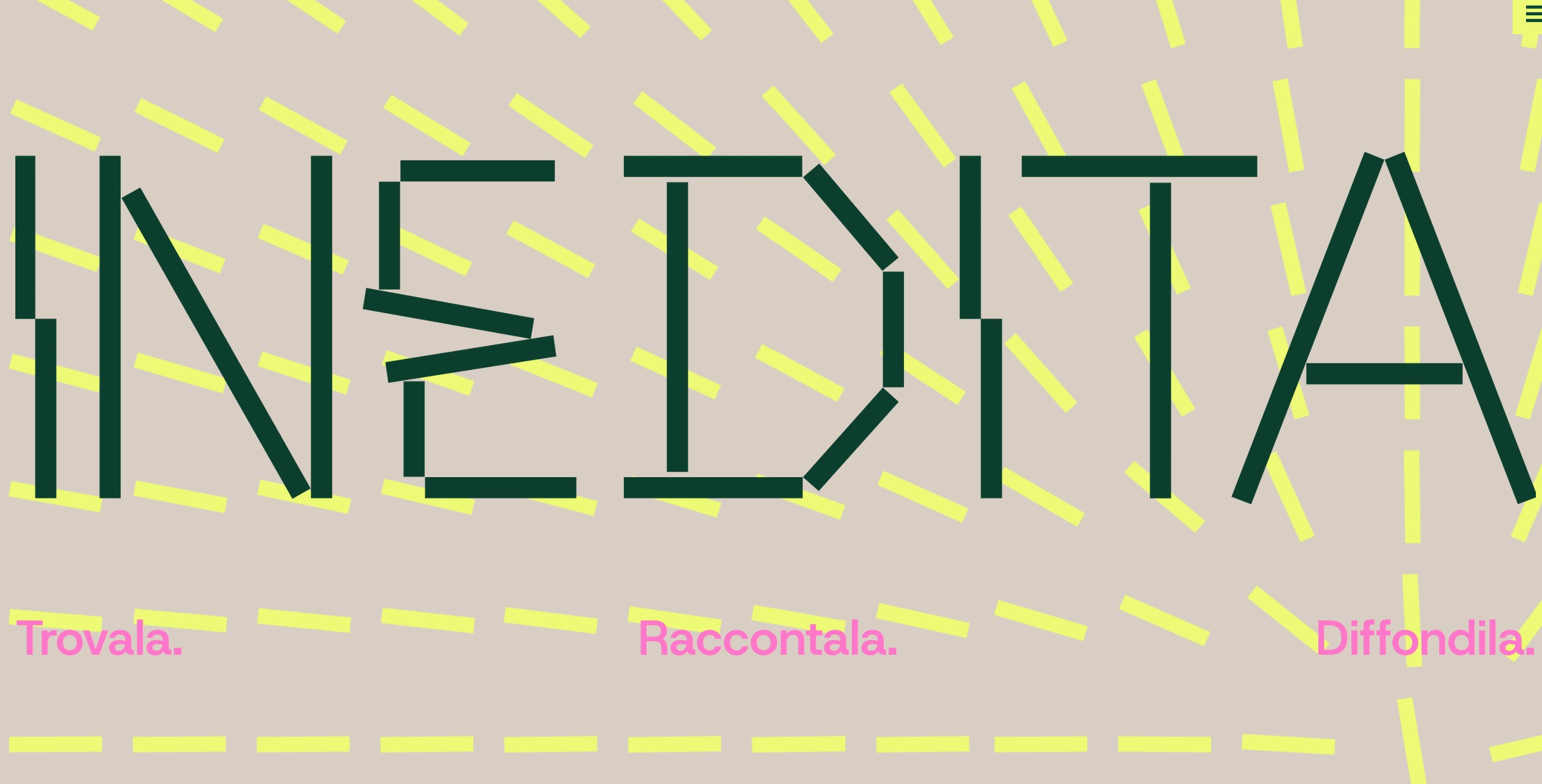
A cooperative that brings students and workers from 43 municipalities between Langhe and Roero into school and into the workplace. A typography workshop in the Agro nocerino-sarnese where, once a month, workers and management decide together in a meeting. A baker and a group of farmers from the Apennines of Bologna who turned a supply chain into a community. These are some of the seven winning stories from the first edition of INEDITA (acronym for Ispirare Narrando Esperienze Di Innovazione Territoriale Autentica), now fully readable on the site inedita.from.cm.
Promoted by FROM (a company specialized in research, social design and communication for urban transformation) with the support of the European Climate Foundation, INEDITA sought for its first edition ecological-transition stories in non-metropolitan territories and entrusted them to young storytellers aged 18 to 40, who inhabit and know those places. The initial call drew sixty responses. The seven selected stories – chosen by a jury composed of Maria Aldera, Giulia Bassetto, Tommaso Ferrari, Gianluca Ruggieri and Emanuela Colaci – were presented to the public on November 4 at Ecomondo in Rimini.
The seven winning stories
Guarene (CN)
“conTrasporto, the community that got behind the wheel“, by Francesco Revello
On the hills of Langhe and Roero, having a car is almost a necessity, and those who don’t drive risk staying at home. conTrasporto, a consumer cooperative and social enterprise founded in 2024, organizes shared trips to schools, work and services in 43 municipalities. Revello follows the people who use it every day, such as Nicoletta, a social care worker at Verduno hospital, who after night shifts stopped driving: “I don’t have to search for parking, I don’t have to worry if I’m tired.” Co-founder Massimo Infunti describes it as: “If a taxi is a fine dining restaurant and a bus is a slice of pizza, conTrasporto wants to be the neighborhood pizzeria.”
San Michele all’Adige (TN)
“Energetica is only the adjective of community”, by the GioVe collective (Giovanni Melchiori and Verdiana Fronza)
The Köncert renewable energy community was born in 2023 in the Piana Rotaliana, with 19 members. In three years the membership has grown to more than 400, with about 1,448 MWh of shared energy and 477 tons of CO₂ avoided. The reportage, built on the voices of councillors Viviana Tarter and Chiara Zanin, investigates the limits and potential of this model: “We were pioneers,” they recount, recalling a period when national regulations still lacked implementing decrees.
Susa (TO)
“T(H)REES. 3 stories from La Foresta“, by Chiara Monzani
In 1995 Giorgio Talachini chose to remain in the Susa Valley and, with his family, founded the La Foresta cooperative. Monzani reconstructs its history by tracing the journey of an ideal wooden cube: from firewood to wood chips, from managing heating plants to selling heat, up to the recovery of timber from the Mompantero forests struck by the 2017 fire. A path that has made the cooperative the first company in Italy to sell PEFC-certified energy.
Nocera Inferiore (SA)
“The Pibiesse Method“, by Rita Cantalino, photographs by Marco Mastrandrea
Mariano Di Palma takes over a historic typography in the Agro, preserving the core of the workers and transforming it into what Cantalino calls a “reversed factory”, with a horizontal organization. Around Pibiesse, the social cooperative Eteria is born, which runs a dispersed reception network for eighty asylum seekers and refugees. “If we managed to do this in Nocera Inferiore, another business idea can be done anywhere,” says Di Palma.
Ferla (SR)
“Counting with the environment. Ferla’s green challenge“, by Elena Cicardo, photographs by Emanuele Lombardi
In 2011 the municipality emerged from a governance crisis with finances in trouble. From there the decision to bring waste, water and energy management back under public control: a green wall that purifies the school’s water for reuse, separate collection, the first renewable energy community in Sicily. “I think changes happen either through furious revolutions or through slow revolutions,” explains the mayor Michelangelo Giansiracusa. “Those slow revolutions are cultural; it takes time.”
Isernia (IS)
“Reappropriating and resisting” by Mattia Iorillo
Iorillo, a historian, traces the watercourses of his hometown to tell how Molise’s resources, from mills to hydroelectric plants, were long exploited elsewhere. The energy communities of Alto Molise and the one started in Isernia in 2025 become the testing ground for a possible reclaiming, with caution: as jurist Maria Difino warns, it is not guaranteed that CERs will be solidaristic.
Monghidoro (BO)
“Looking at bread and fields to build new communities“, by Francesco Pattacini
Everything begins with a question from baker Matteo Calzolari to farmer Luca Minarini: “Why don’t you sow the wheat and I’ll bake the bread?” After years of trials, a community of farmers and processors emerges, today cultivating ancient grains on about 200 hectares under organic management, with an agreed price that pays the growers and allocates a portion to the community. “When we said we’re not just a supply chain but a community, the first reason was that we live here and want to stay here,” says the farmer Marco Lelli.
The next steps of the project
After the publication of the stories and the inaugural event at Ecomondo, INEDITA becomes “live” in the places at the center of these narratives, with “dissemination and exchange meetings” to discuss ecological transition and how these examples are authentic “good practices” that are scalable and replicable.