
Lo Stregone springs from the idea of writing a novel set entirely inside a Michelin-starred restaurant and, during a single night, a night in which the fate of the venue is decided: whether it will stay open or must close.
At the head of the restaurant sits a chef nicknamed “Lo Stregone” for his skills and for his magnetic yet at times sulfurous and mysterious character, around whom something has formed that resembles almost a personality cult.
The first reason that led me to choose this kind of setting is that for a long time I wanted to write a story entirely within a well-defined place, both from a spatial and a temporal point of view. I had in mind books like Yasmina Reza’s The God of Carnage and films like Ettore Scola’s The Dinner or Locke by Steven Knight. Putting an ensemble of characters in a single locale where they must face problems, without being able to escape, is narratively a situation that fascinates me a lot, because it is inherently interesting.
Unity of Time and Space
To manage this tight unity of time and space, I chose to employ a choral narration: each chapter is told from a different point of view, between the kitchen brigade and the dining room, with characters who recur throughout the story.
I had already done this years ago with my debut novel Leave the Chicken Alone and I wanted to return to this technique because it is an effective way to convey the plurality of perspectives. We all share the same world but the readings we derive from it diverge radically: desires, fears, destinies are often completely different. Reality is singular until we enter the minds of human beings, after which it instantly becomes something potentially infinite.
From a narrative point of view this poses a series of challenges: creating systems of values and sensitivities that are expressed through different languages. The most important thing, however, is to maintain the centrality and unity of the story, which, even when told from distinct points of view, must progress in a compelling manner.
Why Haute Cuisine?
The next natural question is: why haute cuisine? At the core of human existence there are few things: life, death, sex, and food. This means that food is not only central to our daily life by necessity, but has always held a central function in religious and cultural symbolism, and that each era says a lot about itself by the way it relates to food. In a sense every human civilization moves from primal need to table virtuosity, and the exact point on this arc tells us a great deal about it and its future.
In recent years, in the West, there has been an explosion of interest in cooking and haute cuisine, with enormous financial outlays in the sector, even from people who probably cannot afford it. It is the explosion of ephemeral consumption, just as increasing difficulties and restrictions are being reported.
Why do so many people seek a deeper meaning in food?
Why this seemingly contradictory obsession? Why do so many people seek a deeper meaning in food, in its transformation and in its form? This is one of the fundamental questions underlying Lo Stregone.
Finally there is the question concerning the main character, the Chef. Who is the principal driver of personality cults and myths that become obsessions and verge into sectarianism? Is it only the prophet’s fault or do their followers also play a fundamental role?
And this perhaps was for me the most important question hidden within the novel. All these issues that one might try to answer by sitting at one of Lo Stregone’s tables.
Provided you can manage to find a seat.

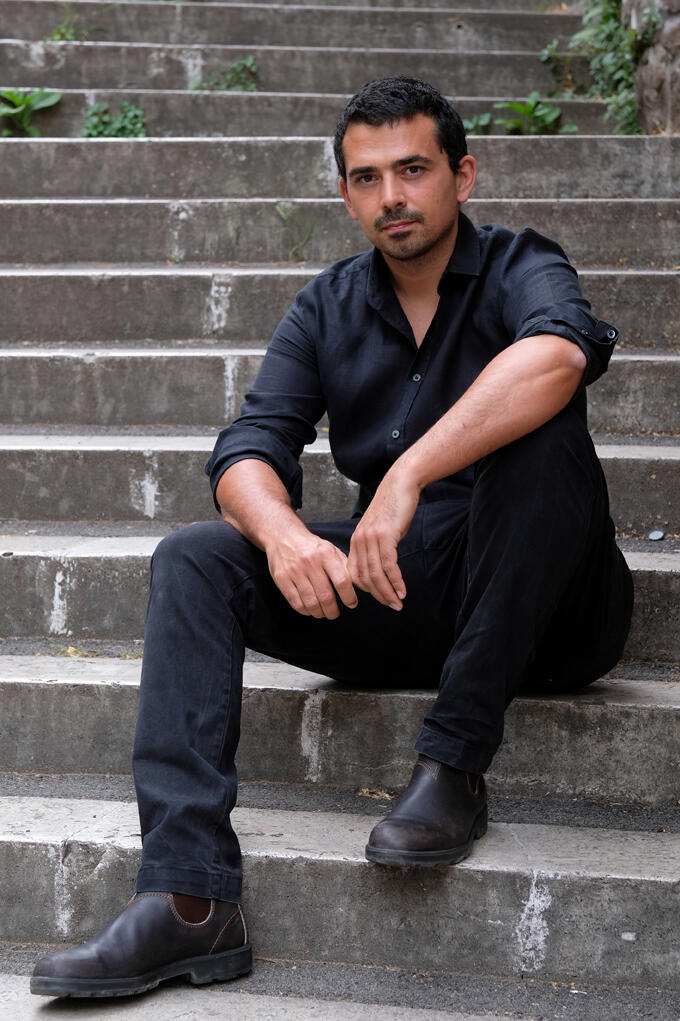
THE AUTHOR – Already the author of Odio (Mondadori, 2020), Il fuoco invisibile (Rizzoli, 2023, shortlisted for the Strega Prize and a finalist for the Grand Continent prize for the best European novel), and previously the author of books such as Leave the Chicken Alone (Bompiani, 2015 and later Oscar Mondadori, 2022) and Storie dal mondo nuovo (Adelphi, 2016), Daniele Rielli, born in ’82, signs for Mondadori a new novel, Lo Stregone, a “polyphonic” work, as described by Antonio Franchini.
Lo Stregone in the title refers to the mysterious Francesco Minervini, a visionary who has changed the way people understand food for some, and for others a “holy man” at the head of a sect; there are those who praise his ability to reach the very essence of life, those who see in him a manipulator, those who remember his first restaurant that went up in flames, and those who would do anything to taste his cuisine.
One thing is certain: the Bíos – his venue – is about to live the most important night in its history, the one that will decide whether it can continue to exist or whether it is destined to disappear, taking with it its founder and its secrets. The decisive hours that make up this novel, though, are not told by the Stregone, but by the members of his crew: Aurora, the head of the dining room who knows the intimacy of every guest; Edoardo, the brilliant and self-destructive sommelier, perhaps the only true friend of the Chef; Monica, the Stregone’s partner and the manager at the head of the fragile empire of the Bíos; Roberta, the young cook who has sacrificed a completely different fate; Mauro, the gutter boy who has fallen into a world he does not understand; Gabriele, who works unpaid for a dream; Luciano, who has had an unexpected second chance and, together with them, an eighty-kilogram wild boar with the sole fault of having taken the wrong path.
At the tables there are those filming for millions of followers, those ordering expensive bottles, and a father and a son who speak to each other without understanding one another, but who end up at the center of everyone’s attention.
The new Rielli novel, also the voice of the interview podcast PDR, is thus a choral work, a game of interlocking pieces based on a highly crafted narrative structure, in which the author varies registers (from the dramatic to the comic, from the psychological to the surreal).