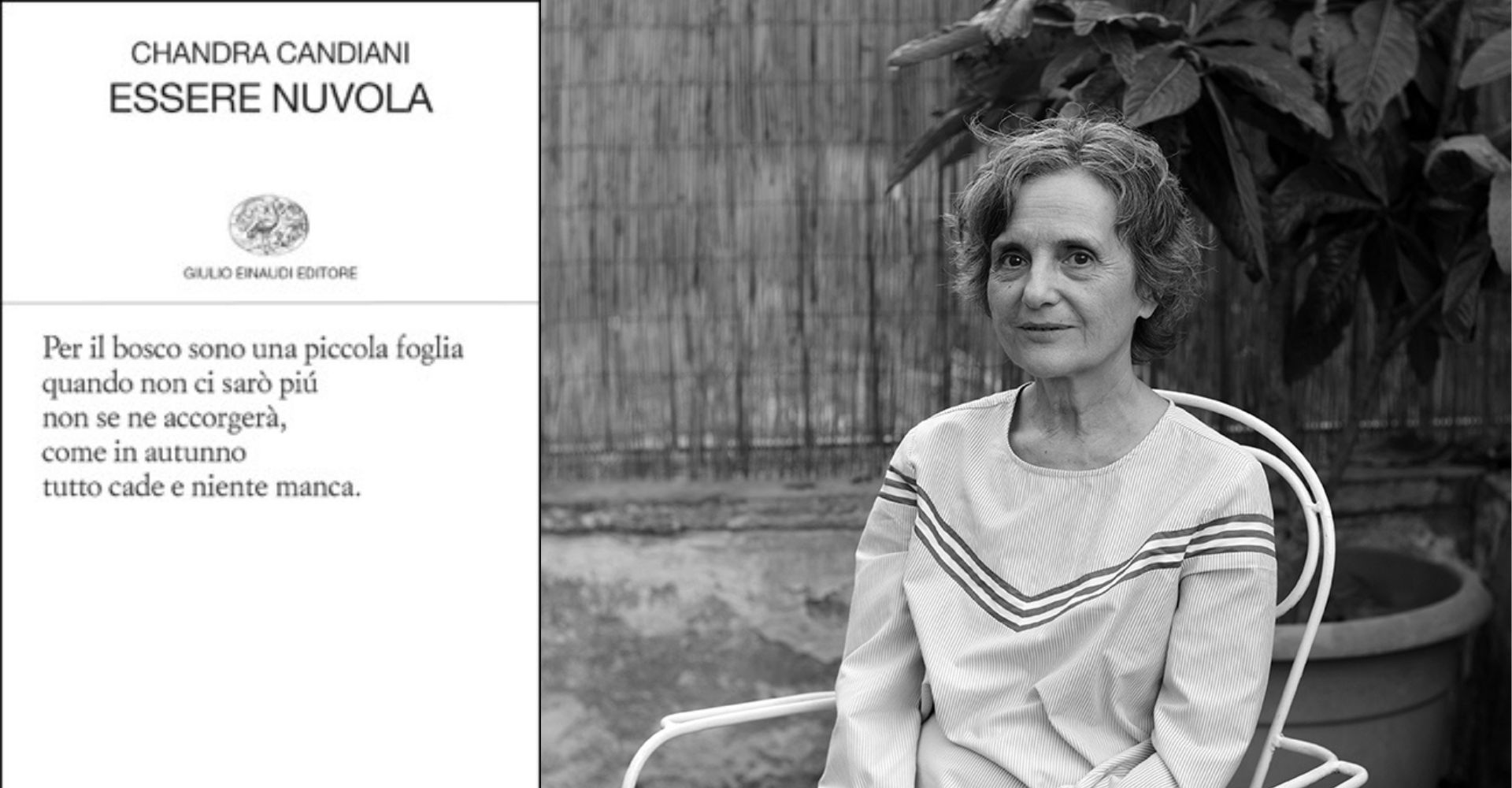
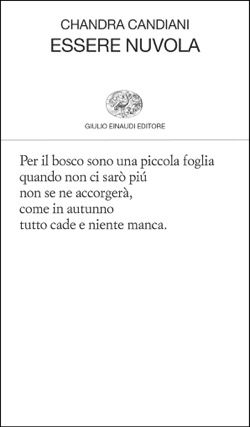
Chandra Candiani returns to bookstores with a new collection of poetry, Being a Cloud (Einaudi), which gathers texts written over three years, between 2023 and 2026, organized into three sections that, as the author herself explains in the interview below, could be defined as themes: “The Dream of Words,” “Lands Beyond Time,” and “The Craft of Breadcrumbs.” Dream, fellowship with nature – understood as animals but also trees – time, neglected childhood and war are the macrothemes that emerge in this collection, but the poems cannot be reduced to them alone.
Candiani, a poet with a gentle voice, has managed, over the years, to gather around her a sizable readership who identify with her verses and with her request for human and natural sharing, a request that remains firm yet delicately voiced. Candiani’s writing moves through essential images that form small life-tales, invitations to inward retreat as a means to then open oneself to the world.

Being a Cloud, as a collection, is characterized by the continual reappearance of animals and natural elements with which her voice identifies and transforms. Western culture often reduces animals and nature to tools, whereas in her writing they become the voice of the soul, entities, oracles that allow, through identification, the telling of different parts of the self. Would you tell me more about this aspect?
“In reality, it is animals themselves, the ones I meet here, day and night, who belong to a chorus, to a community beyond species and definitions. Living in close contact with them, I felt how we belong to a chorus, to a community beyond species and definitions. I recognized in myself the fly, the hare, the badger, the midge, as well as the beech, the larch, the community of trees of which I am a part. A non-anthropocentric vision, into which I entered not only easily, but with relief. Then, of course, they are also symbolic lives, arcana of the tarot deck that every life plays.”
There is a great poise, especially when looking at current events, in this persistent assertion of “being nature” that binds the poems of the collection. The nature conveyed by her words is not tamed; it is fierce. Perhaps it is in this ferocity that one might glimpse a shelter?
“Ferocity is not absent from our world, but what is missing is the awareness that ferocity belongs to all, and there are those who deny it and act on it, and those who, seeing and feeling it inside themselves, choose not to deny it, but neither to act on it. Knowing the ferocity of nature teaches us to see it not as a picturesque backdrop for a photograph or a stroll, but as a living being, with its defenses, its attacks, its inclusions and exclusions. Trees strive for light, for space. Animals prey on one another. Yet there is always a necessity, a vital need. And there are rules written in blood and inherited from which no being, except us, deviates. Living in nature teaches coexistence, the ethics of sharing, not beautifying, feeling one’s own ferocity, precarity, the constant risk of losing and lacking. And above all it makes us feel the Planet and the desire to guard it.”
It also leaves ample space for darkness. A darkness without frightening connotations (once again, one recalls the typical interpretation of Western thoughts), presented as a companion that, like light, walks beside. It seems there is an invitation to inhabit the darkness, to welcome it. What can this darkness convey?““Darkness is the inner life of light,” says one of my lines in Being a Cloud. In tragic times, comforting messages surface, hymns to light, to peace, to the beauty of life. I believe, instead, that it is our duty to know the darkness that inhabits us, the evil that exists in anyone, and the possibility of transformation that it carries. Knowledge is the only path that leads out of the darkness of violence; ignorance is the most destructive poison that exists, meaning to ignore the other and ourselves, not recognizing that we are made of the same matter, but in a different form, to hate and fear differences, rather than understanding how creative they are, and that respecting biodiversity, including human biodiversity, is the first step toward a possible wise peace.”
The darkness, the perception of being animals, are all aspects tied to another important thread running through this collection: the dream. Dream as manifestation, as guide, as rooting. What is the source of this reflection on dreams?
“Dreams, like poetry, are not programmable, they are not made ‘on purpose’; rather, they shape us. We come to know ourselves in dreams, we come to know ourselves in verses, we discover what we do not know. There is always a leap, a gap, between rationality and dream or art; there is a void that startles. The dream is a form of art. When I do not remember my dreams I feel poorer, lonelier, a large part of me remains distant—what have I done? Come home, Chandra.”
In these poems there resounds both a strong individual awareness and a strong awareness of “being the world.” How did the sense of rootedness in your poetic and spiritual path develop?
“I believe that individual awareness leads to awareness of being a community, of being the world. If you are not there, you cannot be there for others either. When there is a known, intimate self, there is also the other. I did not feel I belonged to Milan, or to cities in general. In the forest I feel part of a community, and the people I choose to see are often outsiders, who live within the confines of conventions and seek something else. Thus, poetry reflects this shift. There are many worlds; in cities we think we are the only ones who inhabit and socialize, but that isn’t so. Here I learn the solitude from which to begin to meet others, without ignoring them and without dissolving into them, without losing myself. Here I learn the biodiversity of humanity amid that vegetal and animal life.”
How do you relate to poetry today?
“Poetry remains my mysterious voice and the mysterious voice of others. I need it: to read it, to write it, to orient myself without conforming, to allow it to arrive, to learn to be actively passive, aware and awake, waiting for a gift. A gift of words that make you shudder when you read them, when you write them.”
In your poems you have always accorded great dignity to childhood and to that “child part” that persists into adulthood. Children reappear in Being a Cloud, taking on the voices of ancient sages, of messengers. What do they represent?
“The childhood that I experienced determined almost my entire life; it was extremely difficult, adults were a danger, and I chose to preserve it for life, to safeguard its way of knowing—tiptoeing, stumbling in the dark, glimpsing the arrival of light. In Being a Cloud the children are the future that no longer wants to be massacred, that wants to live, to speak, to count. They are the heirs of the dream. They dream of non-war, non-death drowning because they were not awaited, rejected; disappearance. They do not smile anymore; they are chests of endangered values.”
The human being that emerges from these texts seems to be a human who is somehow “unified,” where masculine and feminine, childhood and adulthood, are an indivisible whole. What does this idea of humanity represent for you?
“It is the daily and nightly effort not to despair, not to yield, to cultivate trust at any cost. In what? I don’t know. Pure faith in being, in our true nature, in not having been born to destroy, in still being able to till the earth and the soul, in knowing that there is an over-self, a space where we can look each other in the eyes, listen to ourselves, speak true words, not divisive, share differences without colonizing ourselves, knowing that the human is only one tile among many in an endless, boundless cosmos.”
What is the tripartite structure of the book aimed at?
“I never start from a plan. The poems of Being a Cloud, born over three years, are the ones that felt most mysterious to me and free from intention. When I sense that the writing phase is finished (and you can feel it), after reading them again, cutting them, discarding them if they no longer sounded right, washed, scrutinized in their details to see if every word was faithful to the whole, I often discover that there are threads, themes, like musical motifs, that recur and connect some poems and not others. Then I collect the poems not in chronological order but following their more or less evident theme. These are months of work. In this book, I noticed that there were words as a theme, but words as beings that dream of reaching, of speaking despite the human drift in which they find themselves, of not hurting but not staying silent in the face of wrong” and I gathered them in the section ‘The Dream of Words.’ There are dreams born from the words themselves that seek to inhabit the new woodland environment, there are words that fall ill and fall silent, there are words that feel utterly poor in the face of the world’s pain, as well as before the grass of spring, and still they try to speak.”
The second section is “Lands Beyond Time.”
“In ‘Lands Beyond Time’ are my metamorphoses into animals and trees, the attempt to meet them fully, in the heart, without the aid of words. And there is an archaic time in which they exist, a land that belongs to no time, a threshold that opens to the origin and from which one can also see the limit, the end of time. The third section, ‘The Craft of Breadcrumbs,’ speaks of war, of the children who were killed, of their dispersed community, fractured by a treaty that precedes us: do not kill, above all do not kill the innocent. There is the inability to trust even what one sees, much less what one says. How can you trust a gaze when your home can, in a few moments, become a pile of rubble? I write about the crafts that children can never perform; they can only walk on tiptoes along the edge of seconds, waiting for a time that is slipping into crumbs. Being crumbs is their only occupation. And, of course, there is my own ‘crumb-ness,’ the feeling of being without a whole loaf, yet knowing that there is something there.”