
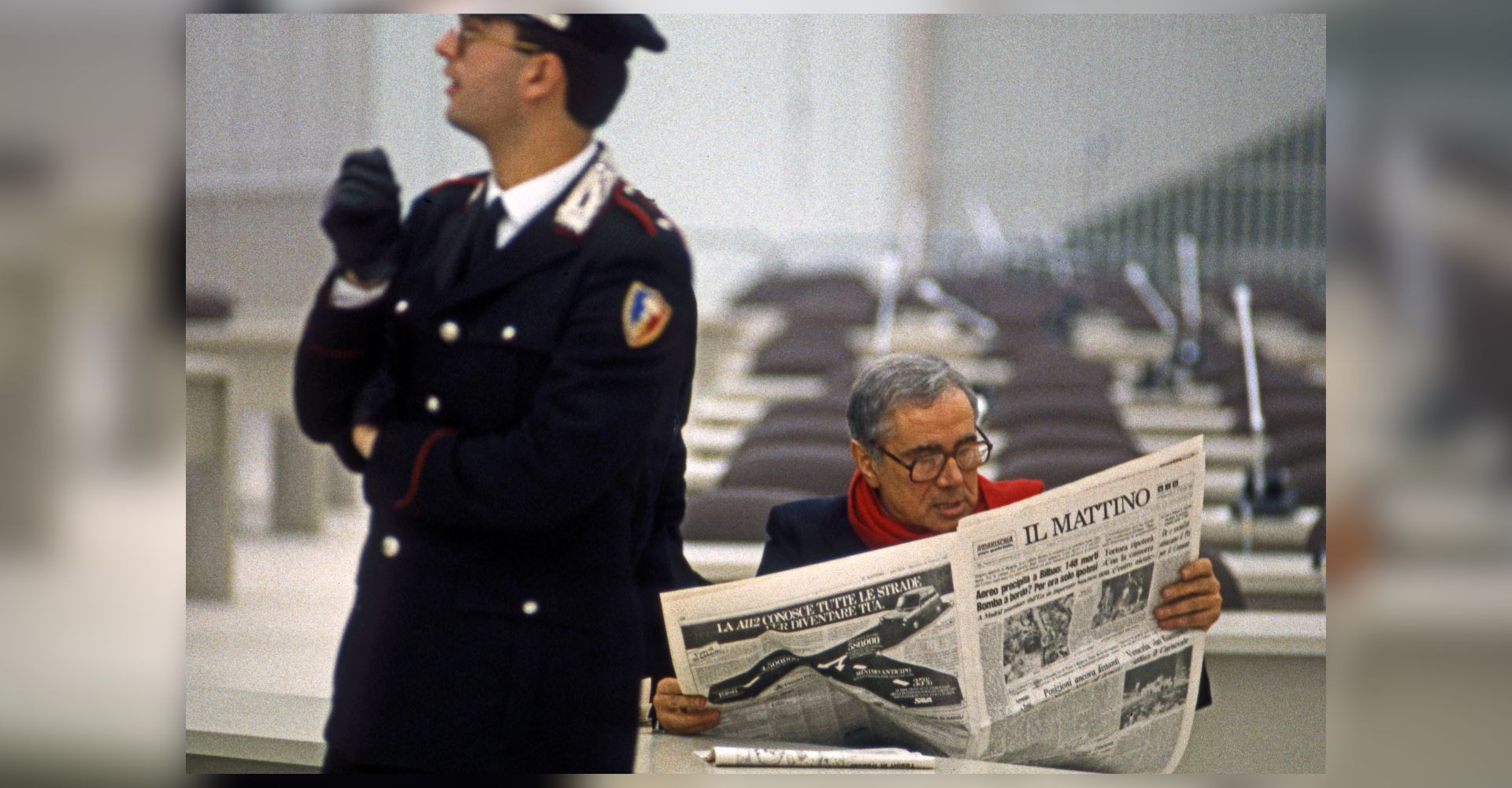
It was June 17, 1983, when for Enzo Tortora, television host, screenwriter, and journalist, a judicial calvary began that would only conclude in 1987, just before his death, a saga that has lately resurfaced in connection with the release of the miniseries Portobello, directed by Marco Bellocchio.
Tortora had become one of the most recognizable faces on Italian television: he hosted a cult program, Portobello, considered the forerunner of 1990s television. Broadcast by Rai on Rai 2, it offered announcements, inventions, and deals, with spots that later entered the collective imagination, achieving audiences that would be unimaginable today.
Then came that fateful day, June 17: the Tg2 announced that “Enzo Tortora has been arrested in one of Rome’s most luxurious hotels, the Plaza; an arrest warrant mentions suspected membership in the Camorra organization Nuova Camorra Organizzata.”
Thus began a long judicial case (during which the presenter would also be imprisoned) that would reach its end only in 1987, when the Court of Appeal of Naples definitively acquitted him.
The Tortora Affair

Guido Vitiello, professor at Sapienza University in Rome, essayist and collaborator of Il Foglio, for which he runs the column The Bi and the Ba, dedicates the essay The Tortora Affair to this episode. Published by Feltrinelli, the book follows the case as “a great allegorical drama in which Italy reflects itself at a pivotal moment in its history.”
Vitiello – who teaches Film Theory and Audiovisual Studies and who has published, among others, The Reader on the Couch – Tic, Manias and Oddities of Those Who Love Books (Einaudi, 2021), Happy Reading – Conversations with Marcel Proust on the Art of Reading (Il Saggiatore, 2024) and Unleashed Joker – The Dark Side of Humor (Gramma Feltrinelli, 2025) – retraces, “with a tight chain of marginal notes and digressions,” all the pivotal moments of the affair, from the arrest to Tortora’s death.
A research that begins from “unusual documents”
The author’s aim is to illuminate not only the judicial and political facets but also the linguistic, social, and anthropological ones. To do this, Vitiello does not start from crime reports and court documents, but from “unusual documents,” such as newspaper clippings, correspondence, memoirs, photographs, even the poems of Camorra turncoats, which he examines with philological interest.
At the center is the figure of Enzo Tortora, a well-known and appreciated figure, but also a symbol of “an outdated survival of an idea of Italy long cherished and never truly realized,” the host of a program that Vitiello describes as “a Gozzanian drawing room of good things of dreadful taste.”
The professor stresses how Tortora, accused of being a Camorrista and a drug dealer, managed to endure the ordeal by clinging to his master tree, that of literature: Sophocles, Alessandro Manzoni, and Joseph Roth helped him find the words to “name the absurd” that was overwhelming him.
But the author’s reflection does not stop at the analysis of the judicial case: Vitiello shows how the affair opened the way for Italy as we know it today, in which the “media-judicial circus” has become “our fait social total par excellence, the drop in which all our ills are reflected.”
“And I want this uncivilized story to reach not only the Court of Cassation but even Paradise,” remarked the secular Tortora in the weeks following his acquittal, almost indicating, as the ultimate tribunal, the celestial ceiling of ancient iconography. There is in this proclamation an echo of the biblical Job: “O earth, do not cover my blood, and may my cry have no rest! Behold, my witness is in heaven, my advocate is there above; my accusers are my lamentations before God” (Job 16:18-20). Throughout the affair, indeed, a disturbing theological undertone had lingered behind the surface of the chronicles. Once he entered prison, in June 1983, Tortora sensed that he had been cast in a sacred, blasphemous representation—a morality play without a morale, a parable of wisdom devoid of any real wisdom; and he promptly decided, with a scholar’s pride, what role he would enact in the drama.
His first identification was with Job, the righteous servant whom God tests by placing in the care of Satan, the Accuser, who will strip him of wealth, honor, and health. But he did not choose the biblical Job for himself. He sought his stage costume in the literary wardrobe of the finis Austriae, tailored by the tailor he most revered: “Joseph Roth’s Job must come to my aid,” he wrote in one of the early prison letters to his daughter Silvia. And indeed Roth’s Job suffers under a god who is a merciless inquisitor, cruel as a isprawnik, a czarist district police chief: “If you observe the laws, you do so only for your own benefit. And if you break even one commandment, he persecutes you with a hundred punishments. If you try to corrupt him, he brings you to trial. And if you behave honestly toward him, he lies in wait to corrupt you.”
In the face of his Inquisitor, Tortora would summon the same virtue as the biblical Job; but it is not patience in the sense of a timeless virtue. The patientia with which Saint Jerome’s Vulgate translated the Greek hypomoné of the Epistle of James paved the path in popular devotion for confusing Job’s endurance with the resignation preached by the more compliant Catholicism. Yet hypomoné stands for tenacity, perseverance. Some translate it as militant patience.
Copyright: Giangiacomo Feltrinelli Editore Milano
First edition in “Feltrinelli Gramma” November 2026
(continua in libreria…)
