
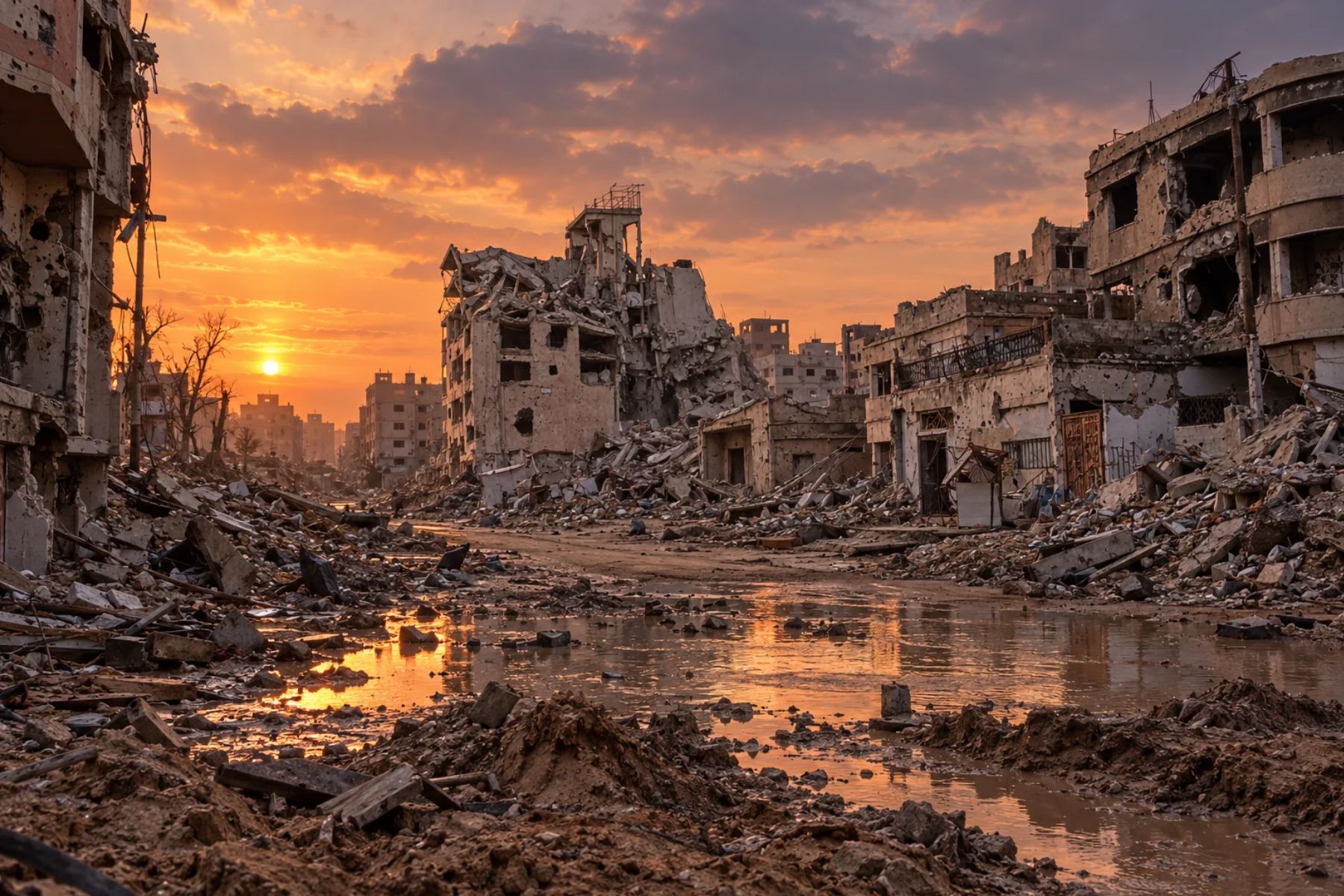
Jean‑Pierre Filiu, The Strange Blindness: How the Great Powers Create a World Without Rights, Les Arènes, 01/10/2026, 192 pages, €19.
A former diplomat in Jordan, the United States, Syria, and then Tunisia, an adviser to Pierre Joxe and to Lionel Jospin before teaching at Sciences Po, Jean‑Pierre Filiu looks at what he analyzes—from insurgent Aleppo in 2013 to Gaza, where he spent more than a month living with Doctors Without Borders when the press was banned. The Strange Blindness demands a different kind of courage, the courage to argue that by consenting to the annihilation of Gaza, the great powers are manufacturing a world without rights, for which Ukraine pays the price.
Two Red Lines and an Absolute Evil
The title hints at, without the author claiming it, The Strange Defeat, Marc Bloch’s 1940 work written as a historian who witnessed a collapse. Jean‑Pierre Filiu, who was a historian in Gaza and remains so in his writing, adopts this role. His preface repeats in anaphora that he left the enclave on January 21, 2025 and has not returned.
The argument begins in Damascus in August 2013, when Barack Obama, who had made chemical weapons his red line, stood by as the Ghouta bombardment went unanswered. Vladimir Putin took note six months later by seizing Crimea. Joe Biden faced the same affront in May 2024 when Benjamin Netanyahu sent his tanks into Rafah. Filiu is right to view these two democratic backslidings as the matrix of the present chaos, for they twice opened the way to Donald Trump’s demolition project.
Netanyahu had forged from 1979 the rhetorical weapon of impunity by casting terrorism as an absolute evil. The Nazification of the Palestinians, which he sharpens in 2015 by attributing to the Mufti of Jerusalem the inspiration for the Final Solution, seems more successful, notes Filiu, than the Nazification of Ukrainians, branded neo-Nazis by the Kremlin since the Maidan revolution. Netanyahu and Putin rewrite World War II for their own purposes, in a nostalgia for a pre-1945 world left to brute force. The essentialization of terrorism condemns Israel to a military response. The “total victory” promised by the Israeli prime minister slips away, so that the war, now perpetual, seeks an internal enemy even inside the independent press and among judges.
The rumor of forty decapitated babies gains the blessing of Joe Biden himself. The author recognizes the Kremlin’s method, whose propaganda in 2014 invented a child crucified by supposed Ukrainian Nazis, while Palestinian dead are relegated to cronies of Pallywood, that imaginary studio where one would cry for plastic dolls.
Hind Rajab was five years old. On January 29, 2024, the vehicle in which she fled with her family from a Gaza neighborhood under attack was strafed by an Israeli tank. Still alive, the girl spoke for hours with the Palestinian Red Crescent, whose rescuers waited for the army’s green light to rush in. The ambulance finally permitted to depart was struck on arrival. Twelve days passed before nine bodies were recovered and three hundred thirty-five bullet holes were counted in the hull. The army had denied for two and a half years that its troops were within firing range. On August 19, 2026, too late for the May-drafted book to report it, it acknowledged that its soldiers had fired on the car and opened a military police inquiry.
Two-Headed European Hemiplegia, or the Faustian Pact
To denounce today the exactions of the Israeli army exposes one to charges of anti-Semitism. The Strange Blindness feeds on this gag, which prolongs Gaza’s closure to the press by redirecting horror reports to the ancient slander of ritual murder. The mechanism, Jean‑Pierre Filiu knowingly dismantles, having been accused as early as 2012 by a polemicist of spreading a modernized version of ritual murder for Zebda’s song about a Gaza child killed by Israeli fire. From the fate of twenty thousand children killed, the debate slides toward the motives attributed to those who report them.
In turn, the Israeli government and its allies label anti-Semitism the International Criminal Court, the UN, Josep Borrell, and Greta Thunberg. The same government, whose hostility to Muslim immigration brings it closer to the European far right, features Jordan Bardella and Marion Maréchal at its Jerusalem conference against anti-Semitism, in March 2025. The conflation undermines the fight against real anti-Semitism, as shown by Gabriel Attal’s appearance at Sciences Po in March 2024. It is, for Filiu, a media coup aimed at a phantom anti-Semitism, while the force currently undermining French society calls for a real and very firm fight.
The blindness extends to a servile Europe, which refuses to see that by abandoning Gaza it weakens Ukraine. Recent history has vindicated Jean‑Pierre Filiu. His warning of December 31, 2023, that Europe’s future would be decided the following year in Gaza, drew skeptical sighs from jaded geostrategists.
Ursula von der Leyen proclaimed on October 13, alongside Netanyahu, the right and even the duty of Israel to defend itself, at a moment when six days of retaliation had already killed as many children in the enclave as eighteen months of Russian aggression in Ukraine. Filiu calls this state hemiplegia, where one half of Europe’s body fights for Kyiv while the other stiffens in front of Gaza. Three sanctions rounds struck Russia within a few days in 2022, while the EU–Israel association agreement, founded on respect for human rights, remained intact after two years of a war of annihilation. The International Criminal Court’s arrest warrant for Vladimir Putin was hailed in European chancelleries, but France invoked Netanyahu’s immunity, since November 2024 facing heavier charges.
In 2025, Gaza and Ukraine become entwined in a textbook case. On February 28, the White House set a political trap for Volodymyr Zelensky. Two days later, Netanyahu suspended humanitarian aid to the enclave with the Union silent, and Washington then halted arms deliveries to the Ukrainians. In Kyiv, Filiu has witnessed this shift of a U.S. administration resolved to humiliate Ukraine to please its aggressor. Christian Zionists, fundamentalists who believed the 1967 conquest fulfilled the prophecies, had frozen military aid to Kyiv at Congress the previous year so that the Gaza offensive would proceed before the Ukrainian front.
By its silence on Gaza, which over a thousand of its officials equated with complicity, Europe believed it could buy U.S. support for Ukraine. It paid this Faustian pact with its principles, to the point of hearing the President of the Commission, cited in the book, declare Europe’s guardian role of a vanished world to be over. The protector bought at this price, unable to contain Netanyahu’s hubris, follows him into the war against Iran. Gaza, writes Jean‑Pierre Filiu, holds up a mirror to Europe. A serious book, The Strange Blindness holds this mirror firmly, with a courage Europe has lost. The fate of our eyes rests on whether we finally open them.
The article L’étrange aveuglement et la ruine du droit international appeared first on Lythrum Press.
The article ‘The Strange Blindness and the Ruin of International Law’ first appeared on Mare Nostrum.
