
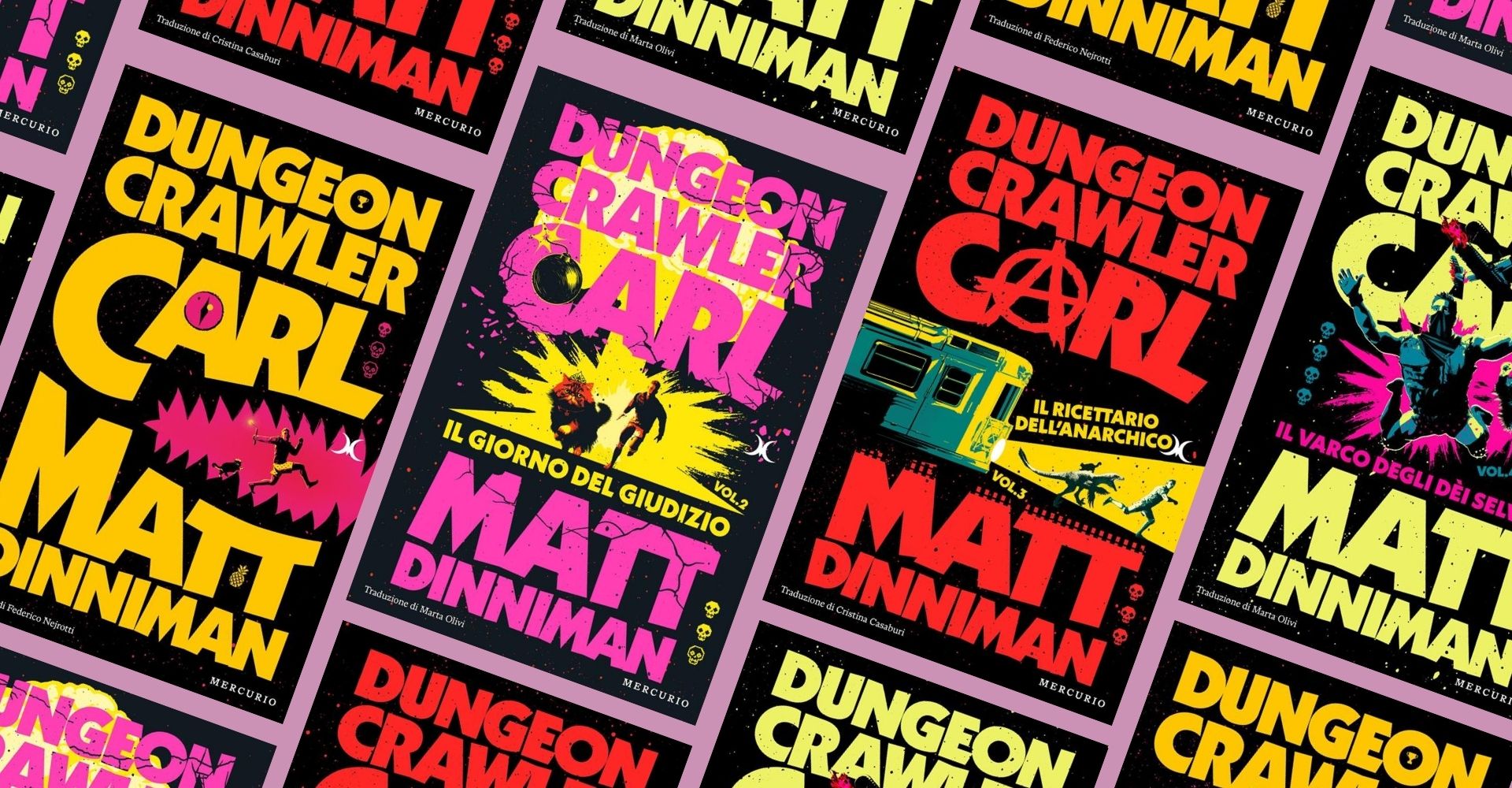
A man in his underwear, a sulky Persian cat, and the end of the world. Here is the premise of Dungeon Crawler Carl by Matt Dinniman, a new curious publishing case. A story born as a game and now steadily among the New York Times best-seller lists, translated into several languages, and which even in Italy, published by Mercurio, is enjoying its success. The site Gamereactor speaks of “over 14 million copies worldwide.”
But how did Dungeon Crawler Carl come to be?
The short answer: a lot of perseverance and a touch of luck.
The long answer? Raised across the United States due to his father’s military career, Matt Dinniman has been passionate since a very young age about writing fantastic stories, fantasy and horror, and already during high school he wrote his first book. Over the years he publishes several works, but without great success, to the point of having to earn a living as an illustrator at the country’s cat fairs. Leaving writing as a hobby.
In 2019 he begins writing Dungeon Crawler Carl on Royal Road, an online platform for fan fiction and short stories, and then the Covid-19 pandemic hits and Matt finds himself without a job. It is thus in 2020 when he decides to self-publish on Amazon the first five volumes of the man’s adventure and his cat, who try to survive the destruction of the Planet.
Thus comes the first real success, and then with the audiobook version Dungeon Crawler Carl becomes an unstoppable voice that attracts fantasy readers and beyond. From that moment it is only a crescendo: Dinniman keeps writing, opens a space on Patreon through which fans can choose some details of the story and the Ace imprint (of the Penguin Random House group) offers him a contract.
Role-playing game or novel?
At the center of Dungeon Crawler Carl we meet Carl, a former coast guard who one night finds himself on the street to recover Princess Donut, the cat of his ex-girlfriend, who cannot (or will not) come down from a tree. It’s precisely this small mishap that allows them to save themselves: an alien race is invading Earth and to do so it wipes out 99% of terrestrial life…
Dinniman uses this apocalyptic event to tell a grotesque and action-packed story, in which the few survivors find themselves inside a labyrinthine complex, the Dungeon, filmed by the cameras of an interplanetary reality show: modern gladiators, who entertain and amuse alien races never seen before.
Monsters, traps, sponsors and time-pressured escapes animate the narration of the three volumes already published in Italian (after the first came The Day of Judgment and The Anarchist’s Cookbook) and of the eight in total, showing the vitality of a genre that has so far remained niche, the LitRPG or literary role-playing game. In the books nothing is left to chance, and the author himself reveals owning “over 240 Excel sheets to keep track of every detail,” from NPCs (non-player characters) to inventories and encounters.
But what further distinguishes Dinniman’s writing is the use of terms and imagery that hark back to role-playing games, with more or less direct references to the worlds of Dungeons and Dragons and Pathfinder: from boss fights to the accumulation of experience points, from goblins and taverns to menus with statistics and weapons in hand. All of this described with a simple and entertaining language, in which satire toward the world of show business and entertainment is not missing.
Moreover, if on the one hand Dinniman has quickly become a well-known name in this relatively young strand (and very often found online), on the other hand the role-playing game has been enjoying a positive moment for some time, consider the success of Critical Role, from whose YouTube campaigns some animated TV series have been drawn, and the Italian project InnTale, able to transform online sessions and the characters played into comics and stories.
Looking at works that in some way are close to the taste of Dungeon Crawler Carl and that, to varying degrees, inspired it, one cannot fail to mention The Hitchhiker’s Guide to the Galaxy by Douglas Adams and Ready Player One by Ernest Cline: books that speak the language of nerd culture and turn those references into narrative material that is today pop. Of course, with Dinniman the picture is enriched with a greater videogaming component, which experienced players will appreciate and those who aren’t will learn about together with Carl, a “Virgil before letters” of this strange universe.
There is also no shortage of recognition of certain traits that have become famous within the Hunger Games saga: survival as spectacle, sponsors who intervene in the lives of contestants, and political interest in the deadly game.
New releases and adaptations
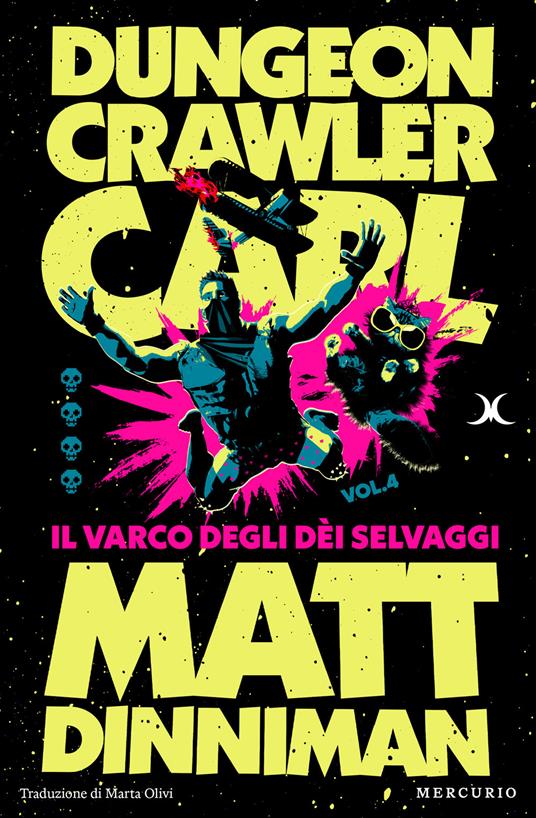
In Italy, on October 27 Mercurio will publish the fourth volume of the saga – The Gate of the Savage Gods –, while Dinniman is at work on the ninth and tenth book, stating that not even he knows how the adventure of Carl and the cat Princess Donut will end: “I don’t know, I don’t plan my stories, I have no idea how it will end. I’m excited to find out as much as you…“. Regarding the plot of the new book (translated by Marta Olivi), the two protagonists will face flying fortresses, warrior gnomes and a survival race that also includes unsuspected and entertaining alliances.
We should also note that a live-action TV series has been announced for Peacock, with Christopher Yost (the screenwriter of Thor: The Dark World and Thor: Ragnarok) and Eric Heisserer (known for Arrival and the series Snowpiercer) at the helm. The production company will be Fuzzy Door, Seth MacFarlane’s label behind Family Guy and American Dad, as well as, more recently, the sci‑fi comedy series The Orville.
