A lone man sits reflecting on the edge of the bed, his gaze fixed on a glass of water whose surface trembles. The light of early morning filters through the curtains. The man is forty years old, a father, and by profession a kettle-maker and tin smith. Slowly he rises from the mattress; in recent weeks he has been prone to dizziness, he senses the danger of falling, the terror of plummeting. He plants his feet firmly on the floor, takes a brief step. From the kitchen comes the clink of plates and glasses: Juliette is preparing breakfast. The fear of opening the door, of leaving the room, of reaching his family, grows as the lucid and chilling awareness of his firstborn’s death returns.
Hugo was fourteen, attending the school in Saint-Nazaire; his favorite subject was art education, but he concealed from his parents his deep cultural sensibility. He borrowed books from the library and had in his room a poster of Rimbaud, the French poet whose existence his father did not know about.
Perhaps they shouldn’t have accepted, the man now reproaches himself as he looks at a white shirt; perhaps they should have preferred isolation. The wife, instead, had looked with hope toward the “white march,” the long procession that day would cross the port city. As the local daily noted that morning in a brief item, the march had been organized “in memory of the student, exactly one month after his disappearance.” That day, more than a thousand people—men and women, girls and boys—would take to the streets to show their closeness to Hugo’s family, a psychologically fragile boy who, after repeated verbal and physical attacks from his schoolmates, had decided to end his own life.
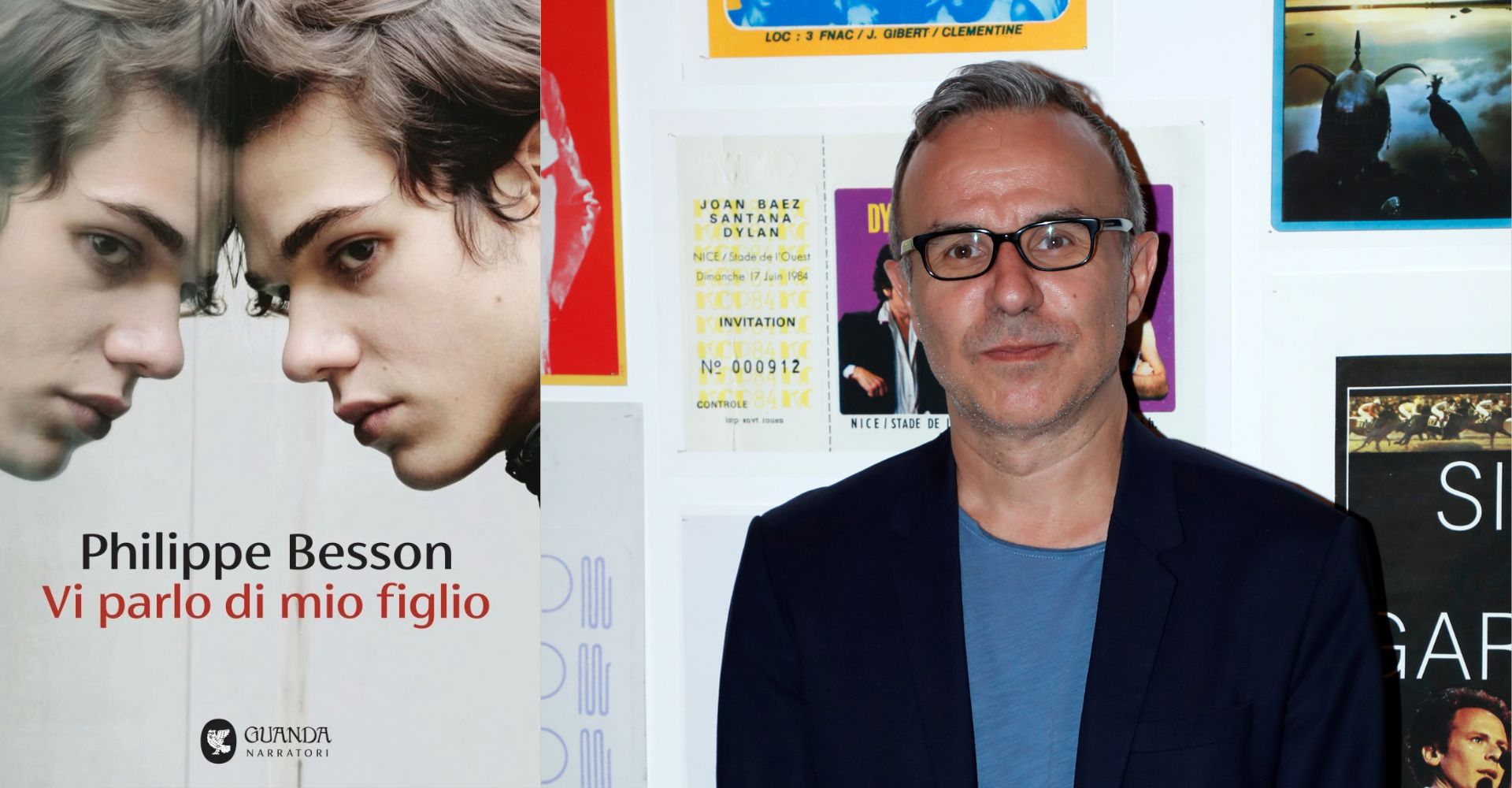
A defenceless father, a suicidal son, a silent social violence called bullying, lie at the heart of I Talk About My Son, Philippe Besson’s new novel, published by Guanda in a translation by Leila Beauté.
Born in 1967 in Barbezieux-Saint-Hilaire—a town in southeastern France—Philippe Besson is a writer, playwright, and screenwriter. Author of more than twenty novels, he made his debut in 2001 with En l’absence des hommes (A Friend of Marcel Proust, Guanda 2005, translated by Francesco Bruno), a story of a homosexual love set during World War I. In the same year, Son frère was published, from which a film adaptation won the Silver Bear at the Berlin Film Festival. In 2017 he published Arrête avec tes mensonges (Don’t Lie to Me, Guanda 2022, translation by Leila Beauté), a book surprisingly gone “viral” on TikTok in recent years. It is a novel focused on an unexpected encounter with a young man that leads the author to revisit his first great love of adolescence. A tormented homosexual relationship that, in early 1980s France, had to be kept hidden, something that required careful vigilance. “Later I will write about lack. About the unbearable deprivation of the other. About the misery caused by this deprivation; a misery that gnaws at you,” the writer writes in Don’t Lie to Me.
The sense of absence, the void and desolation return to the center of his new book, confirming the terrain of inquiry in Besson’s fiction.

In his previous novels, he has repeatedly given voice to the homophobic insults he received as a teenager. In recounting the discrimination inflicted on Hugo—an invented character—has he revisited the past? And how do fiction and his personal story intertwine in the writing of the book? “Writing this story inevitably brought me back to the taunts and homophobic insults of my own adolescence. I recall the impotence when I could not defend myself, the inertia and the silence that ended up magnifying the humiliations. At the same time, the memory of the past intertwined with the testimonies of girls, boys, and parents encountered through associations engaged in the fight against bullying.”
How do social expectations of masculinity condition fathers’ reactions after their children are attacked? “From meetings with the parents of associations, the sense of guilt and the fathers’ anger emerged from the start. It seemed they reproached themselves for failing to live up to the duty society assigns to them, namely the protection of their own family. Unable to forgive and to bear their own powerlessness, many men react with anger, confronting and settling scores personally with those responsible for the violence.”
Facing Hugo’s parents’ demand, the principal refuses to take disciplinary action against the students responsible for the attacks. What should be today the role of the school institution in preventing bullying and, more broadly, any form of social discrimination? “It is essential to organize school programs that give voice to teenagers who suffer abuse, guiding them and offering them solid psychological support. In some French schools, these interventions have proven effective. However, at least in France, the school for a long time preferred to turn a blind eye to the problem, ignoring it and reducing it to simple playground quarrels. In many situations, it proved unable to take a stand—whether to believe the victims or to grant the perpetrators the benefit of the doubt—and to adopt specific disciplinary sanctions. Finally, it has often withdrawn from its social responsibilities, arguing the impossibility of intervening in the realm of social networks, where humiliations often continue even outside school hours.”
Where does youth anger come from, which erupted in the recent student protests across France? “The younger generations have lost faith in the school and in its promise of emancipation through knowledge. Across the country, many schools are dilapidated; many students live in socio-economic precarity and struggle to find housing to continue their university studies. Young people feel part of a sacrificed generation not supported by institutions, which prefer to fund pension-age segments of the population.”
In the book, a large portion is devoted to the world of social networks and the constant violence to which virtual reality subjects the adolescent. To tell these themes, did he need to do research? “Yes, at length. Parent associations showed me videos posted on TikTok and conversations on WhatsApp and Instagram. I was deeply struck by the extraordinary violence, without inhibition, as if one were allowed to say anything and to make the other suffer any abuse with total impunity. I became convinced of the need to introduce stricter regulations, from banning mobile phones below a certain age to requiring the web giants to take responsibility for their actions.”
What is his relationship with social media? “I prefer to keep away from them. I’m on Instagram and Facebook, but these are professional accounts, managed by my publisher.”

I Talk About My Son

Not Just a Matter of News

The Night Lies

A Certain Paul Darrigrand
The Last Son

Don’t Lie to Me

An Italian Boy

And Will You Come On Other Evenings?
How a Love Ends
After the publication of the book, has he taken the novel into schools or is he in contact with parent associations?
“Yes, on many occasions, whenever I have been invited. The meetings have always been deep and emotionally intense.”
Many of his novels revolve around enforced silence, the taboo imposed on the victim, a condition he himself experienced during adolescence as a homosexual in a small town in southeastern France. How does writing today serve as a form of self-revelation and a tool of denunciation?
“Writing allows one to process one’s sufferings and can contribute, at least in part, to healing wounds. It is also an opportunity to bare oneself, to give a part of oneself and let it go to readers.”