
Napoli has long stood among the most sought-after tourist destinations for travelers, both Italian and international. The city, after all, carries a rich tradition of storytellers who have depicted it, whether from a tourist perspective or a narrative one.
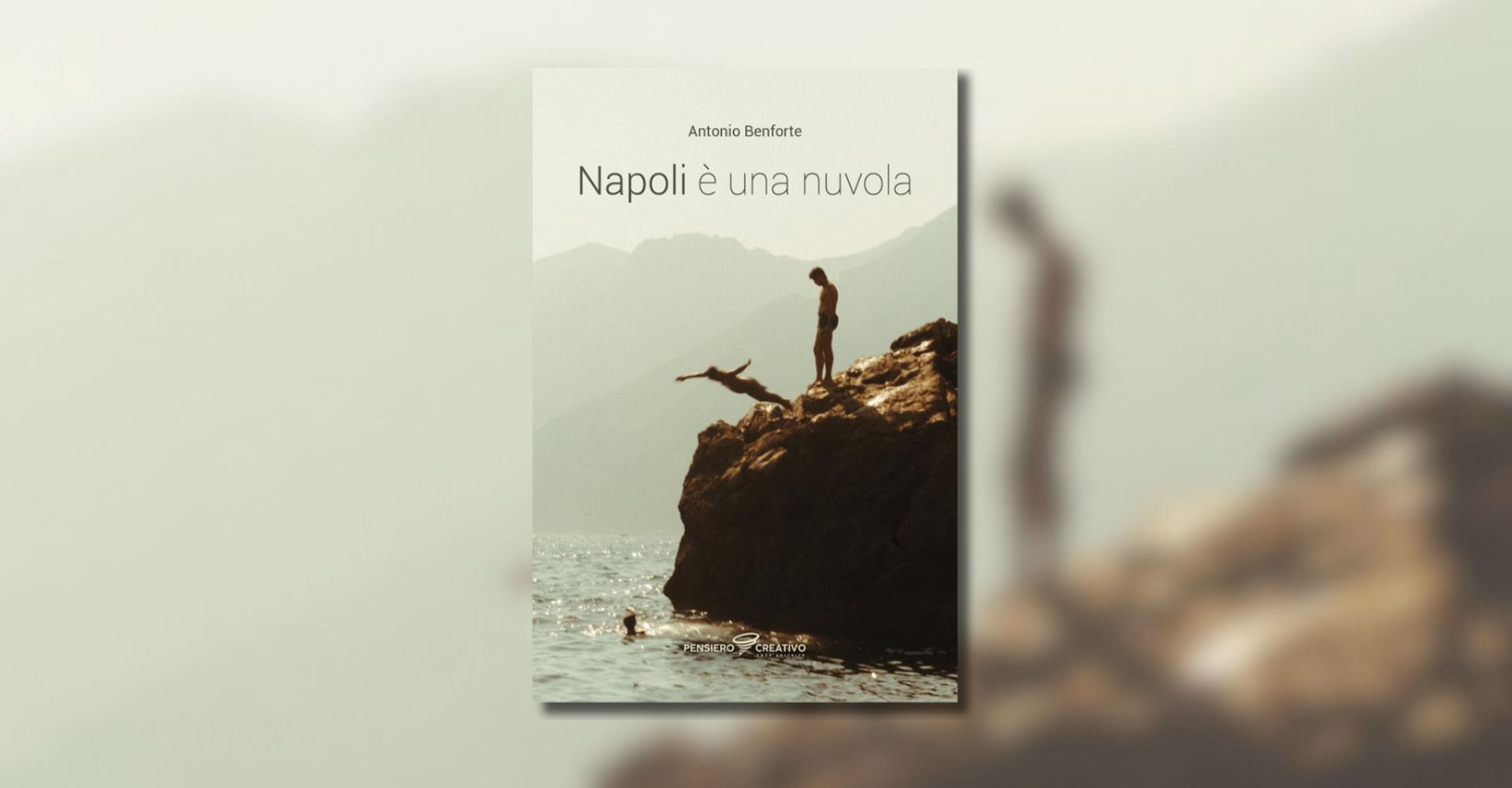
It is in this context that Napoli è una nuvola, the new book (published by Agenzia Pensiero Creativo edizioni) by journalist and writer Antonio Benforte, born in 1983.

A Tourist Guide or a Fairy-Tales Anthology?
The text appears as a tourist guide, but it is also an anthology of modern fairy tales, which nonetheless remain anchored to a reality from which the author seeks to strip away prejudices.
And so Benforte, who handles digital communication for the Pompeii Archaeological Park and has long worked in the publishing world as an editor and social media manager, paints his stories with seemingly minor events – such as the arrival of a couple of tourists at Piazza Garibaldi or a sea day for a group of graduating seniors, punctuated by a night of revelry at Piazza del Gesù – against the backdrop of the city’s best-known spots, but also of squares and alleys less familiar.
Through flash, snippets, and instant moments, the author — here presenting his third work after The Girl at the Fountain, The Space Between Things (both published by Scrittura & Scritture) and The Super Santos Band (published by Prospettivaeditrice) — blends territory descriptions with lived experience, fiction and non-fiction, to tell the city of Naples.
A Narrative Tour of the City
“Every place is the pretext for describing a story, and the characters in these stories cross paths with one another; it is as if the protagonist of each tale passes the baton to the next, to keep the narration going,” the author explained, adding: “Each chapter is linked to the next, indeed, through a thread more or less strong — every character brushes against the one that follows, in one way or another — and all together they contribute to telling a city in constant motion.”
The Narrative Tour of the City begins at Piazza Garibaldi, “the gateway for those arriving from outside the region,” and continues, story after story, character after character, moving from Piazza del Gesù to the Veiled Christ, climbing and descending the Petraio stairs to return to the Neapolitan historic center in the alleys such as San Biagio dei Librai, and then climbing again onto the Vomero or Posillipo hills, passing by the Edenlandia amusement park in the Phlegraean area and the Parco dei Murales in the city’s outer districts.
Each place thus becomes a prompt to tell a story of everyday life in the city of Naples, where personal events are inevitably steeped in the places where they unfold. Benforte, however, watches his characters from above, avoiding moral judgments about their behavior, habits, and actions.
The Petraio
Sometimes you take an alternative path, moving away from the usual routes. Because it’s easy to cross off from your personal list the city’s most famous attractions: Piazza del Plebiscito, the historic center, the churches, San Biagio dei Librai, those are things anyone can see. But the city of Naples has other, lesser-known faces, which she shows with reluctance only to those who want to get lost, to go beyond appearances. And so you can discover one of the most romantic walks, a stroll in a hidden locale: it isn’t like riding the proud hill of Posillipo or taking a few steps along the now-ubiquitous waterfront; everyone goes there and everyone can appreciate its beauty. But here, few go. This is a walk dedicated to love. Especially the people of Naples, who know the city even in its most secret corners, know well that true love exists and must be celebrated. Always. Without differences of gender, of age, or of sex. Love is everywhere, it is in everything. It is love with objects, monuments, places, situations and the stories life puts in front of us. As Matilde Serao wrote in her book Naples Legends, Naples is a city built on love: “all things in Naples, from stones to the sky, are in love.”
Anyone who does not know this long and fascinating staircase, which splits the city almost in two, misses a great deal. Anyone who does not know these streets of Naples does not know what it means to be citizens of a city that is always divided between above and below, forced to an angled landscape formed by tiring steps to climb, yet so pleasant to descend. For those who think the Petraio is only a set of stairs, giving coordinates is almost pointless; alone, without the right guide, you won’t feel like going there. It’s better to have a companion, to save on chatter and gain in astonishment. This long, enigmatic stairway begins at the city’s highest point, the Vomero, and descends “Down Napoli,” as many Vomeresi like to say, to Corso Vittorio Emanuele. Up and down, high and low. A top and a bottom that distinguish the city’s different souls. The narrow, steep alley, made of steps all different from one another, cuts the Vomero hill in two. It does so discreetly, without drawing attention. Like a wound cauterized by time, one of the many scars on the city’s skin. For many, many years. One legend says this street has existed since the sixteenth century, long before the construction of the funicular, for a long time the only easy way to reach what was then called “the hill of broccoli,” because broccoli was the main crop in the Vomero area. Today one walks it with difficulty uphill, with wonder and ease on the descent, even though fewer and fewer people undertake it, especially in summer, due to the heat that envelops you like a wool blanket on the height of August. For a not-so-gentle longing for modernity, everyone goes fast; they use cars to climb and descend the Vomero—never finding decent parking, ending up with fines—many prefer the funicular or the subway, which is always crowded. A few, perhaps only those who live there, walk the Petraio stairs; you wouldn’t think that tens of thousands of people have traversed this path over the centuries. It is a time-out oasis, the Petraio, far from the chaos of the center’s streets, far from the clamor of chic bars and eateries in the Vomero. Those who live there know it and hold it close. But when a tourist happens to stumble upon it, they cannot help but enter, believing they have stepped into another dimension, no longer in Naples. Some bold tourist, though, climbs it from time to time, with aching knees, sweaty, after having read some guidebook somewhere that along these steps you can admire some of the city’s most fascinating panoramas.
He, the young protagonist of this story, is thus an atypical and counter-current character; today he longs to walk alone, along that hidden stairway between low houses and lush plants, as if to find refuge from the pressing thoughts that crowd his mind. He has not taken the subway with his friend Paolo, as he usually does in the early morning and returning, squeezed into a crowded carriage in underground tunnels where the sun never enters. And so he starts from the top, at the beginning of those five hundred and more steps, and with wobbly legs he heads home—after all, the work for today is finished—and it is after a couple hundred meters downhill that he sees her. Beautiful. No, it isn’t a mystical apparition, nor a burnout-induced hallucination—ten hours in front of a computer screen can play tricks on you, especially if you are the youngest, the newest arrival at the office.
She sits at the entrance of a low pink house facing the square, the first little plaza after three flights of stairs. Head down, absorbed in her phone, with the sun bouncing off the smartphone screen and lighting her face as she checks a new notification or tries to beat a game. Just as he descends with slow steps and reaches the square, she looks up. Their eyes meet, in a fleeting moment.
@Agenzia Pensiero Creativo
(continua in libreria…)
