
ENGLISH TRIFLE or The Counterchant of the Dead
For anyone who needs to hear a story that no longer exists.
Summon the presence you need at that moment.
The dessert opens the mouths of the dead again, but only for one sentence. It’s up to you not to waste it.
WHEN TO COOK IT:
The night before a celebration or a meeting.
Never when one is recently grieving or seeking revenge.
INGREDIENTS:
– sponge cake (Augusta’s recipe)
– pastry cream and bitter cocoa to make the brown cream
– alchermes (if a drop falls outside the cup, you must start over) and Sassolino to drink on Christmas Eve
– water with idrolitina, to be served separately to swallow love
PROCEDURE:
Prepare the cream calmly and in silence.
Meanwhile, tell the story of a dead person.
Stir counterclockwise and bow with every turn.
Repeat until seven. If the spoon vibrates on the seventh, you may stop. If it does not vibrate, repeat from the beginning. The cream is ready only when it becomes glossy.
In the meantime cut the day-before sponge cake into long, narrow strips. Soak them one by one in the alchermes with the dissolved Sassolino. They must not cry.
Alternate the layers: soup, yellow cream, soup, chocolate cream. Three layers, never two. The last layer must be a closing one.
SUSURRE TO BE UTTERED:
As soon as it’s finished, before it cools, lean your face close to the plate and whisper:
“Come if you have something to say. Stay beside me as long as you can.”
Then cover and let it rest. The dead have no hurry.
When you serve, have it tell you the story.
When they drink, utter the farewell sentence.
SIGNS TO LOOK FOR:
– If the cream cracks during cooking, the voice will be broken.
– If the dessert doesn’t set, there is something you don’t want to know.
– If the alchermes drips from the edges, someone from over there is calling you.
WARNINGS:
– Never serve it to someone in anger. The voice they will hear will be only their own.
– Do not cook it to receive answers. Cook it to welcome questions.
– After having eaten it, the guest will not be able to speak for an hour. Whoever speaks first forgets quickly.

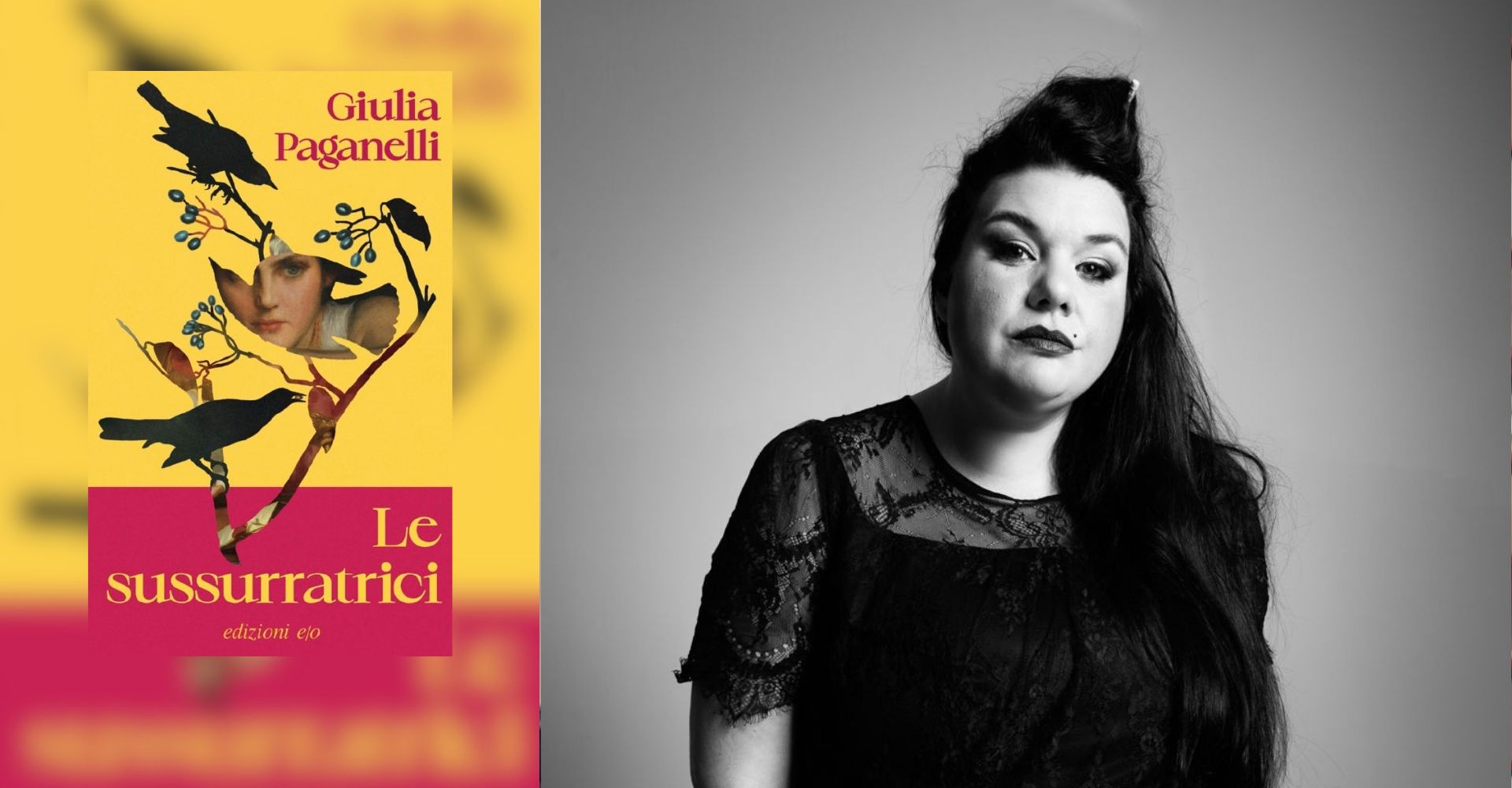
Anyone who knows Giulia Paganelli, author of the novel The Whisperers, in bookstores with e/o, or anyone about to meet her now, should read carefully this phrase: “All bodies are haunted houses.”
This simple concept, which can be read in depth from a semiotic perspective, serves as the hinge of her entire research approach, across every field of knowledge she seeks to probe: history, medicine, anthropology, gastronomy, the history of feminism, or gender studies in a broad sense, and now also the novel form.
A Book with a Substantial, Yet Not Overly Complex, Plot
Paganelli, trained as an anthropologist, has written a book that features a substantial plot, yet not labyrinthine. Five generations of women find themselves living in a villa in the Modenese countryside, the Villa delle Buonedonne.
The book opens in 1930. Adelasia, Caterina’s granddaughter, on her wedding day, hears a sharpening whisper, an insistent voice in her left ear. She is too young to grasp its meaning; she does not know whether it is a dire omen or merely a premonitory sign, but she knows the whisper comes from Caterina’s voice, and that her grandmother’s time is about to end.
Indeed, shortly after giving birth to her first daughter, Bianca, Caterina dies, bequeathing to her a notebook with a red leather cover. The whole of Adelasia’s life will be spent seeking the meaning of the recipes contained within that notebook, full of notes, rewrites, marginalia, and cryptic phrases that seem to unlock the very meaning of existence.
Other Generations of Women
Soon comes Fenicia, the second child born of the union with Teobaldo Martinelli, a man who exercises his dominion over the home with extreme violence.
But Adelasia, regarded as mad by Teobaldo’s family, has on her side a weapon that is also a destiny. Initially chosen as her confinement—and for its ancient tradition as a sanatorium where society’s marginalized women were confined—the Villa delle Buonedonne becomes home for Adelasia, and for all the women it shelters over the years. Bianca and Fenicia, the two daughters, and then Bruna, Clara, Laura, Ebe, Miriam.
As time passes, Fenicia, Adelasia’s younger daughter, will also welcome other generations of women. She will have a daughter, Amelia, and a granddaughter, Luce. It will be she who attempts to close the circle of whispers, solving the enigma that binds Villa delle Buonedonne to Caterina’s notebook, and simultaneously to a mysterious tapestry and to a magpie, which seems to choose one of the house’s inhabitants as its guardian with each passing generation.
Throughout all this time, History unfolds. Fascism, then the Second World War, the horrors of the concentration camps, the years of economic boom, the ’80s and ’90s, then the new millennium, the recession, the pandemic.
Violent Men Who Exercise Power
The men in the novel are almost always violent; they wield power built on centuries of conventions and unwritten rules, sometimes driving the action, but often unaware.
The story Paganelli tells is matrilineal. Written thus, in capital letters, not only because daughters succeed mothers without recognized fathers, but also in the sense of the meaning behind the song by C.S.I.:
Matrilineal
Primordial endowment
Distance of power
Nuclear power
Or in the sense of the epiphany that struck Roberto Vecchioni when he wrote the lyrics to the song Figlia:
She knew the whole truth
The old man who sold cards and numbers
Yet your mother was hard to reach
I know that without me there would be no difference
You would have been born anyway
She would still have had you
A Story That Seems to Repeat Itself in the Same Way
The through-line of meaning that binds this bloodline is the story of women. Technologies change, but it seems to repeat in the same way: the mystery of conception, which is flesh, blood, and estrangement, bearing within oneself another self, the intuition that precedes reasoning, a return to History that is not merely a sequence of events. All this knowledge, produced by women for centuries and never included in books until very recently, is also the history of a resistance to those who tried to normalize it.
The sex as obedience, thinness as asceticism and thus as spiritual purification, the diagnosis of madness to quell the hunger for life. These and many other themes are deftly explored in The Whisperers, in a linguistic cadence that is never abrupt and that makes the shift in mindset across different epochs perceptible, without ever tugging at the reader.
We began by noting the necessity, to understand Paganelli’s writing, of asking what the phrase “All bodies are haunted houses” means. Haunted by the presence of those who came before us, haunted by History, haunted by the houses themselves, Villa delle Buonedonne has its own will.
And, surprisingly, even the form of the novel becomes a haunted house here.
The Form of the Novel Becomes a Haunted House
When Umberto Eco set out to write The Name of the Rose, he also had a brilliant intuition, as often happened to him. He wanted to write the perfect bestseller, mixing every ingredient that, separately, could be found in the ranking novels of the time.
In the same way, Paganelli, who was indeed Eco’s pupil, manages to blend, with a precise and highly coherent sequence, very different genres from one another: the historical novel as container, magical realism (made more appealing and comprehensible to the Italian public because it delves into a regional, both material and immaterial, culture), the investigative novel, horror, and toward the end even autofiction.
The Whisperers is a truly successful world novel. We hope, as we believe the author herself does, that it may achieve success for a single reason: all beautiful stories, meaningful stories, should reach the broadest possible audience. And this book has all the cards to make that happen.
