
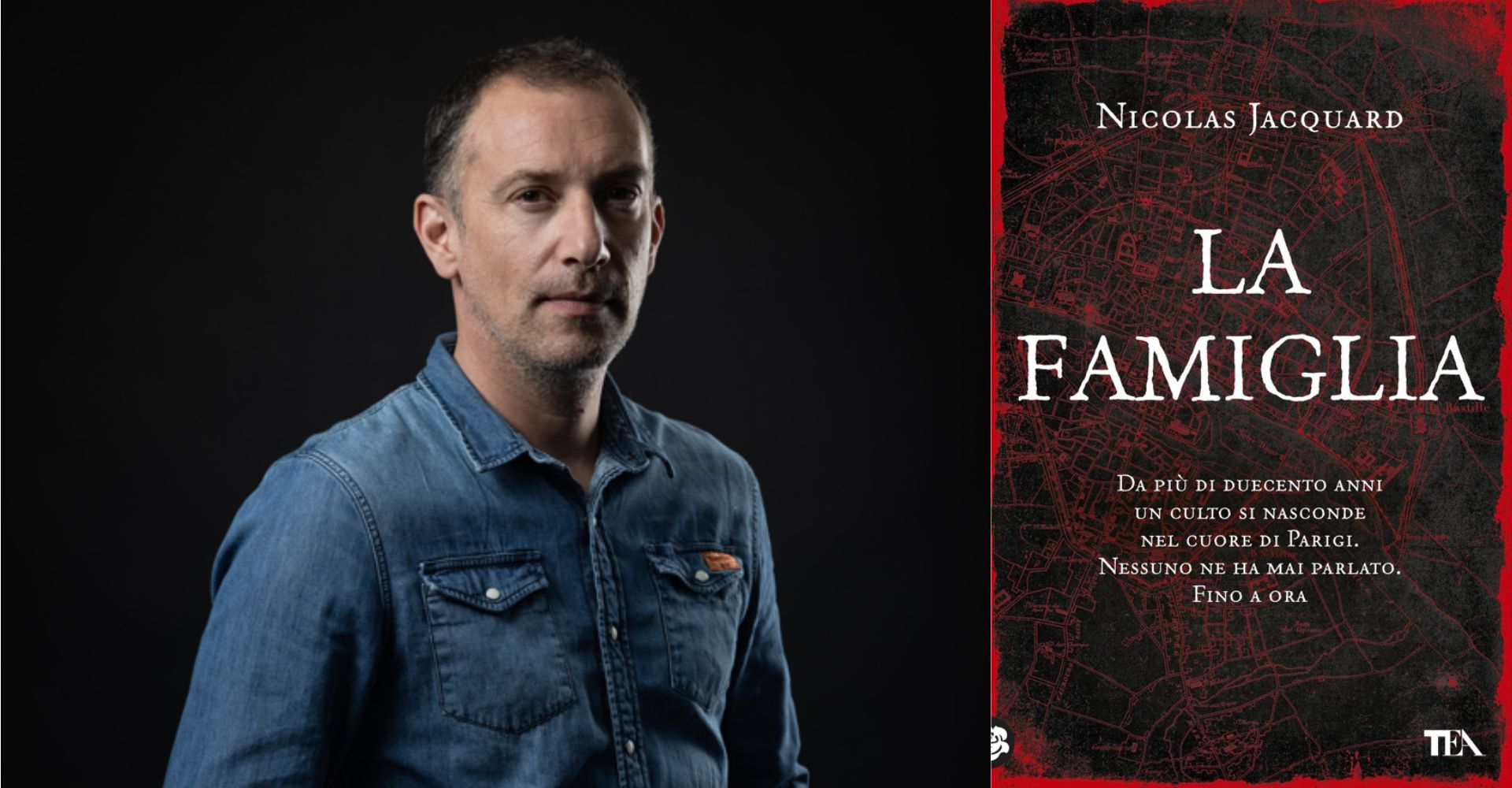
In Eastern Paris (predominantly in the 11th arrondissement) there has existed for centuries a Christian-inspired religious community, which goes by the name of the “Family.” Structured around eight lineages, its guiding principle is that one does not join the Family; one is born into it. And leaving it is impossible.
Nicolas Jacquard, a correspondent for the French daily Le Parisien, who over the years has covered events such as the 2010 Haiti earthquake and terrorist attacks in Europe, delved into its story in the investigative book The Family, published by TEA (translated by Turla Claudine): after being contacted by Alexandre, a member of the community who shared his experience, the author uncovered a reality that is astonishing.

Endogamy at the Core of How the Community Operates
Beginning to investigate to uncover the origins of the community, now numbering about 3,000 members, Jacquard uncovered a Pandora’s box that hides within it centuries of history never told and traditions passed down from generation to generation: the community does not practice proselytism, since endogamy (the practice that requires choosing a partner within the same social group) is the foundation of its organization: cousins marry cousins, only eight surnames remain, women do not work, children are continually warned about the outside world, and together they await the arrival of an imminent Apocalypse.
The First Journalistic Investigation into The Family
In The Family one marries young and still virgins, and from childhood the first affections are formed; one keeps one’s distance, and as one grows up, one begins to imagine building a future together. Ceremonies are organized, during which boys and girls are “put on display” to find the person with whom to spend the rest of their life.
Jacquard’s is the first investigation into The Family, a history rooted in the shadow of the Enlightenment. Who was Elie, the mysterious figure regarded as the Messiah? Who is Sister Elisée, the priestess who presides over forbidden, sensual ceremonies? What are the connections between The Family and the Freemasonry? And why do some of its most rebellious members live isolated in a village in the Haute-Loire department?
“Good morning. My children are part of a sect. I need help. Please call me back.” The words “children” and “sect” send the message to the pile of articles “on standby.” Those I will dedicate myself to as soon as I feel like it and, above all, when the news cycle allows me the time to do so. It is a completely subjective criterion. I have been working for Le Parisien – Aujourd’hui en France for about twenty years, and I know well that writing for a daily newspaper means first of all selecting and giving an order of priority to the news. In the first email I write to Alexandre, I imply that his story is not at the top of the list. He wants everything, right away. A typical trait of his character, as I will come to discover. The threat is the same as ever: if I do nothing, he will turn to other outlets. Very well, let him. In reality he has already done so, without getting much. I offer to listen, but without committing myself.
He tells me that soon his story will reach the Vatican. Sure. At first glance, it seems like the classic case of two parents fighting over custody of the children. On the verge of forty, Alexandre has six. The first four, entrusted to the mother, would live under the yoke of a “sect.” A strange religious community in which he himself grew up and of which none of the social workers handling his case would have understood the true nature. I decide that his personal story, as well as that of this mysterious movement, can wait. After several messages to buy time, a sense of foreboding pushes me not to break the fragile bond that unites us. I explain that his story interests me, but for Alexandre to do a good job he will need patience, a quality he lacks. In any case, the lure works. Alexandre calms down. I assure him I will get back to him soon. A “soon” that will last weeks. Until, to contain the Covid-19 epidemic, the government decreed the first lockdown.
I spend the spring of 2020 in my parents’ home, tucked away at the end of a bucolic dead-end valley in the Jura, the department where I was born. Those months were a breath of fresh air—a blessed pause from daily frenzy. I don’t remember whether it was Alexandre who insisted or if I was the one who called him back, but I clearly remember the two hours spent listening to him. Alexandre is high-spirited. He speaks with the brazen cadence of Gavroche, the character from Les Misérables. Words held back too long spill out in torrents, hard to contain. I struggle to grasp the thread of that disordered flow. Alexandre is impulsive and a bit chaotic. From what he tells me, there would be about three thousand people, all residing in Paris, mainly in the heart of the 11th arrondissement, in the Faubourg-Saint-Antoine district. A family called “the Family,” that has existed for three hundred years. I jot down a few words in a rush. “Jansenists,” “Convulsionaries,” “Pardailhan kibbutz,” “mental conditioning,” “emotional blackmail,” “unreported complaint.” And, above all, “consanguinity.” In this Family composed solely of people who marry one another there would be barely eight surnames. These are heavy words, full of religious ambiguities, that hint at shocking human consequences. Alexandre could be a mythomaniac like many others, yet he doesn’t seem to speak idly. My instinct tells me to believe him.
© Nicolas Jacquard, 2021
International Rights Management: Susanna Lea Associates
© 2026 TEA S.r.l., Milano
(continues in bookstores…)
