Following the polemics of last spring that arose after his statements (and subsequent clarification) about Zionism and the genocide in Gaza, Erri De Luca, now 76, returns to bookstores with Feltrinelli with Under Trial, a volume – illustrated in the first part by Paolo Castaldi – that collects the untitled, unpublished section, together with The Contrarian Word and Other Civil Writings.
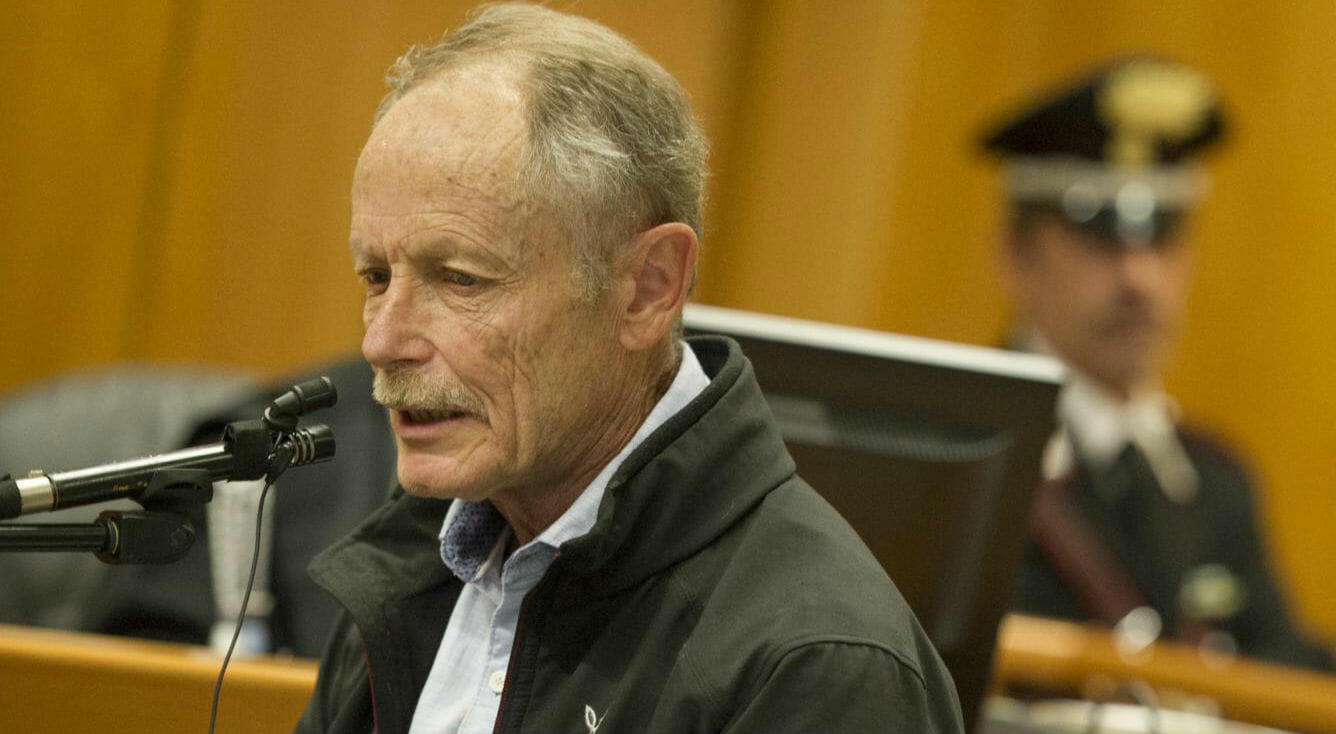
In this regard, it is worth recalling that The Contrarian Word had already appeared in 2015, on the occasion of the trial in which the Campanian writer, after refusing the abbreviated procedures (to be held behind closed doors), was summoned to answer for incitement to sabotage in favor of the No Tav protest in Val di Susa.
“Having the elderly step down from power”
In the first part of the new book, De Luca imagines an elderly writer who, indeed, finds himself Sunder Trial, judged by a group of young people who explain (speaking about the elderly): “They are involuntary participants in the oppression. Our aim is to have the old step down from power. We believe in the birth of a party of the young that we will not found ourselves, but of which we feel inspired. It should no longer be normal that the old vote in elections where the future that does not concern them is decided.”
What unfolds in the interrogation is a dialogue in which there is room also for reflections on reading (and literature).
“This Trial of an Old Writer”
Among other things, the writer declares: “I could resign as a writer, stop adding pages or at least, since it is an old habit, publish them. But this resignation does not open any space for anyone among you who is a writer. If one exists, it will nonetheless make its way among the shelves of the old. Publishing houses love young writers, neophytes. You are, for me, in this court of debuting writers who have found the formula to publish the first book. But after this trial of an old writer, a second tribunal will not interest anyone. No publisher will publish the records of a second proceeding against old age…”

The Stranger in the Bible
“With this face of a stranger,” sang the Greek-Frenchman Moustaki in the sixties. Who is a stranger in the Mediterranean, the most mixed land of skin tones, altars, and bloodlines? A certainty is that we are dozens of variants of mixed lineage. Page one of the New Testament is a list of male names interrupted by the festive intrusion of five female names. Three of them are not Jewish but belong to neighboring peoples: the most precious dynasty, that of the Messiah and of the Davidean line, is mixed. Even the Messiah rejects blood purity.
Those who belong to the Mediterranean cannot exclude from their ancestors any lineage, any origin. Phoenicians, Jews, Greeks, Normans, Saracens, Slavs, and other migratory birds have enriched our genetic heritage through invasions, trade, expulsions, piracy, abductions, epidemics, pilgrimages. It is history that has stirred us in its cauldron, but more than that it is geography that opens us to the seas and not sufficiently enclosed by the crest of the rooster of the Alps.
Who is the stranger? In the beginning, everyone in the sacred writings, starting with Abraham, reached and seized by the voice that orders him to leave his land, his father’s house, toward an unknown destination. Abraham must become a stranger to keep listening to the voice of his master. One night the words arrive, inviting him outdoors, and under the dense tumble of stars they announce a multitude of descendants as numerous as the starry glow that overlays him.
We must have been strangers for at least a moment to grasp a corner of Abraham’s enthusiasm on a night full of immensity. We must recognize in our own blood the instinct to encamp and to feel misplaced in order to breathe with him the gas that rains down from the stars. Abraham, master builder of monotheism, is the stranger who beat the path for all those who set out. After him, the shared experience of those who must lose themselves before they can find themselves became common. After him voluntary exile became a school.
Every person who sets out toward an unknown destination, on an uncertain path, is following in the wake of the stranger Abraham aroused by the command: “Go, leave your land.” It is written that the deity loves the stranger.
In him one must recognize not a brother, but the one who has been long awaited.
I learn it from a cursed history that happened and therefore does not stop happening.
It was September 1941, days of the Jewish new year, and four thousand Jews from a Lithuanian town were led to the cemetery to be shot at the edge of mass graves.
It is a well-planned, efficient massacre: in groups of twenty they are stripped naked and subjected to the fusillade. One of them, a sixteen-year-old boy, strips off with his father. He concentrates on the cadence of the shots he hears before his turn. They have a regular repetition that he times in his mind. When it is his turn, he throws himself into the pit a moment before the shots. He falls alive onto the pile of naked bodies, dead or writhing in agony. Others fall on him. It is dark when everything is over. He rises, disentangling himself from the corpses, covered in blood and excrement.
He goes toward the lit houses of the non-Jews. He knocks on their doors and everywhere he is told to return to the pit from which he came. Finally he knocks on a secluded door, where an old woman lives, alone. She welcomes him armed with a burning brand, guardian against ghosts, to drive him away. Then the boy says: “Woman, don’t you recognize me? I am your savior descended from the cross.” The woman falls to her knees, lets him in, washes him, clothes him, feeds him. After three days the boy departs, ordering her not to speak of his arrival. Then he wanders into the woods, joins the first insurgents, fights, survives.
This is not a parable but a story that happened to him, who is named Zvi Michalovskij.
To me it tells that he is the stranger who knocks at the door and must be welcomed as someone who has been long awaited. Because in him the story and the figure of the risen are renewed.
A Debut
He was no longer called master, but professor. Having left the barracks of elementary school, we still wore short pants, a mark of childhood. Someone with long trousers seemed more grown up and more awkward.
The themes in class, in middle school, bore the titles of the subjects studied; they scrutinized the level of learning. We adhered to a state Italian, rigid as a form. Without being able to explain it to me, I despised it. The embalmed language was part of a general submission to adult power. During the break between hours we vented with dialect, a way of escaping. We rinsed our mouths with Neapolitan.
One day a free theme was assigned: to invent a fable. We were at the early stages of translating Esop and Fedro. Many of us were worried, asked for explanations, a trace, for fear of getting lost in that broad sudden field. We had to invent a story of animals.
The sudden license prickled my skull. I wrote in a continuous line, gripping the pen until my fingers ached, the only trained part of a body still soft. I wrote downhill, the desk tilting toward me with herds rushing and clouds of dust. The beasts love to raise it, to disturb the insects that harry them. The dust from us is swept away every morning; there it rose to the sky, pushed by the drumbeat of hooves.
The dust was the soul of the world. I wrote and the thoughts beat their hooves to come out and run too. It was a plunge into writing; I even managed to copy one for taking home.
I turned in among the first. Usually I freed myself late, in search of extensions to reach the minimum length assigned.
At home I had the theme read aloud. They were surprised by my ardor, more than by the writing. That day I learned the certain news that writing was open field, a way out.
It could drive me to run where there was not a single meter for feet, hurling me outward while I remained crumpled atop a page.
I became someone who started to write, from that day, to force open the closures around me. They yielded, they let me go as long as I could keep writing.
The days returned later when the professor came back with the corrected assignments, with the grade. My writing was insufficient, evidently, because, escaping his control, I had copied from some compilation of model essays.
An unusual freedom of language and an abuse of imagination accused me. Indication was that I had submitted an assignment longer than required.
It wasn’t a slap in the face, but a blow to the stomach, dealt cold. The accusation provoked my rebellion of silence.
I did not reply.
I experimented for the first time with the incompetence of the powers that be. They needed narrow spaces; the open field unsettled them. From that free theme a lesson in air had escaped and had to be brought back under control.
Those powers needed enclosed spaces, stiff bodies to impose their version of knowledge. They were already unhappy that we arrived in the classroom a little heated after the rare hour of physical education.
At that point of friction between my truth and theirs, a knot formed in my body, a resistance opposed to domination, which instinctively abuses. Today I know that the powers, with their false accusations, can render the greatest honor to someone who writes. They make writing a body of crime that disturbs their discipline.
Only powers can, by insult, add value to writing.
Today I know the fragility of authorities, of official hierarchies. At the time, however, they were intact and unquestionable. From the wrong of that day, the crack rose, the wound that time would slowly demolish within me. At that point of a gut wound, my skeleton reacted. I asked insistently and obtained the first long trousers.
(continua in libreria…)