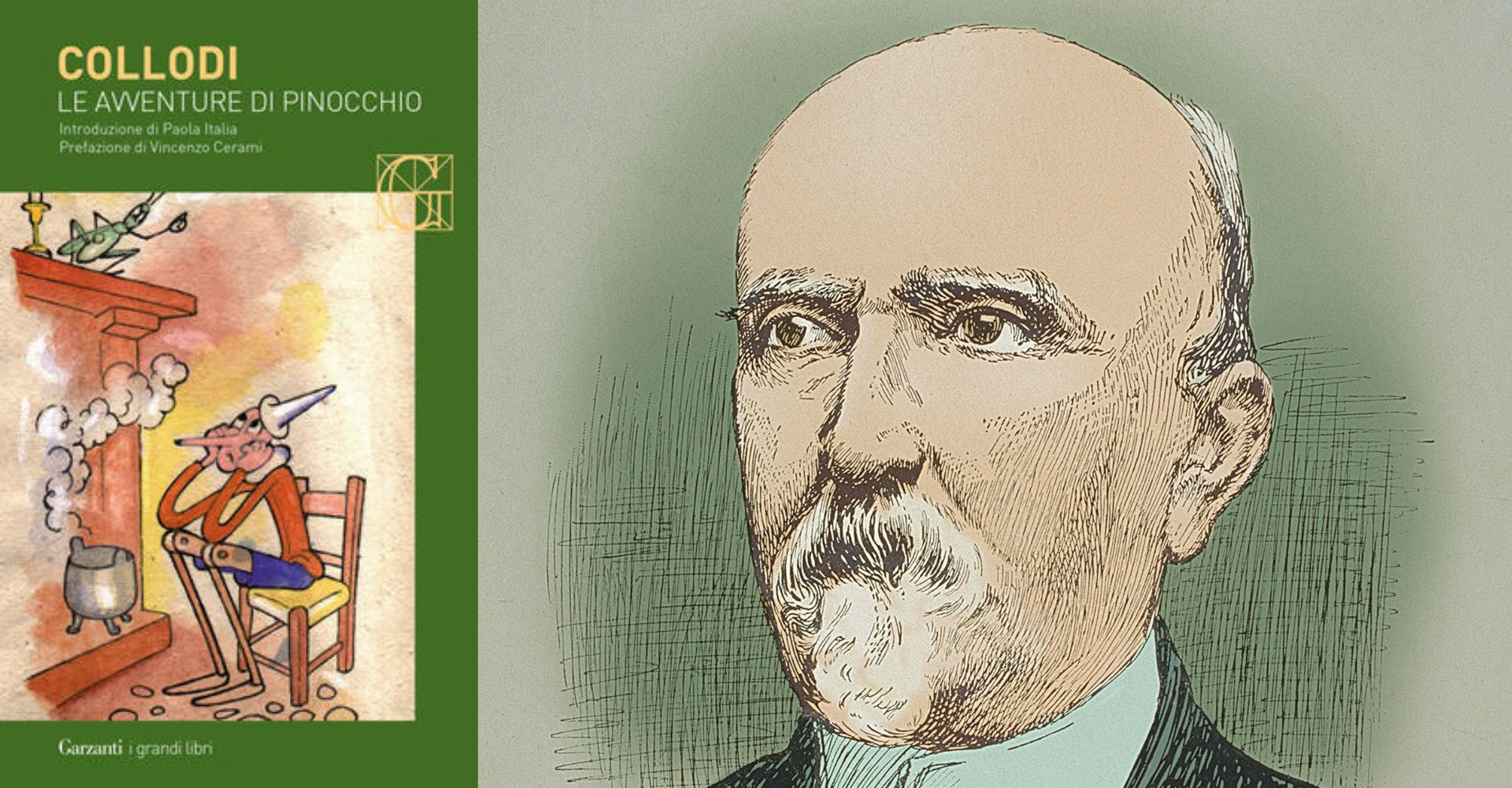
When discussing children’s literature, only a handful of authors have left as deep and lasting a mark as Carlo Collodi, the Italian writer and journalist who entered the public imagination thanks to The Adventures of Pinocchio (first Paggi edition, here presented in Garzanti edition).
First published (in serial form) in 1881, the tale of the famous puppet soon became one of the great classics to read at least once in a lifetime, translated and adapted all over the world, crossing the boundaries of literature for girls and boys.

Reducing Collodi to Pinocchio alone, however, would mean overlooking a central figure of 19th-century Italian culture.
Before becoming one of the most beloved authors of all time, Carlo Lorenzini – this was his real name – was in fact a prolific journalist, a keen observer of the society of his era and a protagonist of the Risorgimento events that accompanied the birth of a united Italy.
His literary output includes short stories, educational works, satirical pieces and translations that testify to a career far broader and more intricate than what the general public typically recalls.
Precisely through these experiences, Collodi developed that narrative sensibility and that ironic vein that would find their most mature expression in the adventures of the famous wooden puppet.
Let us then trace the life of Carlo Collodi, his journalistic activity, his major works, and the genesis of Pinocchio, to discover how a writer of the 1800s managed to create a character capable of crossing generations, cultures, and continents without losing his extraordinary timeliness.
Index
- Who Was Carlo Collodi: the writer’s biography
- Carlo Collodi and the Italian Risorgimento
- Carlo Collodi’s journalism career
- Carlo Collodi’s works before Pinocchio
- The Adventures of Pinocchio: the birth of a masterpiece
- The plot of Pinocchio in brief
- Pinocchio in cinema: the most famous adaptations
- Carlo Collodi: not only Pinocchio
- Carlo Collodi today: why he remains relevant
Who Was Carlo Collodi: The Writer’s Biography
Carlo Collodi, as anticipated, is the pseudonym of Carlo Lorenzini, born in Florence on November 24, 1826, into a family of modest means: his father Domenico is a cook for a Florentine noble family, while his mother Angiolina Orzali works as a maid. It is precisely from his mother that the writer would derive the name by which he would enter literary history: Collodi was in fact the name of the small Tuscan village – today a hamlet of the municipality of Pescia – from which his maternal family originated.
Carlo’s childhood unfolds between Florence and the Tuscan countryside, in a setting that would help form his imagination and his bond with popular culture. From a young age he shows a strong inclination toward reading and writing, qualities that lead him to pursue studies at religious institutions and, later, toward literary and humanistic interests.
His formation takes place in a historically complex period: Italy is not yet a unified state and the peninsula is traversed by political ferment. In this climate, the young Lorenzini develops a growing interest in current political and cultural affairs, cultivating a strong engagement with journalism.
Already in the 1840s, he begins collaborating with newspapers and magazines, distinguished by a bright, ironic, and often satirical style.
Before reaching international success as a writer, Collodi builds his reputation as a journalist, a satirical author, and an engaged intellectual, becoming one of the most original voices of Italy at the time.
Carlo Collodi and the Italian Risorgimento
Carlo Collodi was a man deeply involved in the political events of his time: his youth coincided with the decisive years of the Risorgimento, the movement that led to the unification of Italy and involved thousands of intellectuals eager to build a new national identity.
Like many young people of his generation, Carlo Lorenzini embraced the liberal and patriotic ideals that animated Tuscany and the rest of the peninsula. In 1848 he volunteered in the First War of Independence, fighting against the Austrian Empire. Eleven years later he also took part in the Second War of Independence, confirming a civil commitment that went beyond the pages of newspapers or intellectual debates.
The military experience helped shape his character and worldview. Collodi witnessed firsthand the hopes, difficulties, and contradictions of a country seeking to become a united nation. This sensitivity toward the themes of civic education, personal responsibility, and collective growth would influence much of his later literary production.
Alongside political activity, Collodi also engaged in spreading Risorgimento ideas through journalism. In an era when newspapers were among the main tools for shaping public opinion, intellectuals played a fundamental role in cultural and political debate. It was precisely through journalism that Carlo Collodi began to build his literary voice, refining that ironic and bright style that would make his works unmistakable.
The Journalism Career of Carlo Collodi
During the Risorgimento years and the decades that followed, Collodi worked for several Tuscan publications, covering politics, society and current events.
In 1853 he founded the satirical newspaper Il Lampione, a publication characterized by lively and often polemical tones, reflecting the era’s political climate and his liberal convictions. After a temporary closure due to the Restoration of the Grand Duchy of Tuscany, the periodical returned to the stands in 1860, on the eve of unification.
Parallel to this, he also collaborated with other publications, including La Scaramuccia, distinguished by an agile, ironic prose capable of blending social observation and satire. Through articles, commentaries and chronicles, Collodi narrated the changes of postunitarian Italy, highlighting its aspirations and difficulties.
It was precisely journalism that decisively shaped his narrative style. Expressive clarity, a taste for dialogue, humor, and attention to spoken language are traits that would later be found in his literary works as well.
Discovering children’s and young adult literature: from Pinocchio to timeless classics, up to the most beloved new releases for young readers. Explore our in-depth features dedicated to children’s and young adult literature with reading suggestions, author trivia and books capable of accompanying readers of every age in the joy of reading.
- Over 90 children’s books recommended for 2026
- Young adult books for 2026 to read: over 100 recommendations
- 150 books for boys and girls to read (at least) once in a lifetime
Carlo Collodi’s Works Before Pinocchio
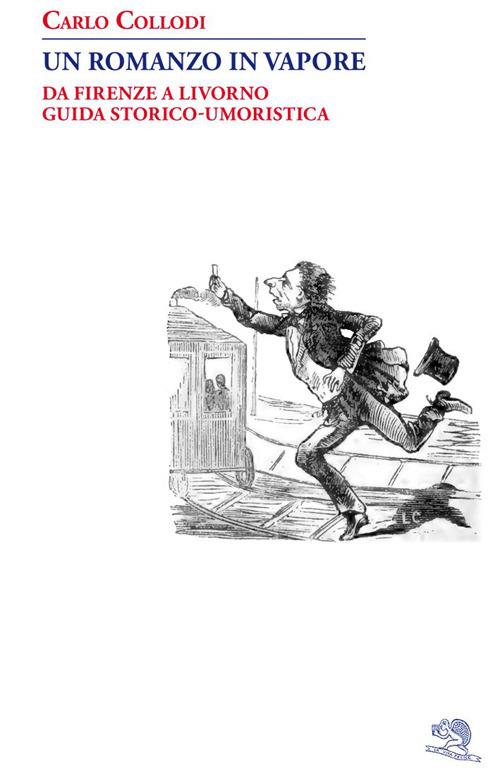
Among Carlo Collodi’s early works is A Novel in Steam (Mariani, 1856), an ironic and original text drawing on the experience of the rail journey, a symbol of modernity and progress in 19th-century Italy.
In the 1870s, the writer grew increasingly closer to the young reader audience. Works such as Giannettino, published in 1877 for Paggi, and Minuzzolo (Paggi, 1878), see Collodi tackle educational and formative themes through a lively style, distant from the moralizing tones that characterized much children’s literature of the period. The protagonists are curious boys, imperfect and often restless, foreshadowing traits that would become central to Pinocchio as well.
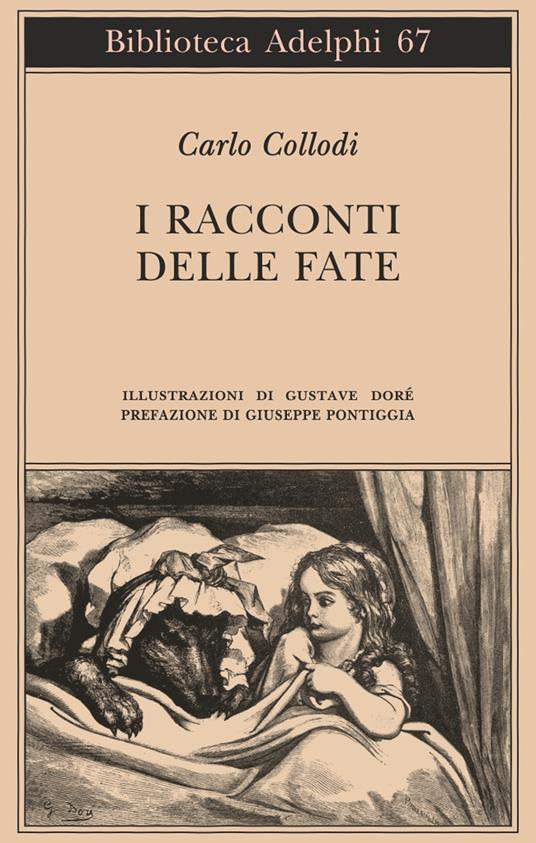
Another fundamental aspect of his output concerns translations and adaptations of French fairy tales by Charles Perrault. Through works such as The Tales of the Fairies (Paggi, 1876), Collodi contributed to spreading among Italian audiences some of the most famous stories of European tradition, including Little Red Riding Hood, Sleeping Beauty, and Puss in Boots. This body of work allowed him to delve into the mechanisms of fairy tale and fantastical narration, elements that would prove decisive in the creation of his most famous character.
All these literary experiences would converge into the project that would forever change his career: the birth of a wooden puppet destined to become one of the most celebrated characters in world literature.
The Adventures of Pinocchio: the birth of a masterpiece
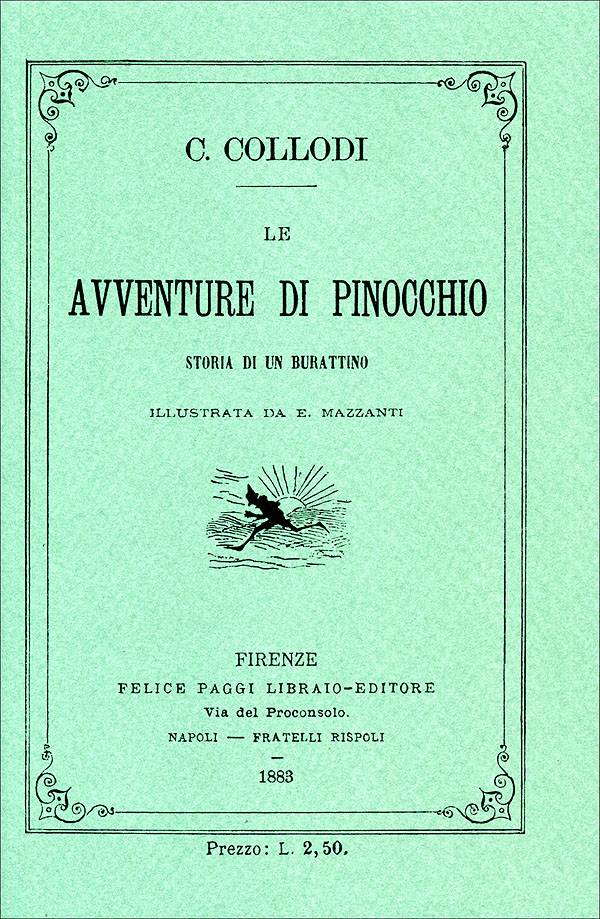
The story of the celebrated protagonist first appeared on July 7, 1881 on the pages of Giornale per i bambini, under the title Storia di un burattino. Initially published in installments, the work quickly captivated young readers, who followed the adventures episode after episode. Only in 1883 was the tale published as a volume under the final title The Adventures of Pinocchio, accompanied by illustrations by Enrico Mazzanti.
Originally, Collodi did not foresee creating one of the most famous figures in world literature. Pinocchio was born as a rebellious, impulsive, and profoundly imperfect figure: a puppet who continually errs, challenges authority, and learns through mistakes, punishment, and often harsh consequences.
The success was immediate. Children and adults alike identified with the protagonist’s adventures and with Collodi’s ability to blend fairy tale, social satire, humor, and moral reflection. From a simple serialized tale to a global cultural phenomenon, the wooden puppet’s story became Carlo Collodi’s most important legacy.
But what exactly does this novel tell, the kind that continues to enchant generations of readers?
The Plot of Pinocchio in Brief
The story begins when the carpenter Master Cherry finds a piece of wood that seems ordinary but turns out to be animated; it is then handed to Geppetto, an elderly craftsman who decides to fashion a puppet and name him Pinocchio.
From the very first moments, the “newborn” boy shows a rebellious and uncontrollable character. Instead of going to school and heeding his father’s advice, Pinocchio is continually lured by shortcuts, promises of wealth, and bad company. On his journey he meets memorable figures such as the Cat and the Fox, the Talking Cricket, the Blue-Haired Fairy, and Mangiafuoco, living a long sequence of adventures that lead him to confront poverty, deception, fear, and guilt.
Through mistakes, escapes, and punishments, the puppet embarks on a difficult path of growth. Only after learning the value of responsibility, work, and familial affection does Pinocchio manage to transform from a mere wooden puppet into a real boy. Behind the fairy-tale structure, Collodi crafts a genuine bildungsroman, in which the protagonist faces the transition from childish naivety to maturity.
The success of The Adventures of Pinocchio did not remain confined to literature: since the early 1900s, Carlo Collodi’s novel has inspired dozens of adaptations for cinema, television, theater, and animation, becoming one of the most reinterpreted works in world culture.
Pinocchio on Cinema: The Most Famous Adaptations
The most celebrated film adaptation of this grand work is probably the animated feature Pinocchio, produced by Walt Disney in 1940.
Although it altered several elements of the original plot and lightened its darker aspects, the feature-length film helped render the puppet a global icon, fixing in the collective imagination characters like Jiminy Cricket (the Talking Cricket) and the famous nose that grows when Pinocchio lies.
In Italy, one of the most beloved versions is the television miniseries The Adventures of Pinocchio, directed by Luigi Comencini in 1972. With Andrea Balestri in the title role and Nino Manfredi as Geppetto, the miniseries is still regarded today as one of the adaptations most faithful to the spirit of Collodi’s novel, capable of evoking both the fairy-tale dimension and the more realistic, popular tone.
Over the years the character has returned to the big screen several times. In 2002 Roberto Benigni directed and starred in an adaptation that generated wide international interest, while in 2019 Matteo Garrone offered a version visually faithful to the book’s nineteenth-century imagination, with Roberto Benigni again playing Geppetto. The following year, in 2022, arrives Guillermo del Toro’s Pinocchio, realized in stop-motion: a poetic and melancholic reevaluation set in Fascist Italy that won the Oscar for Best Animated Feature.
Carlo Collodi: Not Only Pinocchio
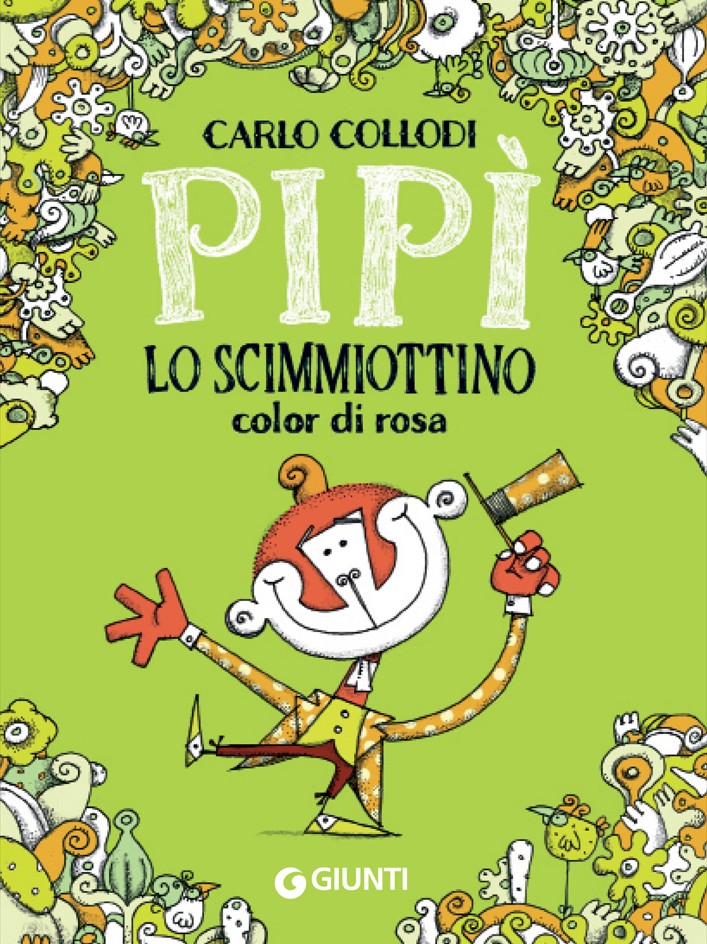
Four years after Pinocchio, Carlo Collodi published Pipì, lo scimmiottino color di rosa, a book that Giunti is bringing back to shelves today to mark the author’s 200th birthday. The edition is accompanied by a short story by Fabrizio Biggio and a review by Pietro Citati that appeared in Corriere della Sera in 2014.
The long tale tells of Pipì, the smallest of five monkey brothers who live in the marvelous forest of Vattel’a pesca. Unlike his brothers, who have brown fur, Pipì is covered in a pink-reddish mantle that, in the apes’ language, indeed means “color of pink.” The little monkey is not very respectful of rules, funny and very intelligent. His greatest passion? Imitating everything he sees humans do…
Carlo Collodi Today: Why He Remains Relevant
More than a century after his death, Carlo Collodi continues to occupy a central place in Italian and international culture. If The Adventures of Pinocchio has never stopped being read, it is because it tackles themes that go far beyond children’s literature and speak to the present.
Pinocchio’s coming-of-age journey indeed tells universal experiences: the desire for freedom, making mistakes, the search for one’s identity, the relationship with family, the value of education, and the difficulty of distinguishing appearances from what is truly right. Issues that continue to concern children, adolescents, and adults.
Many of Collodi’s characters retain striking topical relevance. The false promises of the Cat and the Fox, the lure of shortcuts, manipulation, the pursuit of quick profit, and the tension between responsibility and desire are dynamics that still find numerous points of contact with contemporary society. For this reason Pinocchio continues to be the subject of new translations, film adaptations, academic studies, and artistic reinterpretations.
Collodi’s legacy, therefore, lies not only in having created one of the most famous characters in literary history, but in having written a work that continues to renew itself without losing its strength.
This is the hallmark of great classics: readers change, the world changes, but their stories continually find new reasons to be told.