
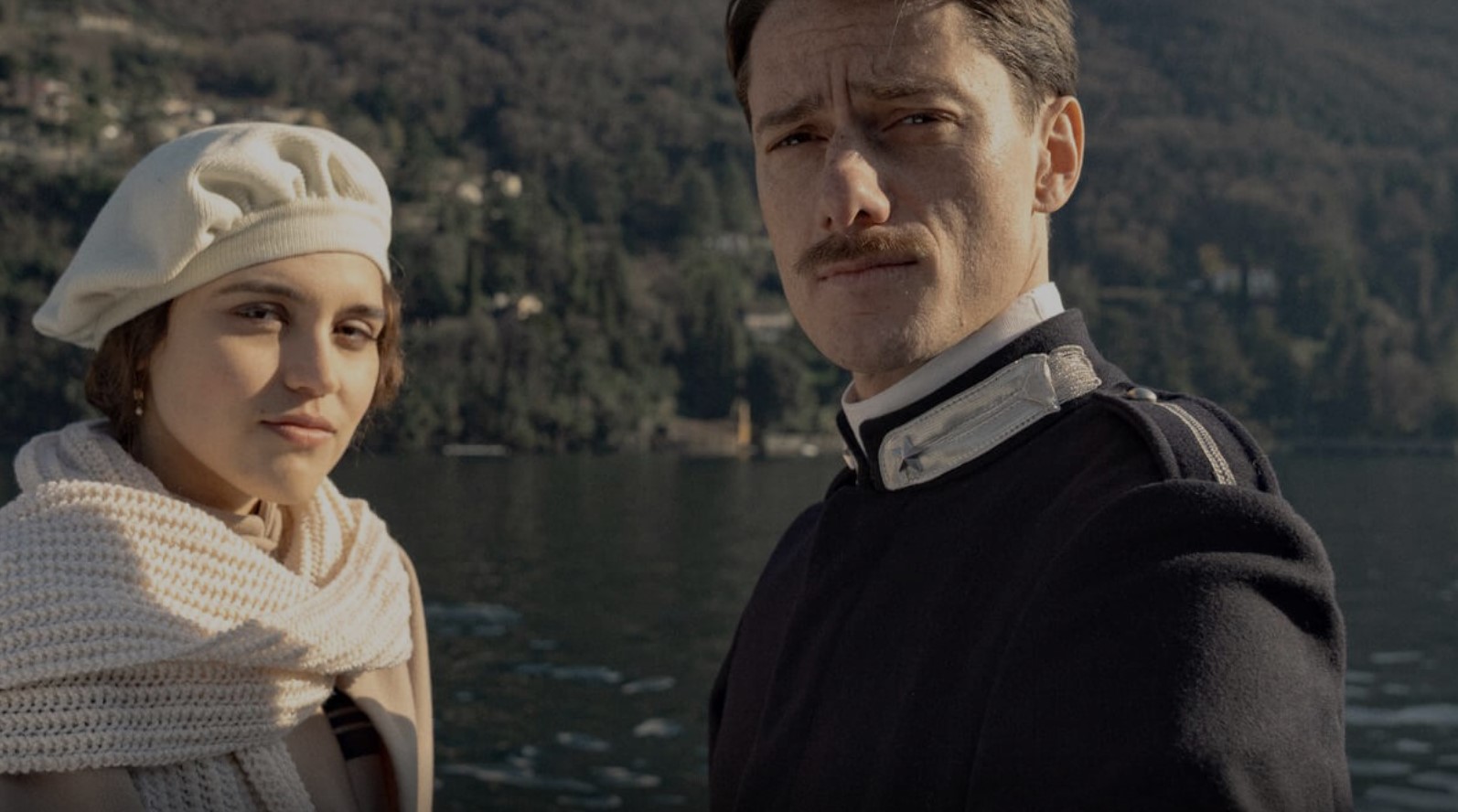
The allure of Andrea Vitali’s novels arrived on Rai1 in prime time with Una finestra vista lago, the TV series making its debut on November 24 (four episodes planned, for a total of eight episodes).
Between comedy, mystery, and surreal atmospheres, the series unfolds in the imaginary Bellamo, and not in Bellano from the books—the lakeside town where, among other things, the prolific and beloved writer born in ’56 lives (here are his numerous articles and short stories published on our site).

The characters of the TV series drawn from Andrea Vitali’s books
The series presents a choral narrative, in which the lakeside landscape stands out alongside the young Carabinieri marshal Ernesto Maccadò (portrayed by Antonio Folletto), who at the dawn of the 1930s takes on his first assignment as commander of the Bellamo station, a Lombard town that he reaches from Calabria with his wife Maristella, played by Giulia D’Aloia, who, in turn, decides to follow her husband to the North “in the name of love, of a life project built together.”
Among the many characters of this ensemble series, there is also the village brigadier, who knows everyone, played by Domenico Centamore.
Parola di perpetua
La figlia del podestà
Una finestra vistalago
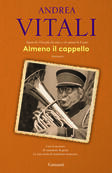
Almeno il cappello

Olive comprese
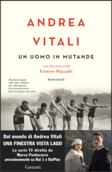
Un uomo in mutande
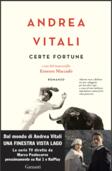
Certe fortune
The series thus revisits the events that the novels—depicting a “small old-world” of Northern Italy—narrate, populated by odd and comical characters, sometimes eerie and sometimes hilarious.
There is space for dramatic moments as well as for ironic and surreal ones: from the love story between two women in Nome d’arte Doris Brilli to the bull free for the town of Certe fortune, from the unexpected complications of an extramarital affair in Un uomo in mutande to the bizarre links between the theft of a small picture of the Sacred Heart of Jesus and the death of a formidable usurer in La signorina Tecla Manzi.
The journey will be full of obstacles, so much so that in the end Maccadò will become convinced that he has failed in his mission, almost considering asking for a transfer. But will that be the right solution?
It’s worth noting that the character Ernesto Maccadò made his first appearance roughly 22 years ago, in La signorina Tecla Manzi. In 2023, the writer told us: “(…) A place like the one where the stories are set would be lame, incomplete in short, if it lacked its fine barracks with a marshal in command. And of southern origin, both to respect a certain tradition and to allow me to transfer into him the suggestions, enchantments, and feelings entirely personal but capable of making him fall in love with this land…”.
In an interview with the Venerdì section of Repubblica, the writer responded to a question about the points in common with his marshal Maccadò: “A little yes, because he’s ironic, he won’t take being fooled, but he’s willing to understand the difficulties and justifications of others. In Il sistema Vivacchia the protagonist who travels with a false document should be arrested, but he realizes he’s fleeing the fascist police; therefore, he lets him escape to Switzerland. He has the ability not to settle for the surface; he goes to the root.”
“The lake has become a major protagonist”
Returning to the series airing from November 24, director Marco Pontecorvo explained the narrative choice to insert a surreal element into the series: “The lake has become a major protagonist, and it somewhat drives the lives of the characters…”.
In the cast of Una finestra vista lago we also find Vincenzo Nemolato (Tartina), Dario Vergassola (Fiorentino Crispini), Gianmarco Vettori (Cagaia) and the young Leo Besozzi in the role of Vinicio, an orphan boy.
Una finestra vista lago is co-produced by Rai Fiction and Alexandra Film in association with Elysia Productions and RaiCom and is realized with the contribution of the Pr Fesr Piemonte 2021-2027 – “Piemonte Film TV Fund” call and the support of Film Commission Torino Piemonte.
Parola di Perpetua, the new Vitali book with Ernesto Maccadò
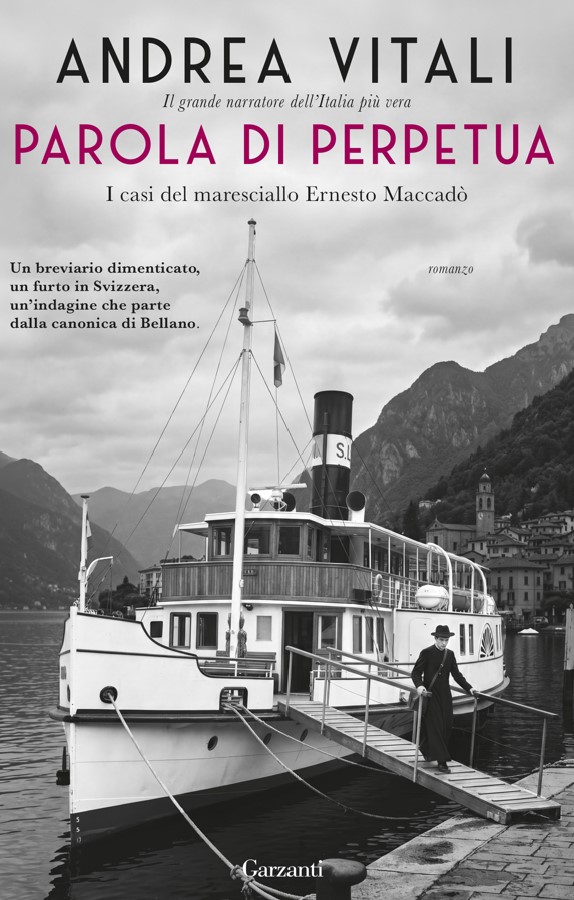
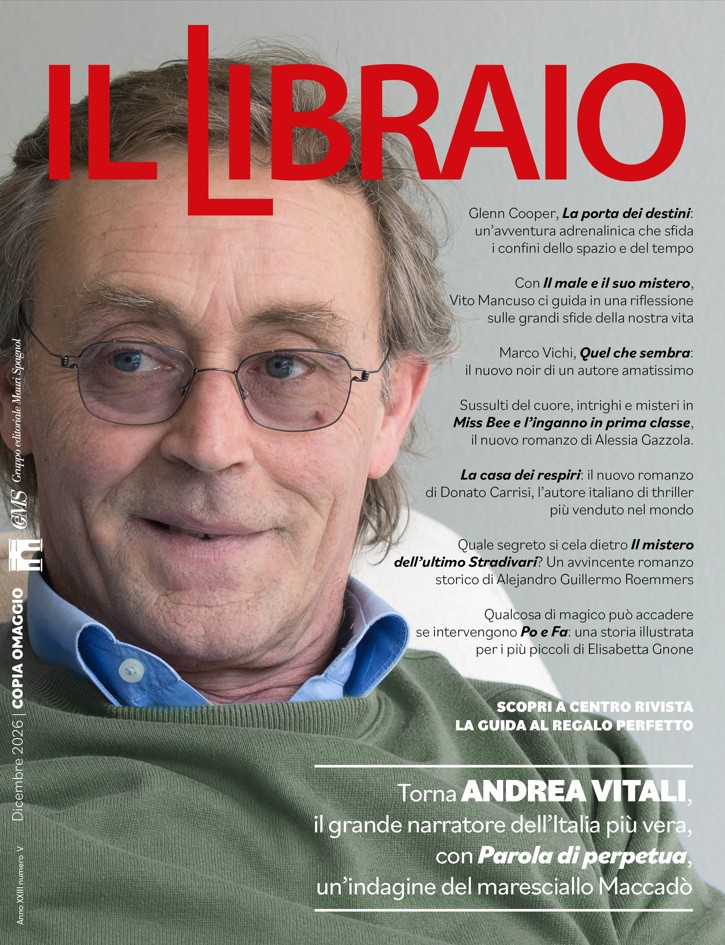
Recently, by the way, Parola di perpetua, Vitali’s new novel, is in bookstores from Garzanti, still set in Bellano.
The plot opens with a scene in perfect Vitali style: it can happen that a passenger forgets something on the boat when disembarking, but that a priest leaves behind nothing less than the breviary seems a bit excessive. Truth be told, it’s not the only thing that doesn’t add up on that evening of 7 November 1935. First of all, what is a priest doing in Bellano that no one expects and no one knows was supposed to arrive? And why in the evening? And why does he vanish into the shadows of the countryside without presenting himself at the rectory? Details? Not even in a dream. The boatman Vincenzo Lepore, who, to deliver the abandoned breviary to the prelate, missed the chance to attempt the umpteenth assault on Primina Imbeni, daughter of the innkeeper at the Bar of the Pier, can quite happily disregard this: he carried out his task—and at what price!—the rest is not his concern.
But to the perpetua Scudiscia these oddities stand out. And not only these, because not even a seminarian would commit blunders like the ones she alone noticed among the pages of that book. “L’è minga un prèvet!” she proclaims.
So who is this shadowy figure? In no time everyone in Bellano asks the question. The news even reaches the barracks, where Marshal Maccadò, wrestling with other mysteries that have embarrassed the young Carabiniere Beola, thinks that the priest thing—perhaps not a priest at all—could be resolved in a snap. And on this, however, he is mistaken.
In Parola di perpetua the marshal thus stumbles into a darker-than-usual tale: a case that spills over into nearby Switzerland and crashes into the tranquil Bellano, fueling curiosity, gossip, suspicions, naivety, and the antagonisms that season the stories of the Lombard writer.
The prizes Vitali has won with his novels
Over the years, among other things, Vitali’s books have earned him numerous awards: for instance, Il procuratore earned in 1990 the Montblanc Prize for young fiction, while Una finestra vista lago took in 2004 the Grinzane Cavour Prize (narrative section) and the Bruno Gioffrè Prize; as for La figlia del podestà, in 2006 it won Bancarella, while in 2008 La modista brought home the Ernest Hemingway Prize; several recognitions also for Almeno il cappello in 2009: from the Procida Isola di Arturo Elsa Morante Prize to the Campiello jury prize, in addition to a Strega short-list; from his side, in 2011 Olive comprese won the Alda Merini International Literature Prize, and in 2021 Un bello scherzo received the Gran Trofeo Casinò di Sanremo. Among the honors awarded to Vitali are the Boccaccio Prize for the complete works in 2008, the De Sica Prize in 2015, the Giovannino Guareschi Prize for Humor in Literature in 2019, and the Racalmare Leonardo Sciascia Prize in 2022.
