
Donna, mother, worker. They are all roles sewn onto her, sweaters too tight to slip off, armor from which it’s almost impossible to escape. Maybe. Or maybe not.
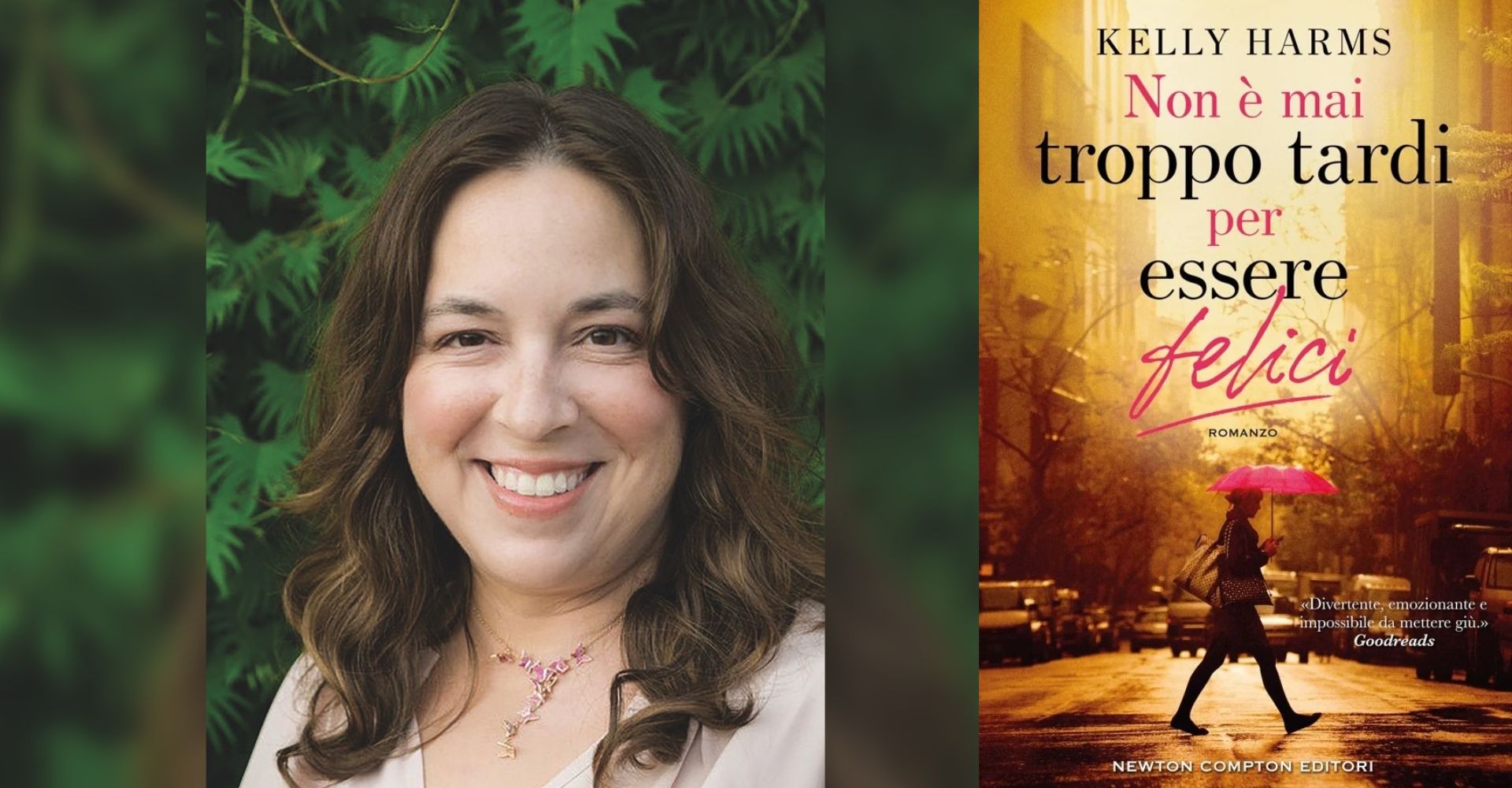
The protagonist of Not Too Late to Be Happy (Newton Compton, translated by Eleonora Toselli and Erica Severi), freshly published and quickly a standout in the lists of best-selling books, does one very simple thing: she stops, takes a deep breath, and tries to shed, even if just for a moment, that armor. At last, a little lighter, she attempts to rediscover herself, reinvent herself, and imagine a new version of herself, freeing herself from the commitments and expectations tied to the roles of mother and worker.

L’autrice, Kelly Harms, vive a Madison, nel Wisconsin, con il marito Chris, il figlio Griffin e il loro cane Scout. Dopo aver vissuto a New York e aver lavorato come editor e agente letteraria, ha deciso di dedicarsi alla sua più grande passione: raccontare storie. Not Too Late to Be Happy è diventato bestseller negli Stati Uniti, dove è uscito nel 2019. Riscoperto dalle lettrici e dai lettori, è stato premiato ai Goodreads Choice Awards, tornando così al centro dell’attenzione.
The Plot of Not Too Late to Be Happy
At the heart of the novel, a chart-topping heroine, is Amy, who works in a school library and has long since set aside dreams and, in general, time for herself. Precisely, she shelved everything for three years, when her husband John left for Hong Kong, telling her over the phone that he wouldn’t be coming back.
But when John resurfaces, contrite and determined to rebuild his relationship with the kids by spending a summer with them, Amy agrees and, with no clear plan in mind, sets off for New York, staying with her friend Talia.
The brief sojourn with her friend, a brilliant woman perfectly at ease in the New York scene, soon proves to be a turning point, from which she emerges fundamentally changed.
The Joy of Making Choices for Oneself
It will be a summer in which Amy rediscovers the pleasure of making choices for herself, in a city that never stops reinventing itself and that offers endless possibilities and intriguing encounters. Like the one with a handsome literature professor, who makes her feel seen and desired again…
And as New York shows her the woman she could have been, Amy also finds time to reflect on the past and her marriage, realizing that the rifts were not created when John left, but had been there for a long time, hidden beneath years of silences and compromises.
“Amy Byler is the Cinderella of modern motherhood”, writes the author on her site, adding: “I believe, in the end, a little bit of Amy Byler lives in each of us. She finds herself juggling a life of too many sacrifices and stresses, working a bit too much, and not allowing herself enough of a life.”
“What I’m particularly proud of,” continues the writer, “is the way Amy shows how much joy can be found out there, when you decide to take care of yourself, even just a little. This book is an invitation to action aimed at all mothers: read more, rest more, demand more. And stop sacrificing yourself like martyrs.”

By courtesy of the publisher, here is an excerpt from the new book:
Three Months Earlier
There are a lot of people you don’t expect to meet in a small town in Pennsylvania. And some you do. I run into my best friend Lena almost every day—she teaches at the same school as I do—so when we don’t do everything we can to see each other, we still end up bumping into each other: in the hallways, in the faculty lounge, or in the parking lot scraping frost off our cars even well into April.
And there is my daughter Corinne’s best friend, Trinity. Dear God, a day without Trinity would be a day to remember. Trinity at school, Trinity at my place, Trinity’s car in the pool parking lot where she waits for my daughter to finish swimming lessons and then wanders around town to check out the guys.
And my dental hygienist. I see her every Saturday at the farmers’ market, where she sells handmade soaps and candles alongside the other parishioners. If I don’t stop by their stand to say hello, she leaves a note in my mailbox and, since she’s really stingy, I know how heavy that weighs on her. “Dear Amy,” she writes. “I’m thinking of you. Let me know if you and the kids are well. In the love of the Lord, Miriam.”
Then there are the people you don’t expect to meet. Jamie from Outlander, for instance. As much as I search for him—and try my best—not a single sighting occurs at the market, at school, or even at my son’s Odyssey of the Mind competitions.
Or Oprah. I would love to encounter Oprah. I think it would be fun to talk books with her.
Or my husband.
If only he weren’t right there in front of me. My husband of eighteen years. Spotted last three years ago, when our daughter was twelve and our son eight, and he packed a carry-on with the shirts I ironed and the ties I chose, a set of clothes, a few sweats, the essentials to shave, and his six different tranquilizers, and left for a business trip to Hong Kong. And he never came back.
He’s back.
There he is, standing beside the bandages aisle at the grocery store. He’s staring at me. He’s forcing a smile. I know in an instant—one brutal instant in which I fear this moment for years—that it’s here.
It was only a matter of time.
He wants back his life.
Like any successful, independent adult woman in a situation like this, I hide behind the cotton swabs.
It’s a futile move. John will be no more than three steps away from me, and surely he’s noticed me. He’s just offered an awkward little shrug of his shoulders. It’s the smile of “Sorry I forgot to pick up milk on the way home, but I’m here now, exhausted after a long day, and it’s too late to turn back, so should the kids have cereal for breakfast tomorrow?” My students have a similar version: the “Can I have an A for effort?” smile.
The problem, however, isn’t that John forgot to pick up the milk on the way home. He forgot to come home, full stop. He forgot to come home, raise our children, pay our bills, and be faithful to his wife for the last three years, and I truly believe that the expression on his face should be something else. I would prefer if it looked like the face of someone whose ex-wife is about to strike him on the head with a blunt object, for example.
From my crouched position at the far end of the first aid aisle, I scan for blunt objects.
I can only see fluorescent pink hula hoops. It wouldn’t be easy to knock him out with a plastic glitter-dusted hula hoop, yet for a long moment—almost a pleasant one—I seriously entertain the idea.
“Amy?” asks John. “Is that you?”
He knows it’s me. I know it’s him. I would recognize him anywhere. For almost a year after they left us, I kept believing I’d glimpse him in other cars as I drove through town; my heart would stop, then crash again on a second glance, those tiny false alarms leaving me drained. Once, just a couple of weeks after he’d gone, I thought I spotted a man shaped like John in the back seats of a ride-sharing car turning into our street, and I felt that sensation, the sensation of “knowing,” and my blood started to surge and I felt as if I were trapped in a canyon with no water or food and someone was coming to rescue me with a rope ladder. I pulled over and waited for the car to stop in our driveway. But it didn’t. It sped past while I sat, staring at the rearview mirror, watching it roll away without slowing down. It hit me so hard that I couldn’t drive for twenty minutes because my vision was blurred.
But this time is different. This isn’t a drill. He’s back, and I’d sooner die of thirst than seize any rope he might offer me now.
“John,” I say, pretending, uselessly, that I’ve only just noticed him. I edge closer, turning into the aisle where he stands. There are ice packs and gauze packs and tubes of antibiotic ointments. Everything you’d need to put him back together after I’d torn him apart with children’s toys and jugs of vitamin D.
“I can’t believe you’re here,” he says, and I can only gape at him in astonishment. Can’t he believe that I’m here? In the town we lived in together for nearly twenty years? Where our kids spoke their first words and took their first steps and are waiting for me at home with—I glance at my basket, not even remembering what I came for—microwave popcorn, tampons, and acne cream? “I mean, I expected to have to come home to talk to you about it, and I was worried about how you’d take it, and how to figure out how to find you alone before the kids arrived, but this is better, right? Because I’m not invading your space?”
I keep staring at him. I want to yell. I want to cry. I want to be the kind of person who could lunge at the face of another and claw it to shreds. But I’m not that person, and we’re in a grocery store, so I just glaringly stare instead.
“Amy?” he asks. “Amy, are you all right?”
“Go away,” I hear myself say. “I don’t know why you’re here, but we don’t need you. Go away. Now.” I set down my basket, which suddenly feels heavy enough to hurt, and give him a small wave of dismissal, as if he were a bird that landed too close to me in the park.
“I’m sorry,” he replies. “I’m so very sorry, but I’m not leaving.”
Suddenly I remember: they sell walking canes here. I could do a lot of damage with a cane, especially with one that has a tripod base for extra stability.
“Amy?” he asks again. Am I smiling? Perhaps even smirking? Finally, is the day I will lose my head altogether arriving? I feel like laughing and have no idea why. “Do you need to sit down?” John asks.
And then he does something so unforgivable, well beyond any limit, that almost—almost—I decide to scream at everyone around and fight back with every ounce of my strength.
He reaches out to grab my arm.
I snatch back. “Oh, no!” I exclaim, and in an instant I reclaim my faculties: the violent thoughts, the shouts, and the urge to hide disappear, and finally, after what feels like an eternity, I return to reality. I take a breath. “I have no idea what you’re doing here, John, but it’s been three years since I last saw you, since you were living with me and our kids and sharing my bed and our table and our life day after day. Three years. More than a thousand days. And you can’t come to my grocery store and buy plasters from my selection of plasters and try to grab my arm as if I were some kind of invalid. Not after all those days and nights and mortgage payments and power bills and dentist visits. Don’t you dare. You can’t.”
John looks mortified. His awkward smile has been replaced by a pain as deep and wide as mine. I suddenly realize that he too has stood in a canyon. And he believes I am the one with the rope.
He shakes his head as he speaks, and the words that come out of his mouth are everything I dreamed of hearing him say years ago when he left, and my world collapsed around me. Only now they ring in my ears as a sharp, painful whistle.
“You’re right,” he admits. “I did something terrible and I am truly, truly sorry. But I’m not here to hurt you again. I’m here to set things right.”
“I don’t know how you could ever do that,” I tell him honestly.
“It’s not up to you to decide,” he says, and the words are so disarming that I am momentarily silenced. “It’s up to me. And that’s why I’m here. I want to be the man I should have been, a real father to our kids. I want to try to be the father they deserve.” He picks up my basket from the floor. “I want to fix things.”
“What does he want?”
My daughter Corinne, my son Joseph, and my best friend Lena sit in my—our—home, a beautiful two-story near Country Day, the school where I work. Like most of the nice things, my home requires a lot of maintenance. It ensures I never have a spare cent saved away. If he notices that I’ve tucked away a hundred dollars here and there to try to take my kids to a national park for a week, the house would crumble. I think she’s afraid of abandonment.
When John was around, it wasn’t a problem. He was handy with manual tasks and happy to tinker around inside the house, fix what needed fixing, and spend whole days watching videos on YouTube to learn how to do things. Those times when he’d give up and call in a pro, his generous salary as an internal legal consultant for a large food company more than covered the costs.
The house needed work from the start, of course; it was already a hundred years old when we moved in and wasn’t exactly getting younger. But everything could be fixed, one thing at a time. The wiring was brought up to code, the walls were repaired, the basement waterproofed, and the wooden cladding replaced in keeping with the architectural style. One thing at a time, no rush. Growing up in Amish country with no Home Depot nearby, John was excellent at fixing almost anything with his own hands.
Except for himself, I suppose. To fix what was wrong in his life, he pursued a two-step approach: phase one, bottle up all his emotions so no one would notice that something wasn’t right. Phase two, run away from his wife and his family.
“He wants …,” I rummage somewhere. It isn’t possible that my kids are about to learn that their father is an asshole, after having protected his reputation—their memories—for three long years of loneliness. “He wants to spend time with you. He loves you to death and he always has. He wasn’t there for you, and he regrets it.”
From Cori’s voice comes the teenage-mouthed sigh, the caveman-era query that means: “Nonsense, you don’t know anything / I’m making up feelings / Back off, old lady.” That kind of sound a kid makes if you tickle them while they sneeze. Thanks to my two long, difficult parts, if I allowed myself to slip into that half-grunt/half-laugh sound, I’d probably leak a little bit of urine too.
“Let’s hear what he has to say,” I suggest. “Let’s organize a little family meeting and hear him out.” And then, as if just thinking about it makes me physically ill, I recount to them what he told me there by the band-aids, once I had finally managed to calm down enough to listen. “He will soon arrive for the summer holidays and would like to spend the first week with you.”
“What?” asks Cori. “No. That’s not possible. I’m out.”
That was exactly what I thought the moment he asked. It does not exist.
“I think I know how you feel,” I say, then realize the mistake.
“You have no idea how I feel. Your father didn’t abandon you the week you turned twelve.”
“True.” God only knows what patience I need with this girl. “But my husband left me with two wonderful kids and a wonderful, beautiful house and moneyless, jobless, so I can try to put myself in your shoes.”
She rolls her eyes. “But it’s not you he wants back.”
And here it is: the adolescent’s secret superpower. It wasn’t his intention, but her words pierce my heart. Had I thought he was coming back for me in that first moment when I heard him call my name? When he tried to hug me before leaving? When he looked at me with a hint of melancholy in his eyes?
How could I not?
I lift my chin. “I think it’s better to discuss it without further drama. There will be no kidnapping. We will make this decision together, all four of us.”
“I’ve already decided. No.”
Mother knows best? That’s what I thought the first time John asked to spend a week with the kids. A week, to make amends for three years of absence. No. That’s not enough.
“Let’s discuss it at the family meeting before deciding,” I suggest, feigning indifference. “I’d like to see what you can learn from him and from facing someone who has caused you pain.”
“First,” interrupts my son Joe, the school’s resident brainiac, “he can’t attend a family meeting. Family meetings are only for family.”
Cori rolls her eyes and crosses her arms. “Only for the family!” she repeats. It makes me want to laugh. When they were little and I’d had it with their endless bickering, I would sometimes threaten, “Don’t forget your father will be back in two hours,” and they’d promptly fall into line, becoming best friends in an instant. Even now, the mere thought of John’s arrival makes them unite against him.
“Second,” continues Joe. “I have nothing to learn from my father. Unless you want me to learn how to have a nervous breakdown and go to Hong Kong and use some younger women to rebuild my self-esteem at the expense of my family.”
I clamp my jaw. Should I be annoyed or grateful that my twelve-year-old son’s psychologist is skilled enough to let him voice all these feelings so early?
“May I?” asks Lena, who wants to speak. We all nod. Lena is part of the family in a way, or she’s become one in the last three years. Would I have survived John’s abandonment without my best friend’s help—finding me a job, cooking for me, and holding my hand while I cried? I don’t think so.
Lena’s voice fills the room. “If we intend to take a stand against your father, using your own legal language, we should consider what we would have to prove in court to cut ties with him permanently. Based on my extensive study of The Good Wife, we would have to prove that, by leaving, he caused you real and irreparable harm.”
Corinne, a devoted fan of all legal dramas, pays attention. Joe, who adores logic but is generally indifferent to television, waits patiently.
“Has he caused you real and tangible harm?” Lena asks. “I would say no, not really. Because your mother is extraordinary. Overnight she has gone from being a full-time mom to working as a school librarian, all so you could keep attending your exclusive private school without missing a single day. She refinanced the mortgage in a flash to free up money and fill you with delicious Eggo waffles and Lego and… Speedo, even without your father’s child support. From the point of view of quality of life, you didn’t suffer at all from his absence.”
I look at her. The sentiment is kind, but what clearly emerges from this speech is how much I suffered. I am the living proof of ongoing, low-grade pain. If an advertising agency wanted to capture suffering in a 30-second spot, they’d make a time-lapse video of me wearing my teaching pants with the elastic at three different colors, shoveling twenty centimeters of snow at five in the morning to get my kids to their morning activities on time, teaching two hundred and fifty ultra-privileged kids not to use computers to look at porn for ten hours straight, and then collapsing on the sofa at the end of the day to watch an episode of Outlander, too tired even to search, let alone turn on, my vibrator.
That would be a pitiful video.
But Lena isn’t done. “Now, on the less tangible plane, we could prove the emotional pain and suffering, right? Because it must have hurt when he left. But is it irreparable? This is the question he wants an answer to now. He wants to know: “Can he make up for lost time?””
“What does it matter what he wants?” Cori interrupts. “What about what we want?”
“Okay,” Lena resumes. “What do you want? To forgive him and enjoy yourselves with him now, can that really make you feel better than hating him for the rest of your lives? In other words, is punishing him really what’s best for you?”
Cori lets out a clearly audible groan. “Lena, try not to make it seem so unreasonable to hate him forever.”
“It’s unreasonable to hate ‘anyone’ forever,” I say, mostly to myself.
“Lena is right, as always.”
She shrugs and gives me a satisfied little smile. “What can I say?”
“I’m not happy with your father,” I make clear to my kids. “In fact, to be completely honest, he hurt me a lot when he left.” And if I’m even more honest, seeing him again today is a hard blow to the heart.
“But don’t tell me what?” Cori comments.
“But as much as the urge to punish him might seem appealing at first, I have to remind myself what I want most in the world. And that’s your happiness. Well,” I add after a moment’s reflection, “it’s not true. What I want most is for both of you to finish college without any criminal records. Then I want your happiness. I believe spending time with your father—and attempting to forgive the mistakes he has made in the past—could make you happier, not less.”
Do I believe what I just said? Do I believe so strongly in forgiveness? To the point of someday forgiving John? One day? Could I even forgive him and reintegrate him into my life as if nothing had happened?
Do I believe it? Probably not. But do I want it for my kids?
“Now, you know your father didn’t leave us for no reason, even if at the time it didn’t seem that way. He left because he really believed we’d be better off without him. He left because he was so sad and troubled that he thought he was bad for you and believed that leaving would be best so that he could come back one day and set things straight.” I try to stifle a grimace. Even though he swore to me endlessly that it wasn’t personal, how could it not be personal when the man you love tells you he has to move away to hope to be happy again? “And you know he never stopped thinking about you. Those ridiculous notes…,” I remind them, referring to John’s habit of sending oversized checks along with the notes he sends the kids for their birthdays, holidays, and, one year, even for Labor Day. “They’re proof that even when he didn’t quite do the right thing, he tried to do something.”
Joe takes on his thoughtful, even-tempered air. Lena, Corinne, and I look at him. Whatever he is about to say will probably apply to the whole family. That’s the kind of boy Joe is. Reasonable. He thrives on reason. I am more of a martyr and Cori is a bit melodramatic, while John has always been a touch selfish. Joe is the good face of all these medals — generous, perceptive, hardworking — and, on top of all that, he is very, very smart. I don’t understand him, but I love him all the more for it.
“Aunt Lena,” he asks, and I know a philosophical question is coming, because Lena, before becoming a teacher at Country Day, was a nun. “Do you think forgiveness is a skill learned through practice, like playing chess, or a natural talent, like being in-tune?”
“Yes,” Lena answers, as she always does. “Some people must practice forgiving and will never naturally be gifted at it. Either they work hard and become excellent, always with effort, or they never do and carry a lifetime of pain as heavy as an elephant.” I know this well, because I risk becoming one of those people every time I stop paying attention.
Then she turns to me and nods. “To some people, like your mother, forgiveness comes so naturally that they don’t even notice it. They end up carrying the wounds double because they forgive too quickly, but they suffer half as much, thanks to their ability to leave things behind.”
I purse my lips. I’m not sure I agree, but I appreciate that Lena makes me seem more capable in my kids’ eyes than I feel.
Cori sighs. “I’m still mad at Trinity for buying the same lipstick shade as mine. It was supposed to be my signature.” I bite my tongue to avoid speaking ill of Trinity, Cori’s least favorite friend. “What my dad did is even worse. I want to hold it against him for, I don’t know, another couple of years. Can I do that?”
“Of course you can,” I assure her. “I think you’ll pay for it, but okay. And you, Joe?”
“I’ll back whatever Cori decides. If she doesn’t want to spend time with him, we won’t. Not even a week.”
Lena smiles and leans back. She knows exactly what just happened, even better than I do.
Cori sighs deeply. “Fine. The pest. One week,” she says to Joe. “One week is fine.”
Joe shows the faintest of smiles, as if convinced no one is watching. Lena and I exchange a conspiratorial look, thinking not even they notice us anymore.
“One week at the start of summer,” I conclude. “Just one week. It seems like it will do everyone some good. And if not, I’ll stay close; I’ll be there to pick up the pieces.”
I still don’t know, at that moment, that I will go to pieces a thousand times over before this imminent adventure is over.
© 2026 Newton Compton editori s.r.l., Roma
(continua in libreria…)
