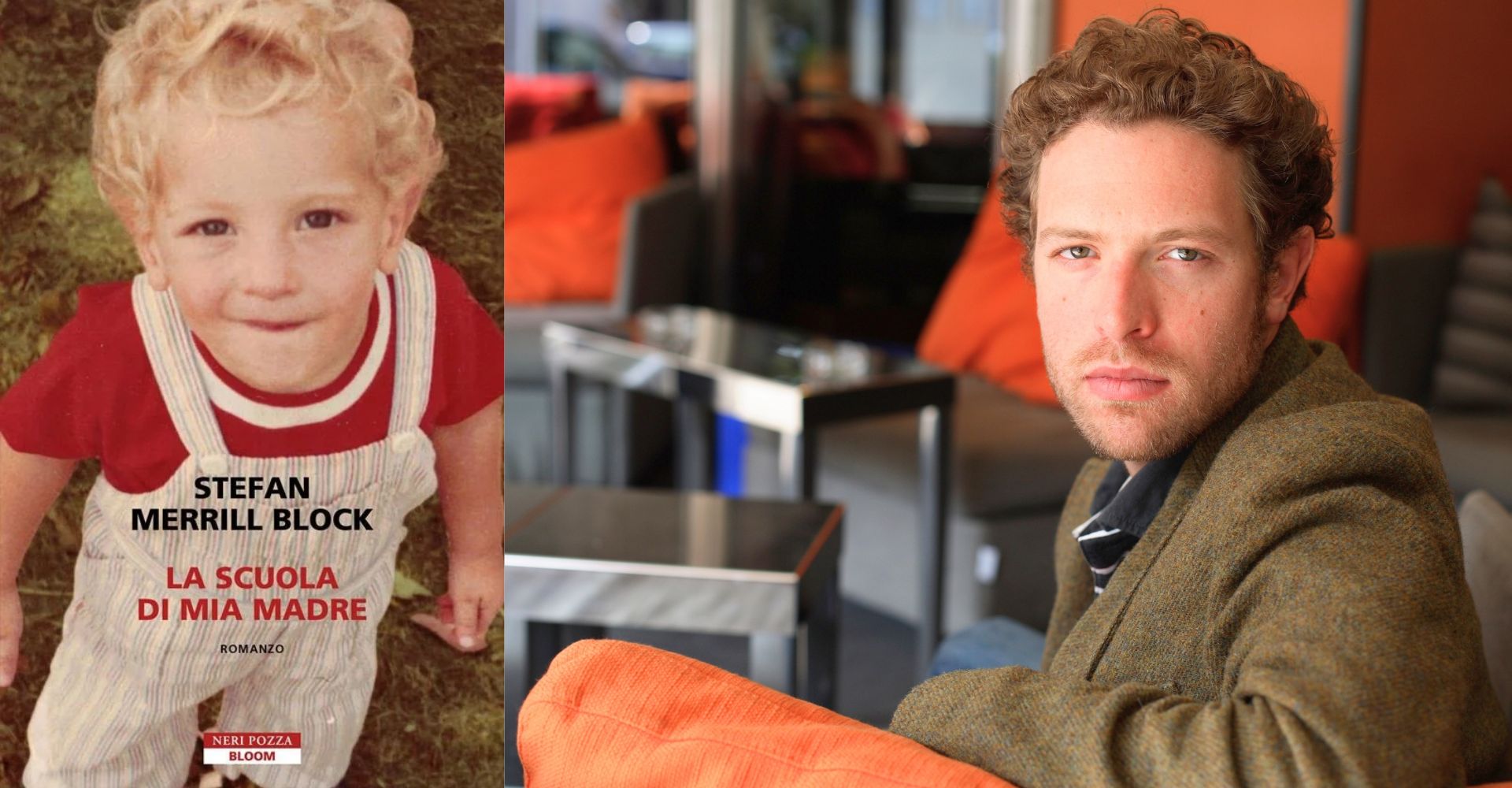
My Mother’s School by Stefan Merrill Block
You can feel the air growing thick with humidity. The sky remains blue, yet it’s already becoming hazy; the sun has dwindled to a pale circle you can look at without even squinting. By noon, a wind makes the evergreen oaks and cedar elms sway, lifting enormous clouds of dust and cut grass from our neighborhood. Thunder shakes the windows, and it’s time to go out and marvel at its terrible reach. A storm in tornado season perfectly mirrors the whole story of the state of Texas. No gradual changes for us Texans. First it’s one thing, and then suddenly it’s something completely different. A dark, heavy lid has formed on the horizon and is already closing in on us, while the sky stitches itself with blue-white flashes. Funnel clouds begin to form in the sky.
On TV, the Doppler radar has started interrupting the programs on air. The tornado warning sirens in town begin to wail. At work, Dad and his colleagues may have huddled in the bathrooms. At school, where my brother goes every day, they will move away from the windows to gather in the gym.
But I don’t go to school. I’m ten years old and in January my mother pulled me out of school. “Homeschooling,” that’s what we call what we’re doing, but so far our weekdays have not remotely resembled a school. Apart from a few math lessons I do at the kitchen table in the morning and the novels I read by myself in my room, we spend our days wandering through the malls and restaurants of our suburban town. In the afternoon we float in the pool, where Mom likes to hold my little body afloat in her arms, tilting my head toward the bright Texas sun, hoping the rays will brighten my hair. The photos Mom keeps scattered around the house of me as a child show my smiling face beneath bright blonde hair, with bangs like Albert Einstein on my toddler head, and my mom’s greatest wish would be to mend the sorrow of my hair turning brown around the time I turned four.
But today we won’t go to the pool. The thunder now rumbles through the walls, while the strong wind lashes the vinyl siding on the outside. Mom takes us to our house’s tornado shelter, which is really just the back of her closet. It’s a comforting and cramped space under the stairs that not only protects us in weather emergencies, but also serves as a refuge for Mom’s boxes filled with our childhood memories: drawings, worksheets, notes made by me and my brother. There inside you breathe an invaluable sense of security and a time that seems to stop, even when the lights go out and Mom lights a lantern.
We moved from Indianapolis to Texas a couple of years ago and, now into our second spring here, hiding from tornadoes has become routine. But tornado season means it’s almost May, and so our first semester of homeschooling is about to end. When I left school, Mom and I had decided homeschooling would last only a semester, but with summer approaching it seems she’s avoiding the topic of my return to school in the fall. I fear she has a new plan in mind.
«We’re not doing well at all,» says Mom.
«What do you mean?»
«Come here.» She brings the lantern closer to my hair. I tilt my head and I feel her examining it as minutely as the gorilla mother we once saw at the zoo. «No, I think we can call this project a failure. With all that sun you’ve absorbed, and honestly I don’t think the color has moved an inch.»
«She truly wants to stay brown,» I say. «I don’t know why.»
«You were my blonde angel. My God, Stef, you should have seen it. You should have seen how the other moms looked at you. Where did my blonde boy go?»
I step away from the lantern so Mom can’t see my face. I know that when we left Indianapolis, Mom had lost much of her happiness, leaving behind those years when my brother and I were little and had an absolute need for her. Even if my memories of those early years in Indianapolis aren’t crystal clear, I can still taste that sweet period, as if a remnant of cherry popsicle still lingers on my lips. Shouts under the sun, sticky hands with fruit pits, laughter echoing through the ranch rooms. I understand why Mom might want to do everything possible to bring back those years through sun and buoyancy in the water, and the thought that I could return to her a version of that lost boy is like one of those cigarettes our neighbor smoked in secret at the back: a terrible kind of pleasure that fully satisfies me while also killing me a little.
«It’s still me,» I tell her, as if it were a question, and I whip around at a terrible dull sound. Outside, some wandering object must have slammed into our living room windows. But Mom doesn’t seem to hear it as she pulls out a Tupperware container with my name written on it. The lid pops open with a bubbling sound, and she digs inside until she finds what she’s looking for. A somewhat crumpled envelope with the inscription Stefan, the first haircut.
I’m breathless. In her hand there’s a bright blonde strand of my hair, which I remember well, tied with a black Goody ribbon. She clenches the strand in her fist, holding it close to her chest, this last remnant of her greatest happiness.
«See?» She slams my old strand in my face. «Now you understand?»

THE AUTHOR AND THE BOOK – The author of several novels, such as I Don’t Remember, The Storm at the Door, and Oliver Loving (all published by Neri Pozza), Stefan Merrill Block returns to bookstores with a markedly different work, his first memoir, titled My Mother’s School (Neri Pozza, translated by Carlo Prosperi).
Between the pages of a work that traverses and describes moments heavy with pain but also of love, the Texas-born writer who now lives in Brooklyn revisits memories of his childhood, and in particular his mother’s decision to withdraw him from elementary school at age nine. A decision that hides the need for control and the obsession of the woman, the will to stop Stefan from growing — who for five years would be apart from his peers — and to keep him from knowing any reality outside that home.
Block retraces that stretch of childhood, reflecting on the “betrayal” by his parents and on the drift that homeschooling can lead to in the presence of permissive laws. In hindsight, those years appear as a forced isolation, and his mother’s demands as a “psychological coercion.”
A book that, inevitably, conjures the memory of the case known as the Family in the Woods, which has been widely discussed in the press, and engages with the debate over the off-grid lifestyle (far from society and institutions) of entire families, offering a rare point of view—the perspective of a child growing up under such conditions.