
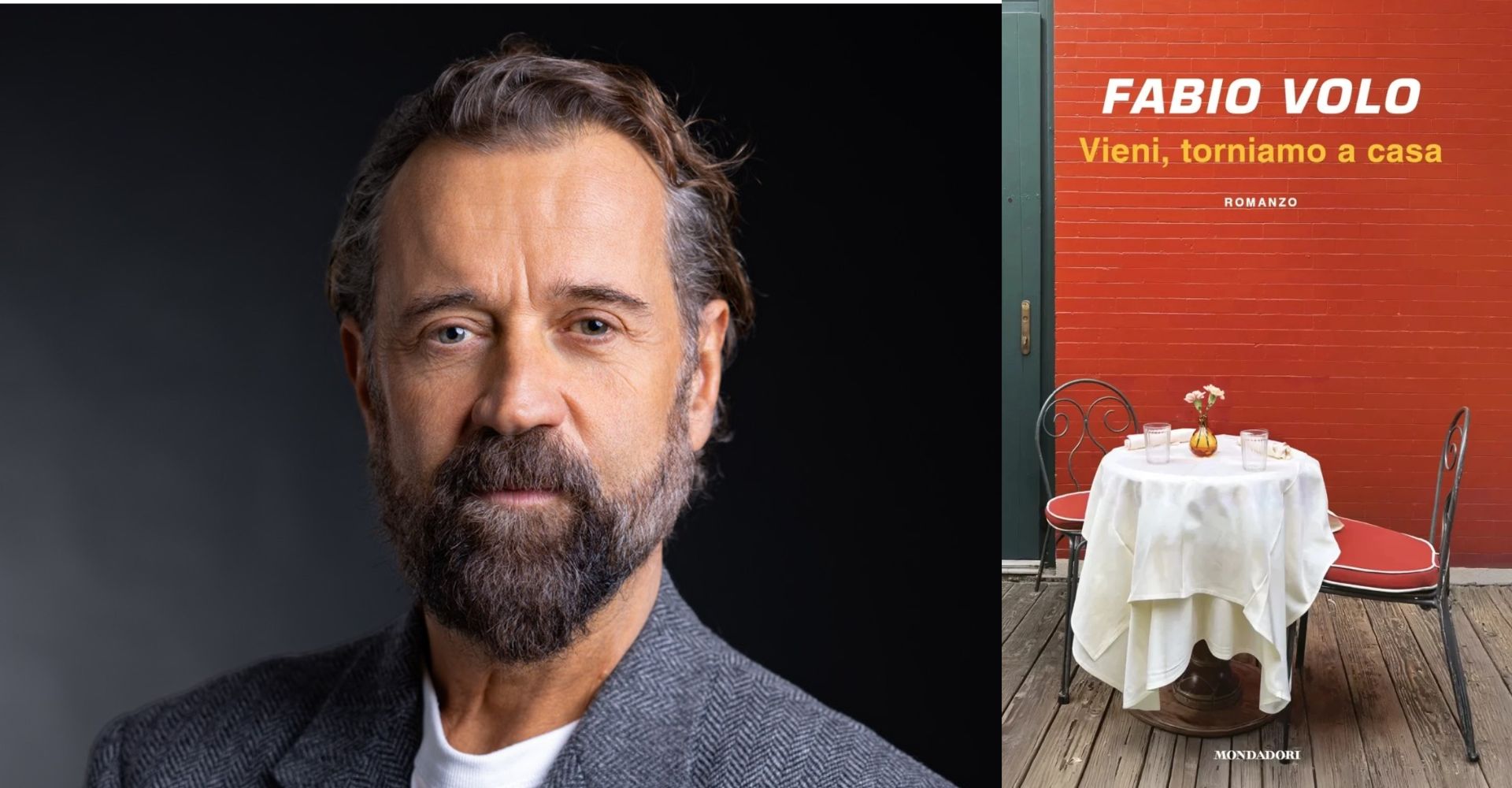
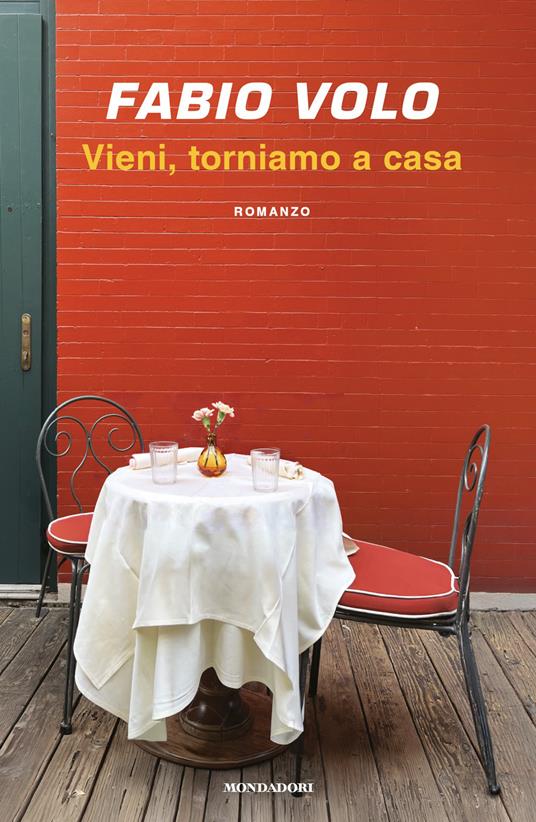
“A transformative love story, a coming-of-age education in adulthood that’s easy to identify with.” Mondadori presents Come, Let’s Go Back Home, the new novel by Fabio Volo (here is our feature on the bestselling books by the writer, actor, and presenter), two years after We’ll Dance to the Music They Play (2024).
“I think no writer can truly write something that doesn’t speak of themselves”
In Come, Let’s Go Back Home, Volo tells of “a love that arrives when you least expect it and forces you to throw yourself into the fray, to lose control.” Until you discover a part of yourself you kept hidden, and it brings you back home.
Interviewed by the weekly Sette of the Corriere della Sera, Volo spoke of many changes in his life, and about his relationship with storytelling he confided: “I think no writer can truly write something that doesn’t speak of themselves.”

The Plot of Come, Let’s Go Back Home
Here’s the plot of the novel: the protagonist, Lorenzo, believes he has already lived through everything there is to life—births and losses, love and its end. He has everything under control, for better or worse… at least until he meets Aurora, so beautiful and free, yet so fragile, a “out of category”, as his friend Ezio would say. And she is a whirlwind, a rollercoaster of emotions, those butterflies in the stomach that he thought belonged only to another era. How can one become destabilized in such a dramatic way, feeling ridiculous and lost like a boy on his first crush? Where did all he believed he had understood, the books he read, the experiences he lived, go? And who would have expected, now, this incredible surge of life?
Speaking to Sette about Lorenzo, Volo explained: “I wanted him to be a rational man, who believes he has an answer for every question…”.
Born in Calcinate on June 23, 1972 and raised in Brescia, Fabio Volo debuted in fiction with Esco a fare due passi in 2001. Among his bestselling novels are also È una vita che ti aspetto (2003), Un posto nel mondo (2006), Il giorno in più (2007), Il tempo che vorrei (2009), Le prime luci del mattino (2011), La strada verso casa (2013), È tutta vita (2015), A cosa servono i desideri (2016), Quando tutto inizia (2017), Una gran voglia di vivere (2019), Una vita nuova (2021) and Tutto è qui per te (2023).
Slowly, day by day, I learned to feel comfortable with my new routine as a separated man. I could enjoy the time with my son, and also the time I spent alone. In the evenings I preferred staying at home. I spent a lot of time at home. To be honest, I spent a lot of time alone.
The first days I let myself go a bit.
According to Ezio, I should have indulged “all the most fleeting pleasures of this mortal life.” But at that moment I was fine just as I was.
“You’re letting yourself go a little,” he’d tell me. “Every time you wear that sweater, a stylist somewhere loses five diopters.”
“Don’t you like it?”
“My mother was still a virgin when that look was in fashion. And those hair? You look like Yogi Bear washed with fabric softener.”
I wasn’t paying attention to my appearance anymore.
The only time I cared to be the best version of myself—groomed, perfumed, dressed up—was when I took Matteo to his mother. I wanted her to find me attractive, hoping she might regret it. How ridiculous; thinking about it now makes me feel sorry for myself, I was truly lost.
One day, after a shower, I glimpsed myself in the mirror and felt something strange, as if I were looking at myself for the first time in years. It was still me, just older. The skin around my chest sagged a little where it used to be toned, effortlessly. I’ve always had a brisk, tense build, something I inherited from my mother. Any activity, even light, yielded immediate results. And now it seemed everything had suddenly collapsed. I pinched the skin around my hips; it offered no resistance. It was flabby. I’d lost elasticity everywhere. I was full of folds. At the level of the navel there was a crescent-shaped line with the points downward, a smile turned the wrong way that made my belly look sad.
At dinner I lacked the desire to eat, I felt inexplicably down.
That night I woke around four and stayed there, grappling with my thoughts. The image of my body reflected in the mirror depressed me, as if with it my spirit, my courage, and my virility were also collapsing. Maybe that’s what Susanna meant when, just before leaving me, she said: I need a man who is more of a man.
We had argued because, while we were shopping, she removed a pack of cookies from the cart to replace it with another. From my face she must have understood how serious that gesture had been for me. There are things I hold onto especially, and perhaps a bit irrationally. Small fixations I can’t go without: my vinyl records and their sleeves, my cult books, some photographs, the pens and pencils I use to correct homework and prepare lessons. Among these, also a particular kind of cookies. I know, it’s silly and obsessive, but I’m not harming anyone.
That day, replacing the cookies in the cart, she seemed to be declaring war on me.
I watched her, grabbed three more packs of my cookies and placed them at the bottom of the cart slowly, awaiting a reaction. It looked like a High Noon showdown at the supermarket.
In the end, she averted her eyes. “I can’t stand you anymore, you and your little things.”
It wasn’t hatred, as Ezio had asserted: “You’re turning her off. Get used to it.”
I’m convinced Susanna never really hated me, but lately she’d had enough of me and of all “my little things.” And she made no effort to hide it.
Later, at home, the tension spilled over into a low-voiced argument, so Matteo wouldn’t hear. Low-volume arguments have more power and are more dangerous than normal ones, because the words become hiss and the gaze concentrates all that cannot be put into the volume.
She said she felt suffocated, that she needed space, light, in short, something better than our relationship.
Her last words petrified me; like a fool I imagined there was someone else and thought it was the worst thing that could happen. And yet no.
“What do you want, Susanna? What is this something better?”
“I don’t know,” she whispered, and it seemed sincere.
“I just know it isn’t this.”
The tone with which she said it had the flavor of a final verdict. It was in that terrified silence that she blurted out: I need a man who is more of a man.
I didn’t expect such a declaration. I hadn’t understood what she meant; it seemed more like an insult than a real need. What did it mean to be a man who is more of a man?
Because I felt hurt I didn’t ask her, and her words lingered inside me.
Now, lying in the dark, in bed, everything seemed unbearable: her words, my flabby skin, life after the separation. On impulse I got up, washed my face, got dressed and went out to run. It was five forty-two, I remember the exact time because I started the phone’s stopwatch.
From that day, in the week Matteo wasn’t with me, I ran every morning.
Slowly I equipped myself, proper shoes, lightweight running glasses, a watch with an app on the phone that signaled everything. I also bought a scale that, besides weight, shows lean mass, muscle mass, body water, basal metabolic rate, visceral fat.
In a couple of months I could manage about fifty minutes without dying.
With running I felt more reactive, more agile, more athletic, but my body still didn’t please me much.
I had never entered a gym in my life. I always considered it a place for buff guys, obsessed with diets and muscles. If someone wanted to exercise, they did it outdoors—cycling, skiing, running—not in a den of pumped-up men who look at themselves in the mirror. Then Ezio dragged me there one day and managed to topple a thirty-year-old prejudice.
I discovered I liked the gym. In the first months I hired a personal trainer, then trained on my own.
The gym became another opportunity to spend time with Ezio.
“You’ll see that, slowly, changes will come. First thing: one day on social media you’ll write ‘I’m back’ under a photo of a lion.”
I laughed. “I think I’ll write: ‘In the end I chose myself.’”
And we rattled off all the lines you read when someone splits up.
The fun part of training together is deciding what to do.
“Do you want us to do some pull-ups?”
“Today I can’t, I’ve got a bad shoulder. Legs? Lunges?”
“I hurt my foot the other day.”
It feels like some sort of rehab in a hospital. Now every morning I wake up with a new ache: feet, toes, heels, knees, back, neck, shoulders. Some days I feel more tired than when I fell asleep, as if a steamroller had passed over me in the night.
It was at the gym that I discovered I had tennis elbow. I felt great, watching the twenty-somethings and lifting my weights for the repetitions, almost with a look of defiance, when a sharp stabbing pain hit my right arm. I dropped the dumbbell, which hit the floor with a loud thud. Everyone turned. The personal trainer approached and immediately declared: “Ouch, tennis elbow. This is going to be long.”
Ezio looked at me. “The time has come to find yourself a girlfriend; it’s obvious you need to stop these habits.”
© 2026 Mondadori Libri S.p.A., Milano
(continues in bookstores…)
