

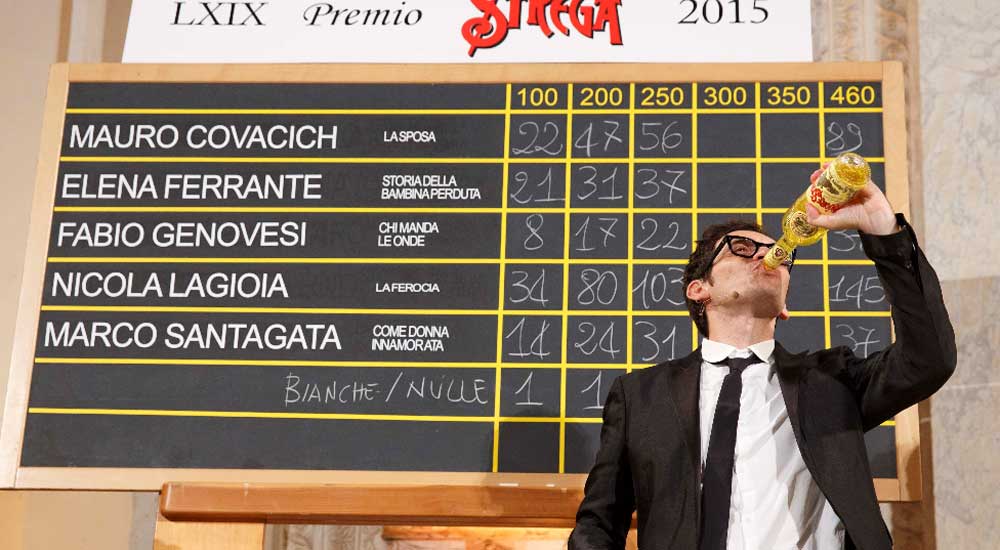
Six years after La città dei vivi, the book about the Luca Varani murder that recently inspired a film, Nicola Lagioia returns to the shelves with Santa Barbara (Einaudi), a panoramic novel that brings the writer back to his region of origin, Puglia, which had already served as the setting for Riportando tutto a casa and La ferocia, with which he won the Premio Strega in 2015.
This time Lagioia confronts himself with a family saga that traverses half a century of Italian history, from the 1930s to the 1970s, retracing the stories of a world he has known since childhood.

A Puglia Where Everything Is Possible
We are in Capurso, a town on the outskirts of Bari, which Lagioia reimagines on the page, merging historical reality with the fantastical heritage of the oral tradition of Southern Italy. At the center of the inhabitants’ imagination is the cult of Santa Barbara, a Christian martyr who, according to local legend, would be capable of granting even the most terrible wishes. A popular devotion behind which lies the hope of bending a destiny that seems already marked by misery.

A Family, Many Ambitions
At the end of the 1930s we meet Nunzia Battista, a sixteen-year-old girl who dreams of breaking free from poverty and, having become pregnant by the young shepherd Nicola Epifania, ends up marrying him. While strolling among the gravines, Nunzia experiences a vision in which a precious diamond necklace appears to her, destined to become the image of the wealth that seems barred to her life.
From this marriage is born Domenico, who inherits from his mother the hunger for social redemption and who, in the postwar Italy, will manage to build an entrepreneurial fortune thanks to the know-how of the local embroiderers. Through his marriage to Anna Levante, the daughter of a Capurso farmer, the story of the Epifania becomes entwined with that of another family, and the narrative takes on a choral breadth.
The Price of Redemption
Around the protagonists takes shape an Italy that changes its skin, as the peasant civilization yields to economic well-being and new social hierarchies. Domenico’s arc thus tells of a hunger for emancipation matured through generations of privations, which ends up turning into an obsession with material success.
The wealth acquired disrupts family balances and brings to the surface forms of domination that seemed to belong to the world the protagonists had tried to flee. In short, the past catches up with you even when you think you have left it behind.
Santa Barbara and the Call of the Invisible
In this setting, Santa Barbara is a presence far from reassuring. Her cult belongs to a popular culture in which Christian religion preserves traces of ancestral beliefs and where the supernatural infiltrates everyday life with the naturalness of an established fact.
Lagioia draws on this patrimony also from the tales he heard during childhood, when he spent weekends at his grandparents’ house in Capurso. From those stories told aloud, a world emerges in which the boundary between the living and the dead was far more permeable than modernity is willing to admit.
Time Out of Alignment
This familiarity with the invisible also informs the structure of the novel, where the narrative voice freely crosses eras and, while maintaining a predominantly omniscient perspective, occasionally lets the first person surface.
The shift in points of view goes so far as to disrupt the normal succession of time, until it suggests that the past could be told by someone who has yet to be born. Even dreams participate in the weave, contributing to that dreamlike dimension that runs through the book and makes the very solidity of memories uncertain.
A Writing That Changes Gear
Also Lagioia’s language changes gear compared to his previous works. The prose becomes leaner and more direct, closely follows the characters and lets the scenes speak for themselves, with a rhythm that has something cinematic about it.
The narrative proceeds through time jumps, spanning entire decades with a casualness that makes the more than six hundred pages surprisingly fast. Meanwhile, the Great History enters the homes of Capurso’s inhabitants, reshaping the course of their lives, with a focus on the affairs of the marginalized that may recall Elsa Morante’s lesson.
The Inheritances We Carry
With Santa Barbara Lagioia thus returns to scrutinize the family, already at the heart of La ferocia, now tracing its fortunes through the transformation of an entire country. The story of the Epifania and the Levante becomes, in turn, the tale of what a generation leaves as an inheritance to the next, including the damages of a past that continues to condition the present.
And if the adults seem destined to perpetuate their own guilt, it is to childhood that Lagioia entrusts a chance for change. Because those who are born find themselves inside a story already begun, and perhaps it is precisely there that they may try to alter its course.
