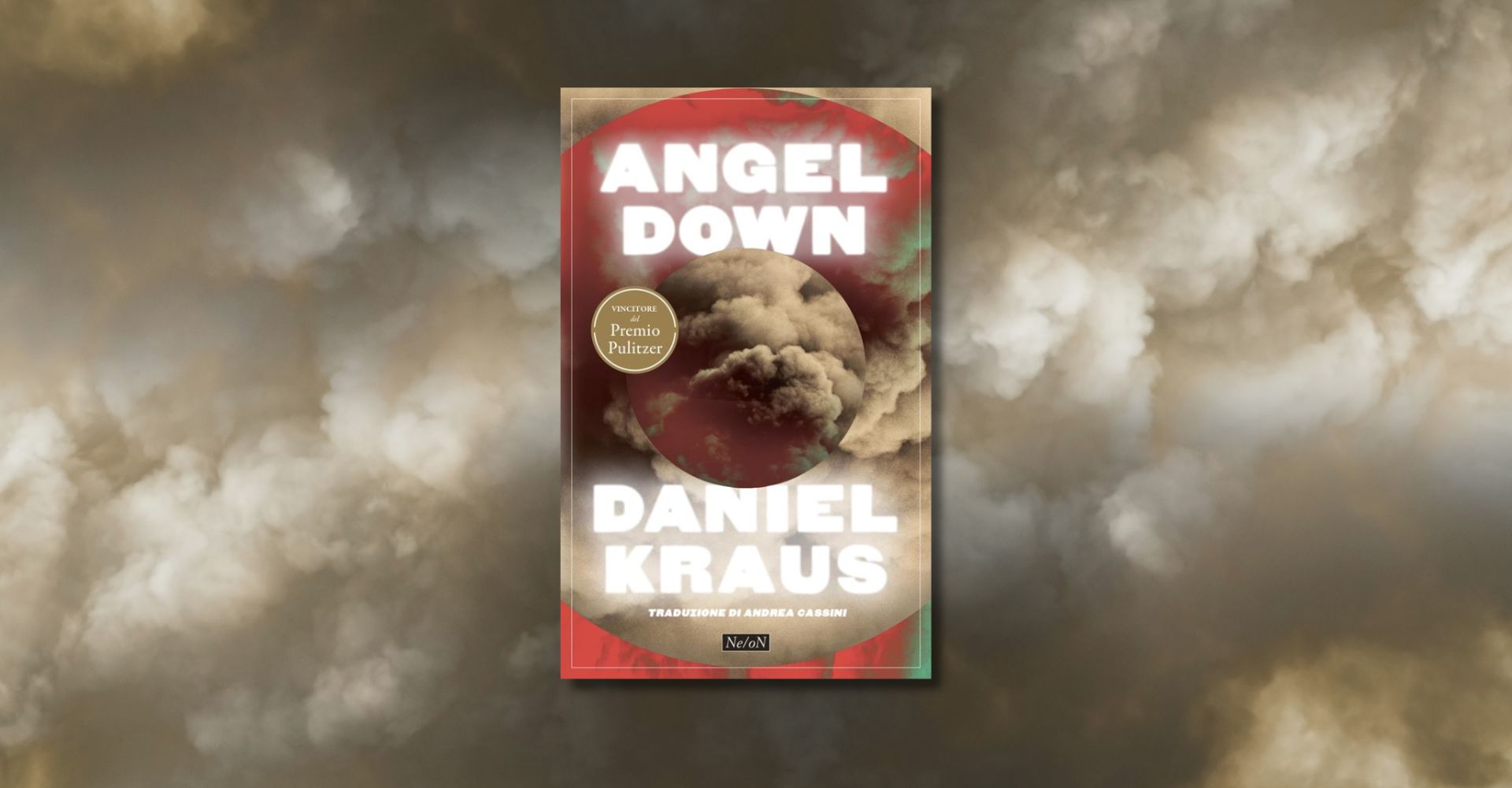
1918, Western Front, between the Argonne Forest and the Meuse. Cyril Bagger, a private in Company P, 43rd Division, Third Army of the United States First Army, rises again, stained with blood and mud after being struck by a mortar blast that should have killed him.
Few books can plunge you as directly into the action as a novel that opens with a sentence already begun, and that keeps going without taking a breath. This is how Angel Down by Daniel Kraus (Ne/oN, translated by Andrea Cassini) begins—a work that would win the 2026 Pulitzer Prize for fiction: with a deafening explosion, a fleeting glimpse beyond this world, and an equally swift return to the hellish trench war; with a river of words laid out one after another to shape the thoughts of the soldier who has just cheated death, yet perhaps would have preferred to remain in its embrace.

Between history and speculative fiction
It is only a moment, and Bagger must rise again: around him gather a brutal cluster of visual, aural, and olfactory sensations that strike just as hard for us readers as they strike his thoughts. There is the vision of the bodies of his wounded comrades. There is the wet, wooden, reassuring smell of the pages of the old Bible that belonged to his father, Bishop Bagger, which the soldier carries like a talisman, even though he never believed in anything. There is the scent of blood, his own and that of the other doughboys, which also has a very particular taste. And then there is a terrifying screech, something far more wrenching than a mere lament or cry for help, an unhuman scream, the sound of endless, ripping agony.
“And the screech, good heavens, the screech permeates everything, so shrill that it makes melodies rise from the dead, a contralto of discarded pistols, a soprano of handheld grenades, the booming lows of dented canteens, a dissonance so piercing that Bagger feels momentarily relieved when he must slip into a muddy crater like a crocodile, there is more silence in the water,”
Bagger and a small group of expendable companions are tasked with locating the author of the scream and ending his torment, braving the open field and remaining vulnerable to any attack by the “Jerry,” the German soldiers.
From the very title of the novel, Angel Down, kept in English even in the Italian edition, readers already know that a “” will appear in the story: it is the premise on which the book rests, blending the brutal reality of a historical novel about World War I with speculative fiction, made up of supernatural elements, science fiction, and horror.
A narrative focused on a single, unpunctuated sentence
It is this blend, together with the peculiarity of a narration centered on a single sentence without periods, that propelled Kraus to the Pulitzer Prize, with the motivation: “a breathtaking World War I novel, a tour de force of style that fuses allegory, magical realism, and science fiction into a cohesive whole, told in a single sentence.”
Kraus is no stranger to these fantastical influences, a hallmark of his most renowned works: The Shape of Water (TEA, translated by Flavio Iannelli), co-written with Guillermo Del Toro, the director of the film of the same name, which focuses on the unexpected bond between an amphibious man and a mute woman; while Whalefall (Ne/oN, translated by Andrea Cassini) tells the underwater journey of a son in search of his father, forcing him to confront a giant squid and a hungry sperm whale that will swallow him, pushing him to find a way out of its stomach within an hour.

The legend that seeds the story
Yet, when the angel reveals himself as the author of that wrenching scream, his presence scarcely amazes; it appears instead as a natural consequence of the atrocities committed on the battlefield. It stands as proof that the horror of war can demolish even the most sacred and enduring things. Or perhaps it demonstrates the existence of a higher entity, come to bring hope, or perhaps vengeance.
For his novel Kraus draws on a real legend from the First World War: the Angels of Mons, a tale that arose to explain the (miraculous) retreat of five thousand soldiers from the British Expeditionary Force during the Battle of Mons, in Belgium, in August 1914. Overwhelmed by the German advance, the British army was not annihilated and managed to complete the retreat, according to the myth, thanks to the appearance of a squadron of pale, ghostly angels.
Amid the deafening roar of explosions and the unbearable stench of corpses, amid mud and smoke, the halo of the angel’s luminous and ethereal presence becomes an undeniable reality this time—a tangible figure, “an elevator between the muddy world of No Man’s Land and the cloudy, murky skies”, a voice that whispers: Save me.
Intruding onto the battlefield, scarred by bombs and corroded by gas, is the same Bagger, accompanied by the very young Arno, an orphan boy who loves adventure novels, who enlisted only to find a place to belong. Cyril Bagger is not a hero: he’s a trickster, more adept at bluffing than shooting; he is a son fleeing his late father’s memory; he’s a soldier who runs from battle, preferring to stay in the rear to bury the dead.
But that day something changes. His resolve grows and takes shape as a graceful woman entangled in barbed wire. Just seeing her and the light that radiates from her skin makes him understand that he must save her at all costs, because only she can bring an end to the war.
The angel as a mutable figure
Daniel Kraus does not chart a linear path for his protagonist, nor for the reader. Through Bagger’s perspective we see how for every man—from the young Arno to Major General Lyon Reis, and through each of the hero’s scattered companions—the angel represents something different to be sought at any cost: wealth, vengeance, lust, fame, love.
The same angel is a mutable figure, taking on different forms depending on the eyes that view him; a being rich with meanings, often dangerous and destructive, but for Bagger it signifies something quite different: the desire to protect what he loves, the affection for the boy to whom he reads adventure tales every night, trying to preserve his innocence, even though he knows that in No Man’s Land it’s impossible to stay safe.
Yet this doesn’t mean he’ll stop trying, again and again, knowing he is doomed to fail, but propelled by a growing and increasingly desperate hope. Perhaps only then, as another war begins a short distance away, this war might end, giving way to a fragile peace as delicate as the translucent page of a yellowed Bible.