Nicolas Deleau, Odyssée funambule, August 26, 2026, 272 pages, €21
One August night, Job leaves the crane operator who has carried him since Dunkirk and sets out across a continent to search for the woman he has loved since childhood, who has become a trapeze artist. Accompanied by Rouslan, a towering Ukrainian, and then by Gabriel the Magnificent, a dapper smuggler whose gold-adorned mongoose keeps him company, he climbs from a ruined Maputo to the coltan mines of the Kivu, where he spends ten years shaping in clay the one he hopes to find again, until a lead takes him to Odessa and then Obock. Nicolas Deleau, winner of the Gens de mer prize for The Kings of Elsewhere, writes for Actes Sud a novel of a quest that runs from the end of apartheid to the Arab Spring and ends in India.
On a granite coast, as a storm subsides, Job, seven years old, defends a sandcastle against the encroaching sea, steps back, rebuilds hastily erected fortresses, then asks his father how the struggle against the tide could have escaped the Greeks, inventors of the rock of Sisyphus. The father answers with a smile, “where there was Homer, there was no tide.” Nicolas Deleau writes the Odyssey to tides that Ulysses’ sea ignored, that of a hero who bears the very name of biblical patience and whom every wave compels to raise his kingdom a little higher on the shore. From the outset, a narrator haunted by Job’s ghost resumes the invocation of the bards to sing this man who returns home as a stranger, poorer than anyone else or richer beyond measure.
The Dreadful Weight of the World
Mozambique emerges from twenty years of war and its mined fields explode at dusk as the rumor of the Rwandan genocide reaches the banks of the Zambezi. Farther north, hills collapse beneath galleries of ore that will end up in smartphones on the opposite side of the globe. Gabriel thrives amid these ruins with the gaiety of a grand lord, selling to all sides both what destroys and what can repair.
The circus counters this heaviness. Five acrobats train at dawn on the deck of the Ilala, and passengers weep at these bodies in midflight. During his years of clay, Job struggles to capture the emptiness beneath the suspended beloved. Simone Weil saw grace entering through the void she herself digs. The book shares this intuition when the model, hollowed out by repeated erasure, reduces to a hollow of light. On the banks of the Ulindi, the same gift takes a material form, that of a widow named Grace who shelters Job and keeps him tethered to the ground. The soundness of the undertaking rests on this wager: entrusting to the artisans of delayed fall the responsibility to resist the slaughter.
Everyone Has Their Ghosts
Across the waves, Captain Jean keeps watch for Dimitri, the violinist from Saint Petersburg whose voice he once captured on the ship’s radio. A girl survivor of a charnel house converses with the apes and understands what Job’s bag hides. Behind her Odessa counter, a Vietnamese businesswoman preserves on the wall the memory of her past as a clown, while in Obock three men wait, perched on a throne of burlap sacks, for the return of a stewardess who left unexpectedly. The novel is precise in giving them long space to speak, a toast or a testimony, on equal footing with Job.
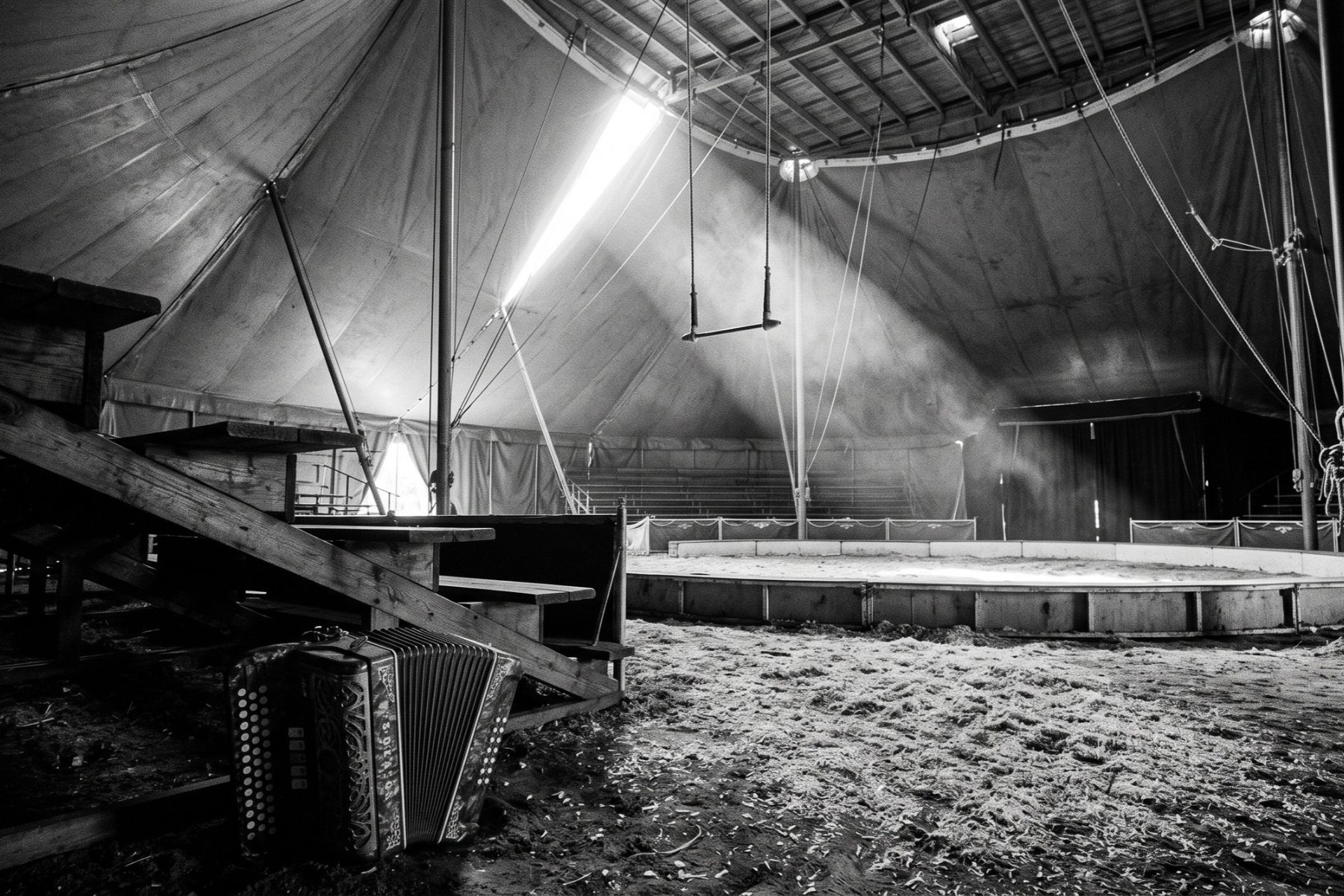
The montage extends this polyphony, as Job’s biographer compiles his notebooks, letters to a certain Regina, a dog-eared photograph in which Gabriel appears in the distance even as the ship’s log denies his presence, passages written in the second person, and free verse. Jérôme Boutain’s black-and-white images, co-signer of Tévennec, punctuate the narrative without captions. True to its warning, the work respects the gaps in this life where its suspense resides.
Under the spell of the Ilala troupe, Rouslan declares that his peanuts will always taste of a circus show, and when Job mentions Proust, claims a madeleine that acts in advance. Odyssée funambule extends this privilege to those who read it and, from the very first pages, entrusts them with memories that linger: Gabriel’s sonorous laughter, a mournful waltz played on the accordion in the dimness of the stands. Dedicated to those who seek Dimitri, this book published by Actes Sud enrolls its reader in their brotherhood and leaves him beneath the tent, eyes raised with a child’s joy toward the wire on which beauty travels from one edge of the abyss to the other.
The article ‘Odyssée funambule, the love quest of Job toward a trapeze artist’ appeared first on Lythrum Press.