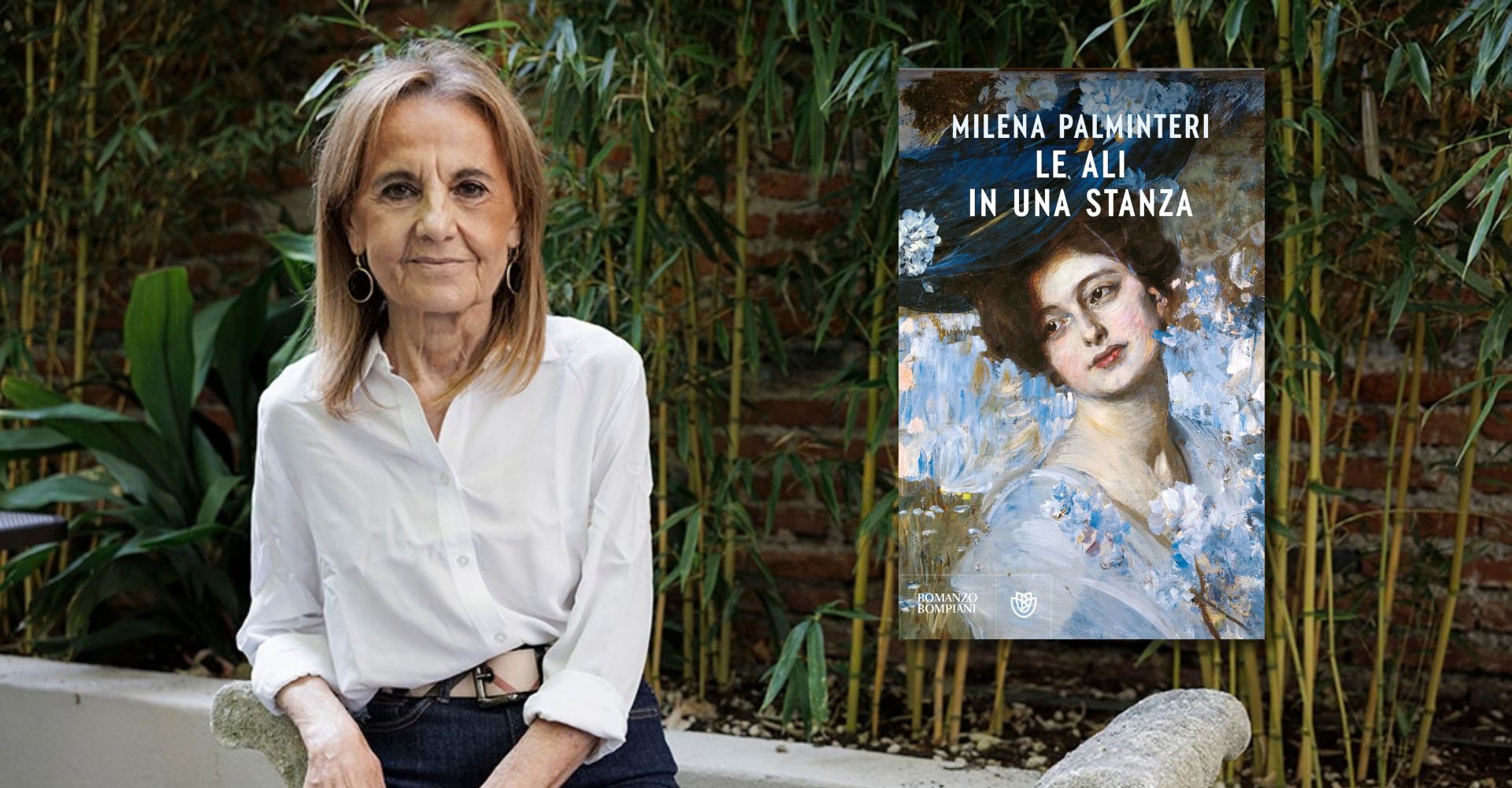
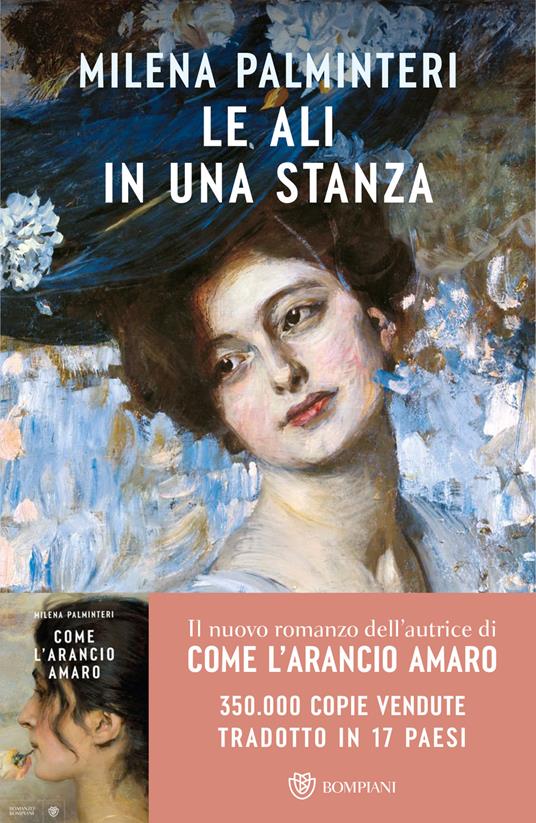
Milena Palminteri returns to bookstores, the author of the debut bestseller Come l’arancio amaro (Premio Bancarella 2025, and around 350,000 copies sold), who now signs the book Le ali in una stanza, with which she brings readers to Palermo, the city where she was born.
The Plot of Le ali in una stanza
The plot of Palminteri’s new novel, who has spent her life working as a conservator in notarial archives, begins in 1914. In the backdrop of a city full of scents, where the fervor of the Liberty is sweeping away the dust of time and travelers from all over the world arrive at the hotels, the ambitions of Giulio Jacona and Irene Scordato cross paths. Giulio, a brilliant architect, refuses to work in the studio of the great Ernesto Basile, choosing to pursue his dream: to transform the small Kemonia hotel inherited from his father into a jewel of splendor and modernity. On the verge of heaven, a rooftop garden will host the colorful birds chosen by Irene, who shares with them the ability to rise as far as the judgment of men no longer matters and to spread their wings freely.
But the flight of Giulio and Irene is abruptly halted when the First World War rends the horizon. And, after the war, another drama: the virus of polio enters their home and leaves its terrible mark.

We arrive therefore in 1950 Palermo. The Second World War is also past, leaving deep wounds in minds and places. Among the ruins of Palermo a new virus extends its tentacles: that of the mafia, which feeds on the euphoria of reconstruction to take hold of the city.
After hosting the occupying and liberating troops, the Hotel Kemonia would also need a renovation, but finding the resources seems impossible. Until a young woman enters the Jacona household, driven by a pride capable of changing destiny once again.
What Milena Palminteri presents is described as “a moving literary homage to the city where she was born” (the author now lives in Salerno and has two grown children), through the portrayal of women and men whom no disease or corruption can bend, because they know that “you do not need large wings for a long and happy flight.”
The bells of the Casa Professa church toll noon, and Giulio Jacona, for an hour now, lectures in the main hall of the University of Palermo on his thesis in Technical Architecture.
The rays of a scorching sun, like carpets of fire, streaming in through the wide windows, unfold unstoppable across the auditorium, and a sharp acidic sweat drenches necks and shirts, foreheads and armpits, shiny scalps and oiled heads of the audience and professors. Giulio, as fresh as if just come from the Mondello sea, seems to have escaped, but the truth is that what keeps him dry is his mastery of the subject and his lack of any reverential fear toward the members of the committee. He is so self-aware of himself and his abilities that the scene could be read in reverse: Giulio teacher, the professors intimidated students.
After a brief exchange of glances, the professors dismiss him. A few minutes later Giulio is proclaimed Doctor of Engineering and Architecture.
The Professor Ernesto Basile, his advisor and head of the Architecture School, shaking his hand firmly, enthusiastically congratulates him: “A winning horse, you, Doctor, you are a winning horse.”
And the horse-loving professor knows his craft. A regular at the Capannelle Roman racetrack, he attends every prize or derby race. He accepts any job that takes him to Rome, grand or inconsequential, to indulge his passion. But never a bet, never a loud, vociferous encouragement directed at the horses; he knows neither legal nor illegal bookmakers. He is enthralled by the animal, the power of its muscles in full sprint, the speed without breaking stride, the competitive instinct that at the finish pushes the magnificent neck forward. He says of the horse that it is “art in nature.”
Giulio Jacona, who knows Basile well and his passions, flattered by the compliment and feigning a timidity that does not belong to him, thanks him with elegance and inviting him, at the end of the degree ceremony, to a fortuitous toast at the Maqueda Café. The Professor accepts.
Later, vermouth and pastries loosen the tongues of both, and Basile reiterates the compliment:
“Yes, yes, yes, you are a winning horse. I have watched you since you first came to Martorana to attend the Architecture School, and I must admit that, in these years of studying our field, you have gained deep preparation and unusual competence. Come work with me: I have ten collaborators between the Palermo studio and the Rome one, and taken together all ten do not equal you alone.”
Giulio instantly regains the necessary sobriety. That unexpected request has unsettled him.
It is at that moment that one feels in the prime of life. He awaits his future in a state of absolute quiet, his path a dream already laid out in perfect balance, with every day written and ready to live. A state of grace. After graduation, there will be a job in his mind that is no longer a project but a completed work: the aesthetic and conservation restoration of the Hotel Panormus. Owned by his father, Don Alfonso, clean and well managed, it is for Giulio a disheartening anonymity, even in the name that repeats that of an older hotel.
To throw down the gauntlet was the Grand Hotel delle Palme. Located behind the Panormus, it is only a few hundred meters away. The former home of the Ingham family, after the death of the last heir, was bought by a hotel industry entrepreneur with his nose to the wind of business: Palermo had become fashionable and the tourists who visit it carry around the world tales of the sweetness of the climate, the beauty of the Conca d’oro, and the curiosity for all traces of Arab, Norman, Angevin, Aragonese, Bourbon eras, spanning centuries as they ride along.
But there is more. It was Ernesto Basile himself who made the challenge even sharper, having supervised the transformation of that house into a hotel.
A master of the new Liberty style, Basile has made it his by blending it with original intuition and, for posterity, the extraordinary grandeur of the past vestiges of all the peoples who have made the island their own Sicily. Tireless, eclectic, and multifaceted, his work in Palermo includes the Teatro Massimo, Villa Igiea, and the Villino Florio; in Rome and across the world his signature can be found—from the Chamber’s hall to Montecitorio’s Transatlantico, from designing the Avenida della Libertà in Rio de Janeiro to his authoritative presence on the jury for the Museo delle Antichità Egizie in Cairo.
Giulio does not betray the inner turmoil that the professor’s offer now brings, but an overly ambitious youth invites him to dare the challenge.
He has pictured for months the new Panormus. It will be something different from the flamboyant beauty of the Grand Hotel et des Palmes, even in that French name: his new name will be Hotel Kemonia, in memory of the river that together with his brother Papireto flowed east and west, guarding the small Phoenician nucleus that over time would become the imperial city of Palermo.
On the hot summer nights Giulio, sleepless, designs a winter garden. The façade in his mind is already a reality.
Yet the discomfort in which the professor’s offer binds him is visible. His face has clouded, and the usual expression of confidence gives way to a pallid line. He lowers his gaze, tracing with the tip of his shoe on the floor spirals as precise as a compass. His folded arms signal to the world that no embarrassing emotion would ever escape him.
“No! You’re telling me no! I understood you want to deny yourself!”
The Professor Basile now laughs, eyes squinting, the mouth open in amused surprise as a row of regular teeth peeks out from a goatee crowned by an incredible pair of black mustaches.
Giulio, having now uncovered his hidden thought, has become emboldened.
“Your fellow professors would do nothing but mock if you had made this proposal to one of them. But no one beats you in the race, right, Jacona? Well, anyway I am pleased. You have finally convinced me that my eye and mind still give me satisfaction.”
Then the Professor grows more serious: “But one word of caution I must give you. You’ll end up gnawing your nails, you’ll surely gnaw them!” And he sets his jaw as he speaks.
“It isn’t an easy choice, Professor. But I’ll do everything to make you rethink; it’s a challenge even for me.”
They part with a hug as if they were old friends.
© 2026 Giunti Editore S.p.A.
Via Bolognese 165 – 50139 Firenze – Italia
Via G.B. Pirelli 30 – 20124 Milano – Italia
(continues in bookstores…)