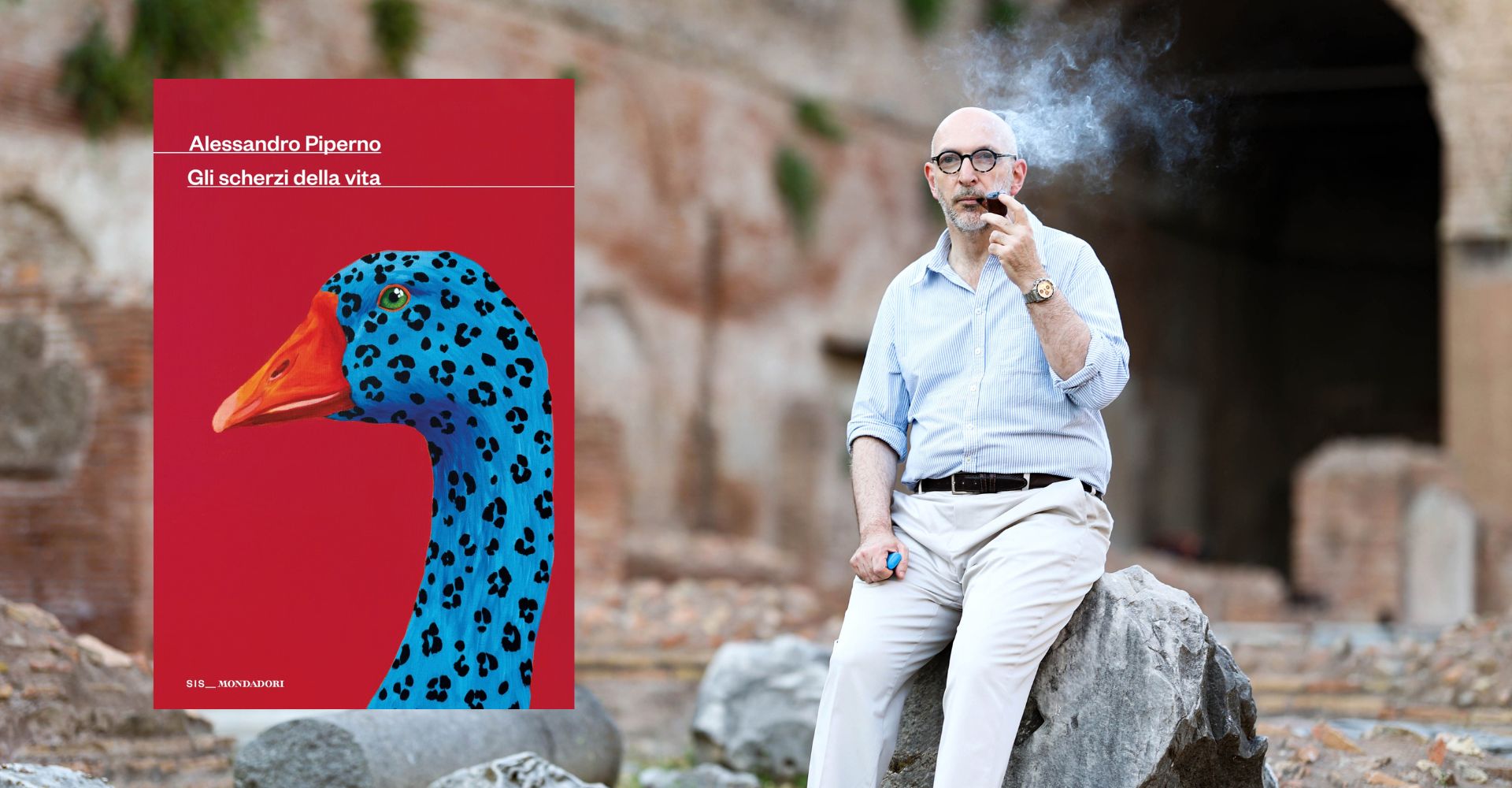
Two men, a mature yet captivating art critic not devoid of the usual aches, and a Hollywood actor of immense fame, in excellent physical shape, wake up one morning—specifically on Christmas Eve—in each other’s bodies. If the first, Ludovico Pestalozzi, seems to benefit not a little, the unfortunate Etan Kaffee, hurled from his room of a luxurious Colorado hotel where he spends his holidays in sporty and healthful fashion, into an old and somewhat dilapidated Roman palace, must face not only the shock but also a kind of sudden and incomprehensible physical disaster, since that new body is not exactly stellar.
Living a life that is half not yours
The two obviously do not know each other; at first they know nothing about one another. From that moment they will have to live a life that is only half theirs and, therefore, they must learn quickly, because they have preserved their original self-consciousness, memories, tastes, idiosyncrasies—everything. Except the body. It has been a truly mischievous metempsychosis, which kicks off the mechanism of the fantastic novel: henceforth one must move forward in a way that remains fully coherent with the initial situation, strictly following the template.

In Gli scherzi della vita, a novel that at first glance stands apart within his already prolific body of work, Alessandro Piperno pulls off a remarkably effective blend, crafting a comedy that is not only funny but also somewhat cruel. It is obvious that inhabiting another human being’s body—when one wakes up in it—is always preferable, if one must choose, to awakening as an insect, yet here the matter goes beyond Kafkaesque concerns, neatly inhabiting the widely popular body swap subgenre that has long dominated English-language cinema and literature (though its roots stretch much further back in European storytelling).
A Stunning Trap
Piperno, who among Italian writers is one of the most self-aware about the form of the novel, appears to decisively detach himself from his earlier outputs in this book, yet there is a through-line linking Gli scherzi della vita to his broader oeuvre, threaded through characters who are, or feel themselves to be, trapped, even if only by a social or family dynamic, overwhelmed by an identity in which they are not sure they can recognize themselves.
Here the trap is spectacular, but it remains, as ever, the same refrain rendered with Piperno’s characteristic narrative flair: psychological analysis, careful dialogue, and a strong devotion to verisimilitude, all conveyed through a pronounced ironic distance that tends toward comedy.
In the new book, which while still a family novel in disguise, these traits are essentially amplified: we laugh and laugh at Ludovico and Ethan’s misadventures, at their continual blundering in a new environment—and in a new body—the bewilderment of those around them who suddenly see them in altered forms, and the comedy of errors that ensues.
If, with respect to the distant or near past, the two must discover almost everything and thus expose themselves as little as possible (though there are secret parallels, especially in their roles as fathers), regarding daily habits there could hardly be anything more distant and resplendent, and thus inconceivable to the reader.
A Fantastical Notion Becomes Reality
To Ethan, who, for instance, recognizes in Ludovico’s seventeen-year-old daughter the same eyes as his lost son, who died by suicide, a question even arises as to whether his new life is not truly new at all, but merely an extension of the old one. A similar idea dawns on Ludovico as well, who can’t fully become Ethan and continues to take advantage of the situation in the new body, while still stubbornly remaining himself—though perhaps not entirely, given the impossibility of the circumstance.
Between Roman fêtes and film shoots in California, the two worlds are told with the same stylistic ease and the enduring humor that marks Piperno’s work. Ethan and Ludovico make significant strides in understanding one another, all perfectly in line with the starting premise (the only nagging question, one might wonder, is how they fared with the computer passwords—an issue the author leaves deliberately unexplored). They remain, in a sense, pulled out from themselves, yet also bound in some manner.
Will they emerge from what could alternately be a double dream or an incredibly wry reality? It isn’t necessary to reveal more. Piperno leaves a few doors open, after all. Let us simply say that they will meet again, and, of course, there will be mutual recognition, alongside a certain, not entirely clean challenge (not quite the Viscount Halved of dodecasyllabic Calvinist memory, but we’re close enough); and the resolution of the tale will carry with it some lingering regrets. For the rest, it would be unnecessary to deny the reader a few ironically (and perhaps melancholically) charged surprises, entirely in keeping with the book’s logic. life can be very playful, sometimes even too much.