
From childhood we learn to weigh the great events in our lives. To the flashy performances, to special occasions. The birthday, the first day of school, the state exams. And what if that isn’t right? Or rather, what if the greater weight in our lives is given by events we consider marginal? Sometimes it’s the details that make the difference. The small things, almost invisible. That’s what June McFlynn, the protagonist of The Hermitage of the Fools, learns thanks to forensic entomology. Studying this field, she discovers the importance of keeping a worldview that jumps beyond the macroscopic and focuses on the microscopic.
What is forensic entomology?
But what is forensic entomology?
When we hear about an investigation, we imagine fingerprints, traces of DNA, surveillance cameras. We rarely think of a fly. And yet, it is precisely the insects that can hold some of the most valuable information about the crime scene. They do not lie, they do not forget, they do not fall for suggestions. They follow only the laws of nature. It is precisely on these laws that forensic entomology is based, the discipline that uses the study of insects to reconstruct events of judicial interest, helping investigators answer fundamental questions: when did a person die? Has the body always remained in the same place? What happened in the hours after death?
Insects can help uncover all this, if questioned in the right way. And they do so with measurable data: the developmental stage in which they are found, the species recovered, their distribution, etc… These data, however, must be not only collected, but interpreted. It is precisely here that the entomologist comes into play.
Those tiny differences that can change everything
June has learned to observe the tiny differences that can push the death date forward by one or more weeks, to distinguish two insects that look identical thanks to a thoracic ornamentation visible only under the microscope, to notice discrepancies in the presence or absence of a particular insect at a crime scene. Thanks to these details, forensic entomology offers solutions. And it reminds us that small gestures are often the ones that betray, that reveal lies and deceptions. It’s easy to cleanse a place of evidence as obvious as fingerprints. But there, somewhere, there is a small creature that can unveil the truth.
View this post on Instagram
Science fiction? It might seem so, but forensic entomology is a branch of forensic science that has existed for centuries, though it remains still not very well known in Italy.
One of the earliest documented testimonies of the use of insects in a murder investigation dates back to the 13th century in China. Other chronicles recount an investigation in Paris in the second half of the 19th century, where a husband and wife accused of hiding a child’s body in the walls of their house were acquitted thanks in part to entomological evidence that dated the act to two years earlier, when the house had different owners. Even today forensic entomology is used to solve real cases, even high-profile ones, and researchers from all over the world work to refine the knowledge that allows us to explore new perspectives, each day increasingly precise.
The role of entomology in fiction
It’s impossible not to be captivated by the enormous potential that forensic entomology holds in investigative work. If in Italian fiction this discipline has remained almost absent, Anglophone literature has long realized its value. As early as 1994 Patricia Cornwell set one of the Kay Scarpetta novels in the famous Tennessee Body Farm. Those who loved the forensic anthropologist Temperance Brennan, created by Kathy Reichs, will probably have encountered forensic entomology as one of the many investigative tools used in her cases.
One might ask: is it necessary to have a strong stomach to dive into the pages of The Hermitage of the Fools? Surprisingly, the answer is no. There are no macabre scenes or sensationalized depictions of death. What June wants to make you discover is something else. She shows how being a woman of science leads to transforming the way you look at the world. In what way analyzing life with the same meticulousness as a crime scene can change you and, in some sense, allow you to survive.
The laboratory as a comfort zone. And outside?
Science shows us a portion of life. After all, the everyday truth is that none of us always has at our disposal grand means, nor a career studded with dazzling successes or has reached the major milestones considered essential by contemporary society. Sometimes you have to content yourself with crumbs. A half-smile, a stolen kiss. A millimeter more on the climb toward the peak, which confirms that we may seem still, but we are not really. June stops observing the world in its human complexity, trying to reduce it to the simplicity of nature, made of certain data, of inalienable numbers. Her comfort zone is the laboratory, the obsessive order in which she stores the samples and reagents. Out there, though, is more. There are feelings that do not follow biological laws and there are relationships that even contradict them. She who built her entire life on trust in science, turning work into a kind of sacred office, risks being betrayed precisely by her devotion to investigations.
Instinct and the hunger for justice, this time, will force her to face what she would never have wanted: the most unforgivable mistake she should have simply forgotten. And then? Once again, what can save her are the small things. The details arriving at the right moment that reveal something that, though spectacular, could not be seen by others. Because forgiving does not require handshakes or serenades under one’s window. Especially if you must forgive yourself.

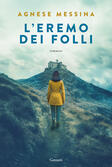
The Hermitage of the Fools
THE AUTHOR – Agnese Messina, born in 1989, is from Catania. After graduating from the Technical Aeronautical Institute and earning a degree in Biology, during which she completed a master’s program and wrote a thesis in forensic entomology, she pursued studies in Medicine and Surgery at the University of Catania. She lives in her hometown, splitting her time between writing, research, and a love for classical music.
In bookstores, her debut novel arrives, The Hermitage of the Fools, published by Garzanti. The protagonist, June McFlynn, is a forensic entomologist. Science is not just her work: it’s her “way of being in the world.” It guarantees order and justice, all that life around the book’s protagonist lacks. The study of small things allows her to keep at bay a world too large for her, starting with the sun-drenched and troubled Sicily that surrounds her.
Not only that: being a woman in her field is not easy. Every day she must prove she deserves the role of court consultant in Catania, putting herself on the line, challenging prejudices. June McFlynn, “the American,” has always believed that science would be enough to keep her safe. But now she faces a case unlike any other: a mother and her daughter vanished into thin air. No trace, only the shock of their absence. And in that absence the protagonist recognizes something she believed buried and that fills her with anguish. June McFlynn guards an unconfessable secret, and she will have to confront it…