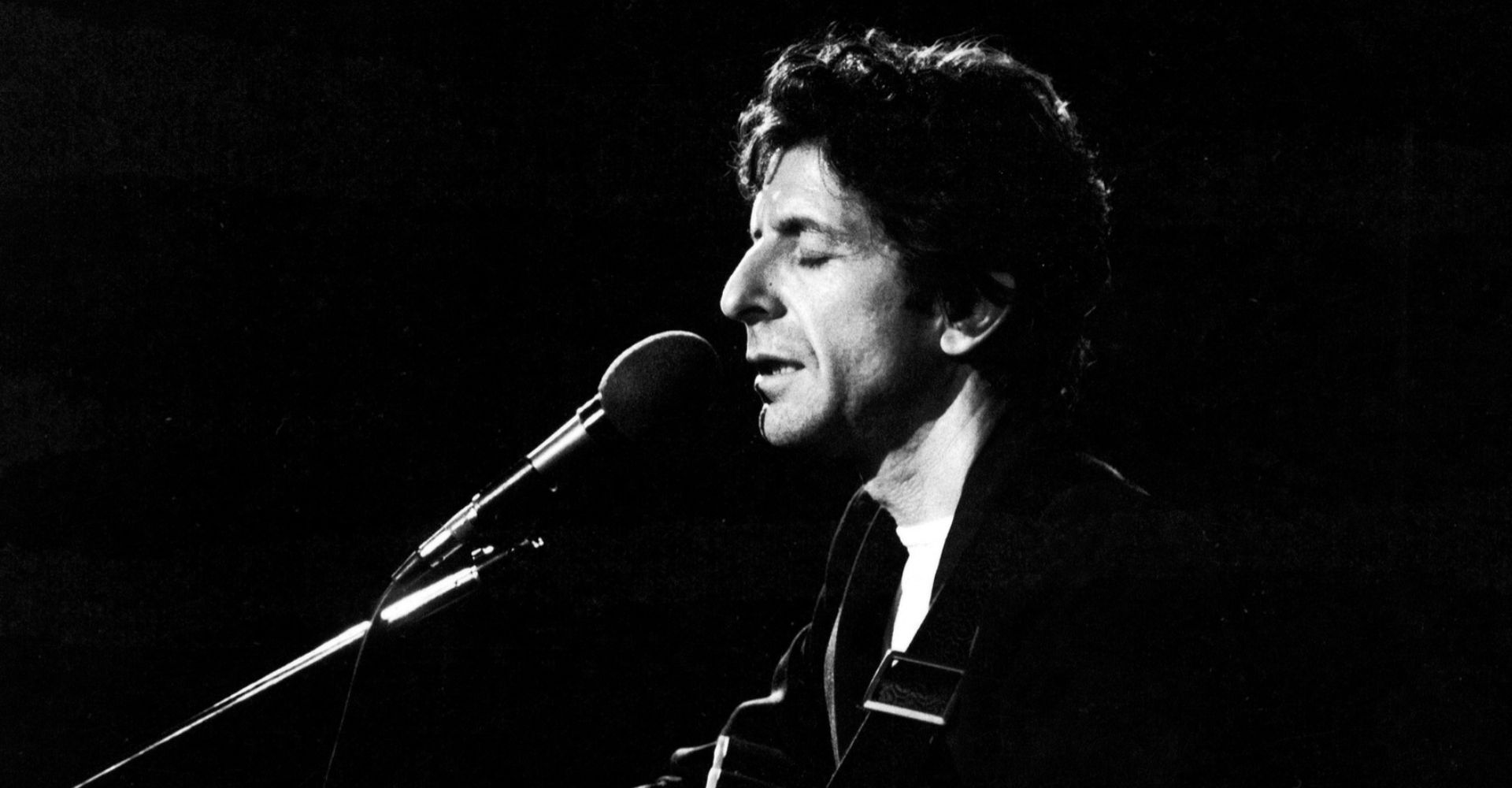
In 1950, at 599 Belmont Avenue, in the hillside district of Westmount, Montreal, a fifteen-year-old boy stumbles upon a book that is about to change his life. The spark strikes with a stanza that reads:
For the arc of Elvira
I want to see you pass by,
to hear your thighs
and make me cry.
The author of the lines is the Spanish poet and playwright Federico García Lorca (1898-1936) – and the fifteen-year-old who has just discovered him is none other than Leonard Cohen (1934-2016).
In the poem, titled Gazelle of the Morning Market and drawn from the posthumous volume Divan of Tamarit (Passigli, translation by Arianna Fiore), the young Canadian of Lithuanian-Polish origin glimpses a ferocity that grips him, between the voluptuous and the visceral, and which pushes him to wonder if one day he will be able to speak of love and heartbreak in the same way.
When Leonard Cohen Turns to Writing
In doubt, he gives it a try.
He moves toward writing by casually forging a fruitful partnership with the Canadian author Irving Layton (1912-2006), who will help him publish his first collection at McGill University and to whom Cohen will dedicate the track Go No More A-Roving in 2004 (which takes its cue from an eponymous poem by George Byron), and in the meantime he also picks up a guitar for the first time.
Over the years, life will lead him to establish himself more as a singer-songwriter than as a writer, but his career actually begins in this youthful period when his creative horizon is filled mostly with poems and short stories – when not the songs he performs with the small folk group Buckskin Boys founded as a boy, which gradually gives way to a sensibility that becomes increasingly essential and at the same time contaminated…
Between the Mysteries of the Sacred and the Grip of the Profane
The blood-tinged and spiritual beauty of Leonard Cohen’s songs is in fact inextricably linked to the words of literature, and it will remain so throughout his fortunate and immensely popular musical activity.
One of the most evident examples, probably, is the influence on his lyrics of the Judaic-Christian tradition. Cohen comes from an Orthodox Jewish family, and his maternal grandfather was the renowned Talmudic scholar Solomon Klonitsky-Kline (1869-1958): it is therefore not surprising that the images, stories and characters of his religious formation frequently flow into the pieces he writes, helping him explore the ancestral dichotomy between the sacred and the profane.

Pense to Suzanne (1967), Story of Isaac (1969), Last Year’s Man (1971), The Future (1992), Amen (2012) and You Want It Darker (2016), but above all a soft and minimalist piece like The Land of Plenty of 2001 – which, as Brunetto Salvarani and Odoardo Semellini state in The Gospel According to Leonard Cohen (Claudiana), sounds like “an authentic, moved, painful prayer” – and Hallelujah from 1984, perhaps one of his best-known and most loved singles of all time, thanks also to the countless covers recorded by artists such as John Cale, Jeff Buckley and Rufus Wainwright, to name just a few of the best known.
A complex rock waltz with tormented tones, that makes use of allusions to the Old Testament to highlight the contradictions and the “cracks” through which the light of human relationships enters.
There is the shepherd David, in particular, the extraordinary musician deemed author of many Psalms and who uses his gift to create a bridge with the divine; the same David who, once king, yields to earthly temptation by peering from the roof at the beautiful Bathsheba, a symbol of the fall of the faithful man before carnal desire.
And there is Samson, the hero betrayed by Delilah, who, deprived of her hair and the associated superhuman strength, becomes a symbol of emotional submission and vulnerability within a relationship. All of this becomes a hymn that no longer resembles a song of joy to God, but a hoarse murmur with which we can only acknowledge every one of our fragilities.
A Mysticism That Always Returns to the Body
But to call it mysticism, when we look at Leonard Cohen, does not mean simply sacred texts.
First of all, because his curious nature and open-minded attitude lead him to engage in parallel with other forms of sacrality, as evidenced by his closeness to Advaita Vedānta Hinduism and his decision to live from 1993 to 1999 in a Buddhist monastery at Mount Baldy, on the hills of Los Angeles.
And secondly, because in his songs there are many echoes of transcendence dear to poets such as Walt Whitman (1819-1882) and William Butler Yeats (1865-1939), which indeed often intertwine with more existential and sensory themes, as also happens in the works of three other literary models: Thomas Stearns Eliot (1888-1965), Dylan Thomas (1914-1953) and Allen Ginsberg (1926-1997).
From his earliest compositional experiments, one can detect in Leonard Cohen a similar tension, perhaps born from the early awareness of not knowing and not wanting to renounce pleasure: there is something that attracts him toward a higher dimension of life, and yet a force equal and opposite pulls him toward the female body, as perhaps first inexorably realizes him on the Greek island of Hydra, in the Saronic Gulf.
Here, at the beginning of the 1960s, he moves there in search of solace, soon publishing some of his most famous books: the poetry collections The Spice-Box of Earth (minimum fax, translated by Giancarlo De Cataldo and Damiano Abeni) and Flowers for Hitler, and the novels The Favorite Game and Beautiful Losers (both published by minimum fax, translated by Chiara Vatteroni and Francesca Lamioni), considered still today one of the masterpieces of the Canadian Renaissance.
Yet, still during his bohemian sojourn on the island, Leonard Cohen has an intense relationship with the Norwegian Marianne Ihlen (about whom he speaks in the bittersweet So Long, Marianne, in the rugged ballad Bird on the Wire and in various other pieces in which she will be the muse): certainly, it is a relationship with almost Platonic contours, as Maxence Fermine recounts in detail in Dance me to the end of love (AnimaMundi Edizioni, translated by Roberta Castoldi), and yet it helps to make women a pillar of his life.
On one hand, therefore, the stern education he was given pushes him to feel guilty for his impulses, while on the other hand, his need for intimacy convinces him to sublimate physical contact and to adorn it with meanings, even and especially through music.
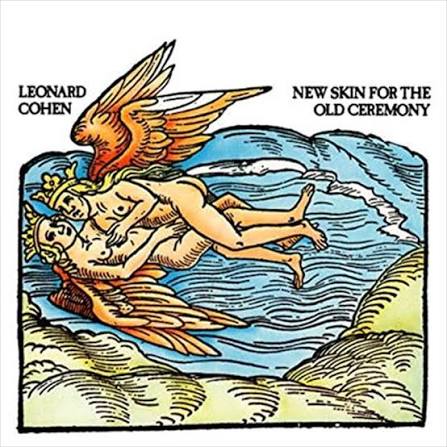
Just as the cover of the 1974 album New Skin for the Old Ceremony depicts the scene from a 13th-century alchemical treatise titled Rosarium philosophorum, taken up in the 20th century by the psychoanalyst Carl Gustav Jung (1875-1961) in the essay The Psychology of Transference (Il Saggiatore-Garzanti, translation by Silvano Daniele) to describe the union of the opposing psychic forces.
Leonard Cohen, Singer at the Threshold
If, however, we widen our view to other kinds of literary references scattered through Leonard Cohen’s songs, we will notice, here and there, a different form of latent unease: that of someone forced to leave something behind, or to continue a journey whose destination is unknown.
Case in point is a sophisticated synth-pop song like Alexandra Leaving (2001), inspired by the poem The God Abandons Antonio by the Greek poet Konstantinos Kavafis (1863-1933), in which the final moments shared by Mark Antony and Cleopatra in Alexandria lead the singer to transform the city into the figure of Alexandra, a woman who leaves behind an entire season of life, interpreting separation as a painful but necessary rite.
As well as the hypnotic A Thousand Kisses Deep (2001), in which Leonard Cohen revisits some verses from the poem Stopping by the Woods on a Snowy Evening by Robert Frost (1874-1963), lending a melancholy meditation on the cycle of life made of fleeting triumphs and inevitable falls, which we can only face by finding refuge in love.
The same road that centuries ago seemed to be pointed out by some illustrious Persian poets such as Jalāl al-Dīn Rūmī (1207-1273) and Farīd al-Dīn ʿAttār (1145-1221), whose insinuations thread through some tracks on the album Recent Songs (1979), including the solemn The Guests, made unique by its driving gypsy violin, and the floaty The Window, in which the meeting with the Other and even suffering are seen as tools of elevation, not being shied away from even by the most detached of ascetics.
Toward a Return to the Origins
And then, of course, there is García Lorca.
The only figure for whom Cohen continues to feel such admiration that he named his daughter, born in 1974 from his relationship with the artist Suzanne Elrod (with whom he had already fathered Adam, who would also become a singer-songwriter), and who meanwhile devoted “months of work, perhaps years, and a nervous breakdown” to the linguistic and sonic translation of another’s text, is Lorca himself.
We are talking about the Little Viennese Waltz, which on the 1988 album I’m Your Man becomes Take This Waltz – and which blends numerous surreal, elegant and spectral elements of the Austrian capital with the disillusionment of someone who is caught between what he stubbornly desires and what he knows he can no longer hold between his fingers.
Also from Lorca, the songwriter from Canada will be drawn to one of his latest endeavors, namely the free adaptation of one of Lorca’s most cherished poems: The Faithless Bride, included in the collection Romancero Gitano (Passigli, translation by Valerio Nardoni) and transfigured after decades of attempts into the song The Night of Santiago, which with its Spanish and flamenco-inflected sounds would appear posthumously in 2019.
A passionate story, set along the banks of a river, in which we are told of the union of two bodies and the complicity of the seduction that surrounds them, ambiguous until the very end in its past, present and future aspects. And it would be impossible to listen to it without instinctively thinking of that arc of Elvira from so many years before, and of a moving circle that closes.
Because, after having probed the duality of existence for a lifetime without resolving it, Leonard Cohen again draws on the words of his first master with astonishment, at the height of fame, reawakening the intact youthful exaltation that would allow him for decades to turn his restlessness into an immortal game of semantic chiaroscuro, as sweet as a wound and as priceless as a worn blue raincoat…
E for those who have a fondness for the intersections between music and literature, or who want to know more about the subject, here are some of our other pieces on the topic:
- From the Rolling Stones to De André: when literature inspires music
- Knowing how to read the book of the world: literary references in De André‘s songs
- Mogol and Battisti, or when songs turn into poetry
- The literary references in Francesco Guccini‘s songs
- Theater Song: the literary references in Giorgio Gaber
- Rigor and common sense as north stars: the literary references in De Gregori‘s songs
- Delving the unfathomable dimension: the unforgettable songs of Franco Battiato
- The literary references in Lucio Dalla‘s songs, between abysses and paradoxes
- A traveler in space: the literary references in Caparezza‘s songs
- The literary references in Taylor Swift‘s songs