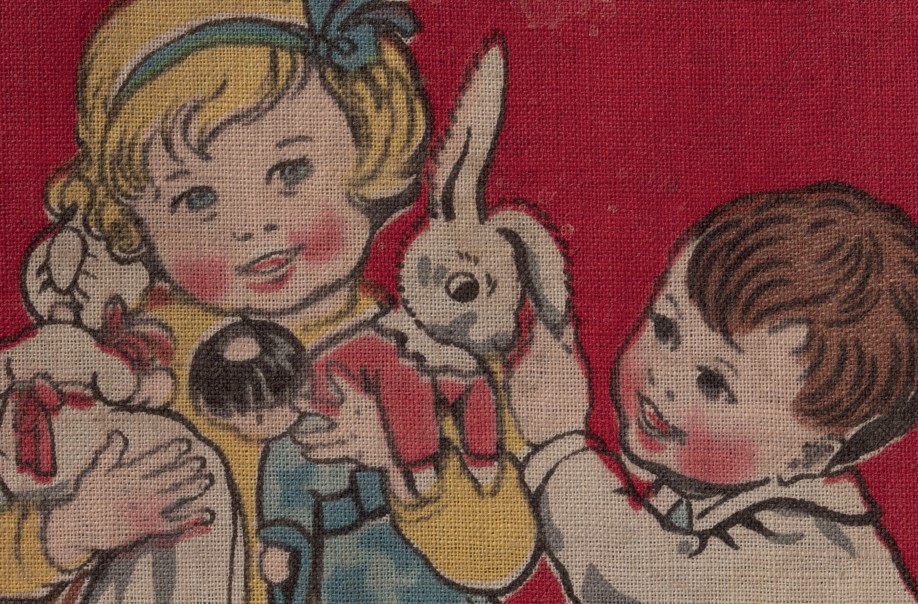
At the Beginning of the 20th Century, a silent yet radical innovation challenged the very idea of a book. With the invention of the Rag Books – the cloth books made of cotton and linen sewn by hand – reading was in fact crossing the boundaries of paper to become a “a deeply tactile and sensory experience.” Unlike traditional volumes, destined to be carefully kept on shelves, these books were born with a “pioneering” mission: to withstand the hands of children. Uniting the world of words with the realm of play allowed these objects to be manipulated, washed, hugged and even gnawed on, inaugurating a new era.
Born in London in 1903 with the famous Dean’s Rag Book Company, this insight swiftly spread through the English-speaking world, before inspiring artisanal productions across Europe.
Characterized by bright colors, essential illustrations and textures designed to stimulate fine motor skills, cloth books traced a path that crossed the entire 20th century up to the present day. Today their heritage lives on in modern “soft books,” in sensory pedagogies such as the Montessori method, and in inclusive and therapeutic publishing projects designed for accessibility.

Until October 3, at the San Giorgio Library in Pistoia, the exhibition Books to Embrace – Dean’s Rag Books, the First Rag Books in History will be on view.
The exhibition owes its existence to the generosity of collector Fabrizio Mugnaini, and offers a fascinating journey among historical specimens. At the same time, it presents a reinterpretation of the symbolic value of these artifacts. “The marks of time and use visible on the volumes on display do not diminish their beauty, but testify to their extraordinary emotional charge: objects capable of telling stories of affection and of proving how a book can become a life companion, a sensory device and a bridge between narration and the body.”
The first part of the exhibition presents about 80 Dean’s Rag Books, through which one can follow the evolution of this publishing invention. Special attention is also given to the famous brand of the two dogs that contend for a book, an image that accompanied Dean’s production for decades and that encapsulated the promise of a “Quite Indestructible” book, practically indestructible.
The second part of the exhibition broadens the view and documents how the Dean’s intuition was embraced and developed by other publishers, including Italian ones.