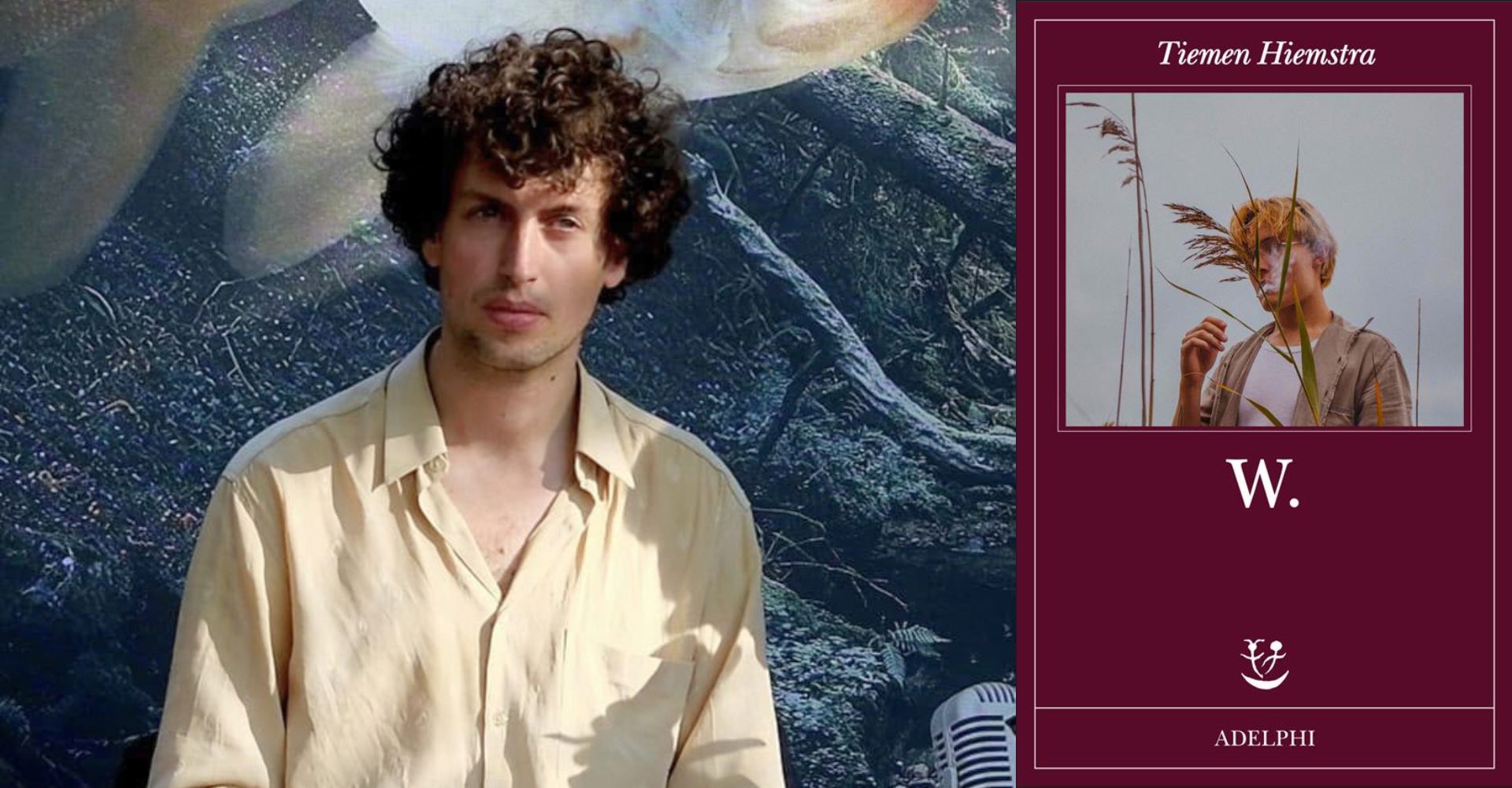
W.
One single letter can summarize the entire debut novel by Tiemen Hiemstra, a Dutch writer born in 1991, who introduces himself to readers with a surreal and melancholic book. Because at the center is the disappearance, or rather the unexplained abandonment, of a boy a little over twenty years old, W. indeed, and the effect this has on the people closest to him: Olaf, the narrator of the entire story, and Hilde, Olaf’s friend and girlfriend.
Everything revolves around this. Around that presence only recalled or perceived—and yet incredibly strong—and the echo of an absence that still lingers, despite a couple of years having passed.
Although the novel moves along a thirteen-day arc (during the first of which Hilde seems to have recognized W. in one of the passersby), most pages are set in the past. Olaf travels through his memory, revisiting key moments of his life, and thus of their friendship, making these flashbacks far more than simple memories, but crucial scenes for understanding the strong bond first between the two boys, and then within the trio.
Thus you realize you are facing a multifaceted and rhizomatic novel, which makes its structure a central element (as does the language), leaning as much toward a bildungsroman as toward reflection on themes of humanity. Life, love, death.
An intense work that fuses humor with the obsession to understand the loss of someone you love.

Hiemstra, let’s start from one of the central themes. W. leaves, and no one knows why, where, or how. It seems you’ve aimed to focus more on the effect of absence (or abandonment) on the two friends, rather than on absence itself?
“I’d say it’s more a book about absence, even though obviously absence and abandonment are deeply interwoven, because it is precisely this abandonment that makes the absence felt so intensely. It’s hard to separate them. And W. is present through his absence, when he’s spotted and then when Olaf recovers all his memories. In general, though, I’d say the book speaks more about facing absence in different domains, about coming to terms with it.”
In the novel we watch Olaf reconstruct the entire history between him and W.; Hilde creates artworks inspired by some fantastic creatures from literature. W., on the other hand, builds memes from scratch. Is that what characterizes him?
“Yes, you could say Olaf is more modernist and W. more postmodern. In the sense that Olaf truly believes in essence, and tries to probe the essence of W., and of their friendship. And W. tries to escape from it, and even these memes are very absurd, right? They seem to spring from nothing, and that is precisely the point. It is the very fact that they are so out of place that makes them funny, or at least gives them a meaning. I find them funny, but many people don’t. And Hilde, instead, is interesting because she tries to reconstruct, or perhaps more to build, animals that never existed. So perhaps she sits halfway between the two.”
For W., do the memes represent freedom?
“Yes, W. is in search of freedom. I think W. fears having an identity, being labeled. In this sense the memes represent a form of freedom because they are absurd, surreal, defying any categorization. I’d also say that W. finds them attractive because memes aren’t a form of personal expression, they are something that is created and shared. That is the essence of their existence. W. wants to be everything, and memes are a way to escape being an individual.”
And is she afraid of being categorized?
“In the past more so. I think W. has inside him a part of me, but exaggerated. Many people of my generation grew up thinking the sky was the limit, that everything was possible with effort. And they grew up with this sense of the infinite. Then someone realizes ‘Oh, I actually am this person, I can be labeled as such…’ and develops a form of resistance. With the character of W. I exaggerated this tendency.”
And speaking of friendship, what does it mean to you?
“It means a lot, because with friendship you build together an idea of what the world is like. Your first sense of identity is discovered with your friends. And it is something that deeply sustains us as human beings. Also in the book, when W. disappears, the concepts Olaf has of how the world works become less secure, and he begins to doubt.”
Is Olaf less Olaf without W.?
“Yes, in a way that’s how it feels. He feels lost because his personality depended on the friendship. And that is precisely what I wanted to show: much of what we think we are is, in fact, something we share with the people around us.”
And today, with social media, is it harder to build a friendship like the one described in the novel?
“I think so. When I was in high school we had MySpace, but it wasn’t as pervasive as Facebook, Instagram, and TikTok have become. It was a very different era. I realize that today it’s arguably easier to stay at home, behind a screen, without real contact with the outside world.”
Should there be more books addressing this? Books that really tell how social media operates and how young people use it?
“I think there’s always a time and a place to write a classic: even if you set a book in the Middle Ages, with no reference to the digital, you can still craft a compelling story that says a lot about the lives we live today. So it isn’t mandatory. At the same time I have a feeling some avoid the topic, as if it weren’t true literature.”
And yet?
“I think it’s time to shatter that notion, to accept that the language we find online is part of the world and can be used in literature, leading to very interesting results.”
In the novel, moreover, philosophy is discussed, partly through the character of Professor Staartjes who states that what we see is always temporal and spatial. What form do philosophy and literature take for you?
“As a child I asked myself all these questions about life, death, time… I imagine many children do this, but in my case they never really vanished. Literature and philosophy, when I encountered them in high school, felt exactly like what I needed. They are a way to try to give meaning to the world. You will never find the definitive answer, but seeing how others have thought about reality is a great reassurance.”
And in literature, is there something that inspired you more than anything else during the writing?
“Two books come to mind. One is Seymour. Introduction by J. D. Salinger, because the narrator describes the missing brother and tries to evoke him through the text. I found this attempt to recreate someone through language very beautiful. And it’s what I wanted to do as well. The other is Rayuela – Hopscotch by Julio Cortázar, a novel with no fixed reading order. It is very fragmented, yet very interesting and playful. My book turned out more linear, but I strove to draw inspiration from him.”
In the book there is also talk of the loss of a parent, and in some interviews given when the novel appeared in the Netherlands (in 2023, editor’s note) he spoke of his father’s death. Was it always a deliberate choice to address the theme, or did it arise more spontaneously?
“I don’t think I set out to write about this, not in a strict sense. I imagine our obsessions and questions are defined very much by what we have lived through. So this all starts from there. My father’s death when I was a child undoubtedly shaped how I perceive the world, and this is reflected in the book more than I consciously intended to write about that experience.”
Two final questions. One lighter, one more serious. On Instagram you spoke about your football fan devotion to Roma, but in the novel you include some lines about the prowess of Jaap Stam…
“Yes, though he actually played for Milan and Lazio, I know.”
What’s behind it?
“I’m not a fanatical supporter, let’s say. I was a big fan of Totti and De Rossi, and when I played FIFA with a friend I always chose Roma. It’s a bit of a meme, this choice. And yes, Jaap Stam is a legend; I enjoyed the idea of including him.”
Are there female writers or male writers with whom you share the themes, the stylistic approach, or the generational references?
“Two Dutch authors come to mind, very interested in using internet culture in literature, but I think they are not yet translated into Italian: Nadia de Vries and Dominique de Groen. As for international writers… Have you heard of Alejandro Zambra, the Chilean writer? I hope to share a sense of humor similar to his, because I greatly admire the way he can be poetic and funny at the same time, being humorous without losing poetry. So yes, he’s the one I feel closest to.”