Students of Italy and Europe, enough with this violence. It is unacceptable; at most, behave like us adults, limit yourselves to invading countries, bombarding cities, massacring civilians, exterminating peoples, letting thousands of people die in the Mediterranean Sea, exploiting labor and polluting, destroying nature. At most, girls and boys, do as we do.
A key to reading what is happening, in my view, is this: the deliberately ironic hyperbole proposed by Professor Matteo Saudino in a reel that went viral on his Instagram.
The mistake, and the example…
There is one thing you learn quickly, if you are a teacher, namely that the real great sources of learning are ultimately only two: the mistake, and the example.
That’s where most of what we learn comes from. Yes, study, yes, the occasional sermon, but to err and to imitate are the two fastest means we humans have discovered to become experts of the world.
Now, before we begin: can we skip the part where I must say “Violence must be condemned always and in all cases”, and all those phrases that point a finger at those who demonstrate by smashing storefronts?
“It’s obvious that destroying a bookstore is wrong”
First: we don’t really know who is behind the acts of vandalism.
Second: I’m tired of stating obvious things.
It’s obvious that destroying a bookstore is wrong and that those who perpetrated the vandalism must be held accountable, I’m even a little embarrassed to have to underline it. It’s almost sad to have to explain that you’re not justifying anyone, but merely trying to reason to better understand the complexity of reality, which isn’t made only of black and white, nor of “the police are right” or “the protesters are right.”
What comes before the protests…
Now can we talk about what comes before the demonstrations? Do we have the courage to look in the mirror and ask ourselves: what example are we giving?
Because that’s how young people learn. By imitation.
Do you think the adult world is free from violence in this historical moment even more so?
And just because your hands aren’t stained with blood, do you think you can still call yourself innocent?
Fabrizio De André sang it almost sixty years ago: “Even if you now think you are absolved, you are still involved.”
“Here, no one denies anything”
If you try to raise this theme, many will tell you: “Whataboutism!”
No, Gianfranco. Whataboutism is when you deny a problem by using others as a screen. Here no one denies anything. Exactly.
Violence must be condemned in all its forms, not only the ones that suit us.
It is right to condemn the person who devastates a bookstore, of course, but why don’t the front pages talk about the agents who entered schools to beat up kids who weren’t doing anything wrong except expressing dissent?
It is right to condemn those who refuse to protest peacefully, of course, but isn’t it equally violent to bring to tears farmers and truck drivers who don’t know how to put bread on the table?
Ignoring millions of people who are at their wits’ end is violence too
It’s right to condemn those who throw firebombs at the police, and that’s fine, but are the bombs purchased by governments to kill civilians okay?
And shall we talk about the violence of stripping public resources from health, education, and safety, and then, when it comes to weapons, suddenly the resources appear?
Ignoring millions of people who are at their wits’ end is violence too.
Also pretending that everything is fine when it isn’t is violence. Also using silence as a weapon is violence. One of the worst kinds there is.
“Let’s listen to what these kids have to say, to whom we are literally stealing the future”
Maybe, instead of stopping at the usual disturbances and burned bins, this time we could do something different: listen to what these young people have to say, to whom we are literally stealing the future.
Perhaps their fragmented cry isn’t just a cry to be silenced: perhaps there is something inside it that is worth taking seriously.
Whoever must pay, will pay
And the people who have our mandate to represent us, perhaps after having deplored, condemned, and criticized, should start giving answers to all these voices.
Have some of them erred? Who must ascertain will ascertain. Who must pay will pay.
But what about all the others? Those who didn’t break anything? What do we want to say to the protesters because we’re nearly November and they still don’t have the math teacher? What do we want to say to those who took to the streets because we are discussing limits on foreigners while the roof of their school is crumbling? How do we respond to the person who carried the banner in the square asking for toilet paper at school?
The mistake of not giving them answers we have already made far too many times. And, since we learn from mistakes as well, let’s not get it wrong again.
Il mio migliore amico è un fantasma

Il cuore non va a dormire
Quel posto che chiami casa
Geografia di un dolore perfetto
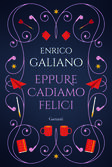
Eppure cadiamo felici
THE AUTHOR – Enrico Galiano, a Friulian teacher and writer born in 1977, who is in the classroom as well as on social media, where he has a large following, knows how to speak to young people.
After the success of novels (all published by Garzanti) such as Eppure cadiamo felici, Tutta la vita che vuoi, Felici contro il mondo, and Più forte di ogni addio, he published a peculiar book, Basta un attimo per tornare bambini, illustrated by Sara Di Francescantonio. He then returned to fiction with Dormi stanotte sul mio cuore, and for Garzanti his first essay was published, L’arte di sbagliare alla grande. With Salani, Galiano published his first youth story, La società segreta dei salvaparole. And Garzanti likewise published his second essay, Scuola di felicità per eterni ripetenti.
After the novel Geografia di un dolore perfetto, he returned to the shelves with Una vita non basta, and then published, again with Salani, the second book for young readers, L’incredibile avventura di un super-errore. With Garzanti in 2025 came the novel Quel posto che chiami casa, and with Einaudi Stile Libero, in 2026, Il cuore non va a dormire.
His new book is Il mio migliore amico è un fantasma (Salani).
Here you can read all the articles written by Galiano for our site, with whom he has been collaborating regularly for several years (including some videos for Instagram and TikTok).