“If you were alone in a forest, would you rather meet a man or a bear?”: a few years ago this question went viral on social media, generating a lot of chatter because, perhaps not surprisingly, users chose the animal almost unanimously.
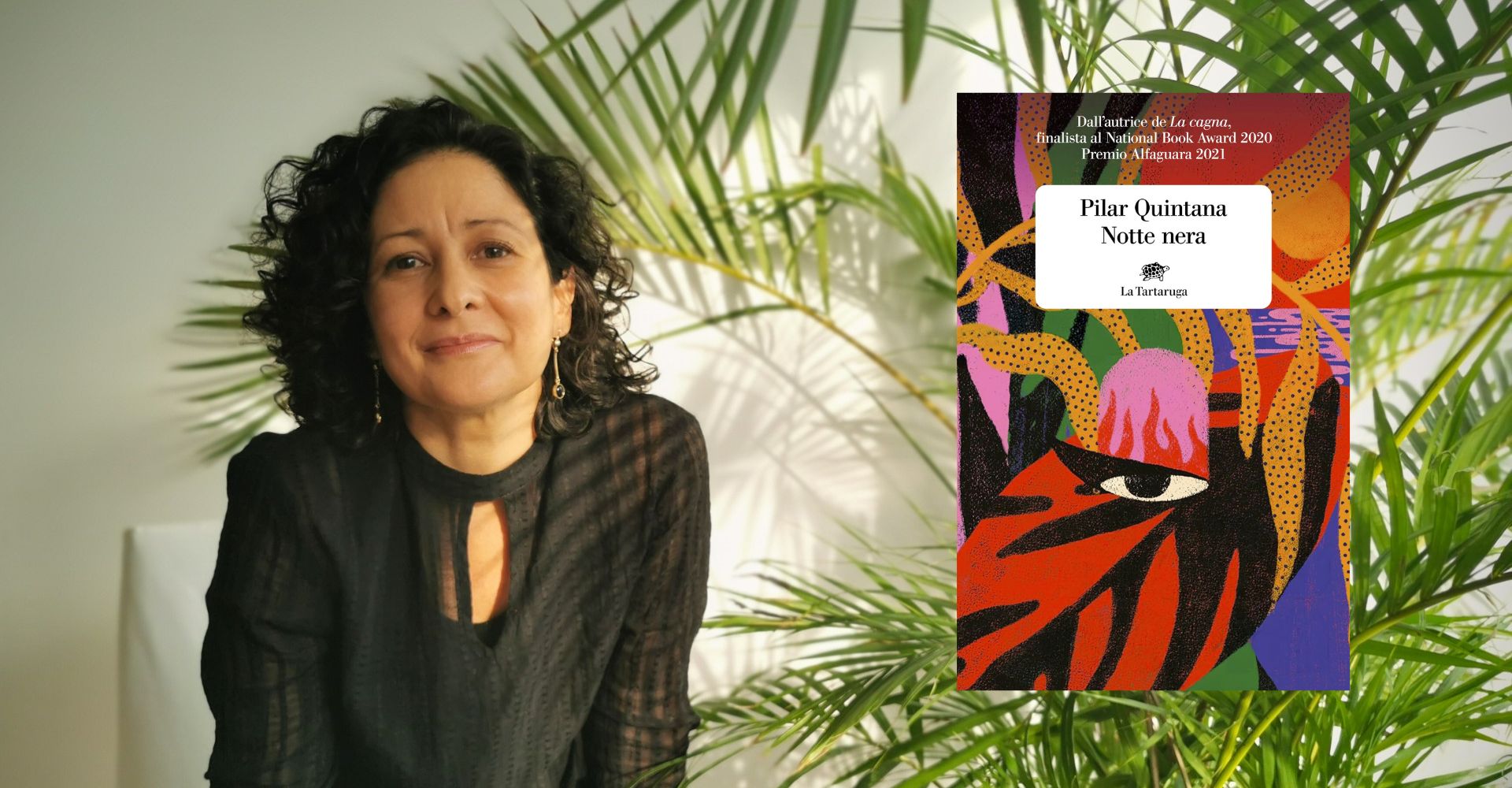
Perhaps Rosa would give the same answer too, the protagonist of The Black Night (published by La tartaruga, with a translation by Elisa Tramontin), the new work by Colombian writer Pilar Quintana, finalist for the National Book Award with The Bitch (2020) and winner of the Alfaguara Prize with The Abyss (2021).
Alone in the Forest
Rosa, who has appeared several times in Quintana’s body of work, from a few stories to The Bitch itself, is a young woman who, having left behind her city life—a life not bad at all, as a partner in an advertising agency—decides to move to the Colombian forest on the Pacific coast. With her is only the Irish partner and, quite distant from the land they purchased, a few neighbors (all men), who during the move period have shown themselves to be helpful and kind, always ready to lend a hand and offer advice.

The story opens on a Sunday: Gene must depart to retrieve the visa, and in front of the rather unsettled woman unfold four days of complete solitude, which will culminate on Tuesday, the darkest night of the season.
The Story of a Life in Four Days
Can you tell a person’s life in four days? Yes, if you’re Pilar Quintana. The Colombian author (who, incidentally, has herself lived a similar experience, staying nine years in the Colombian forest: “Living there, I realized that we are tiny creatures. That we are nothing and at the same time we are nature, even if we would like to distance ourselves from it. We are nature and as such we behave”) introduces us to Rosa’s routine, a routine made up of schematic steps – have breakfast, wash the dishes, take a bath, check the house, protect the house – that mark a day that appears simple. And yet not even the routine can save Rosa from what will happen to her.
The Descent into the Dark Night
Imagine: a woman, alone in the forest, her husband away and around her only wild animals, and not only four-legged ones.
The first spark of unease arises in a completely understandable way: “Tranquilla, Rosita, that we’ll come to comfort you,” says one of the neighbors, while the other sneers. And from there in the protagonist’s mind — but also in that of the reader — terrifying scenarios unfold; yet none of them includes, say, a raging storm, a bite from a wild animal, the scratch of a poisonous plant…
Because whether it’s the deep Colombian forest, or a dark street in a metropolis, there is nothing more frightening for a woman than staying alone in the night. Quintana conveys this feeling well through a character who, contrary to what one might think, is fully aware of her descent into madness.
The surrounding environment is of little help. Without invoking the greats of literature, it is well known that wild nature can be fertile ground for exploring the human psyche. And the Colombian writer does just that: Rosa’s daily routine, her desperate attempt to protect the house from intruders (a house that has neither doors nor windows), whether they are aggressive termites (that perhaps only she sees) or intrusive neighbors, seems like the feat of an ant against a titan. Nature is never friendly; it is never tamed.
“The Husband Leaves Her and the Forest Devours Her”
Whether it’s a bat that threatens her chickens, or a tarantula lurking in the dark, Rosa seems prey to constant attacks. And it hardly matters whether what she tells us is true or not — as her neighbors remind her, always ready to mock her: “The husband leaves her and the forest devours her” — we readers can do nothing but watch helplessly as she descends into madness, and undergoes a transformation.
As the nights grow darker, in fact, Rosa’s senses seem to intensify. She nearly never comes out on top (in this, Quintana is very hard on her protagonist), but at least she knows how to take the blows and move forward, trying to keep herself prepared for the next danger.
In all this, wild nature also offers moments of contemplation. And it is in contemplation—the background of the sea’s waves, the forest’s almost electric restlessness—that Rosa thinks about her life, the one she left behind. The use of flashbacks lets us know her, first as a child, then as a university student sympathetic to the revolutionary movement, and finally as a partner in the company. The through-line? Always them, the men: inattentive, indifferent, vindictive, always fleeing.
Between one flashback and another, between paranoia, an animal or human attack, real or imagined, we reach the fourth night. Rosa is ready. And a transformation is underway.
Perhaps not into a bear. Maybe a bat… Maybe a tarantula…