Where do our waste end up? Where do all those material residues that our daily life produces and accumulates over the course of a day, a week, a month, or a year disappear?
These are questions some townspeople ask themselves, seeking online images and information about colossal recycling and sorting plants. Few, however, question what—or rather who—lurks behind the work of urban cleanliness, coming close to considering a miracle the disappearance, from night to morning, of the foul-smelling bag of garbage, hurriedly left on the sidewalk in front of one’s home.
“Nothing disappears by magic”
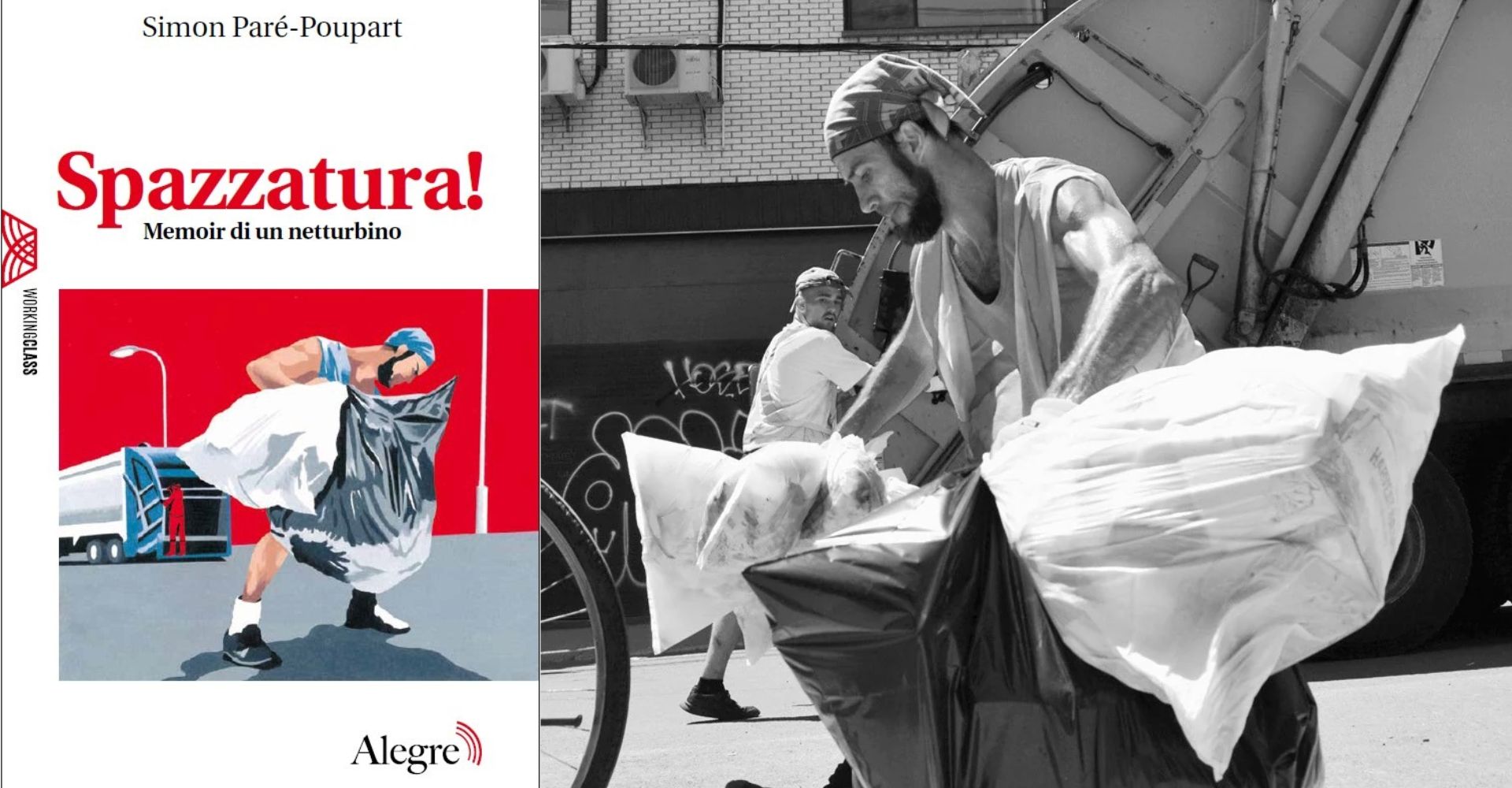
“Nothing disappears by magic,” says Simon Paré-Poupart, a Canadian sanitation worker and writer, author of Garbage! Memoir of a Sanitation Worker, whom we interviewed. Published in Quebec in the autumn of 2024, the book quickly became a publishing phenomenon in Canada, with tens of thousands of copies sold and numerous literary accolades, including the Prix du libraires du Québec 2025 in the nonfiction category. Listed by the New York Times among the most anticipated nonfiction books for 2026 and compared by literary critic Dwight Garner to Kitchen Confidential by Anthony Bourdain, it now reaches our bookstores through Ediciones Alegre in Silvia Turato’s translation.
From university to the garbage truck
Son of an alcoholic father and an affectionate mother, Paré-Poupart grew up in Montreal, playing Dungeons & Dragons and avidly reading. Convinced he would soon become an intellectual, he enrolled in university, earning degrees in anthropology and sociology. However, one day, exhausted by the constant provocations of a stepfather who accused him of being a “mama’s boy” lacking virility, he decided to work behind a garbage truck.
His “debut” in the world of waste takes place in Mirabel, an industrial town about an hour from Montreal, in the summer of 2023. It is nine in the morning and the thermometer already reads thirty degrees. While on TV a weather alert urges people to stay home and avoid exertion, Paré-Poupart, following the energetic movements of the other sanitation workers, climbs onto the bed of a pickup and wipes sweat from his brow. Under a scorching sun, he stomps on filthy mounds of garbage and climbs a mound to grab a couple of bags and hurl them into the truck.
“The true face of humanity”
Returning home late at night after his first day on the job, he feels exhausted, unable to sleep even. Suddenly, however, he senses “something special,” the inexplicable desire to join that team of invisible street workers. Over his twenty years in the trade, it becomes ever clearer that sanitation workers represent “the true face of humanity” that no one wants to see; they are the “insignificant beast” entrusted with keeping the small-bourgeois world immaculate and healthy.
“No one writes novels about sanitation workers,” he writes in the book. Was it his passion for the profession that led him to tell a working reality that remains largely invisible to society?
“More than passion, it was the chance encounters that guided me to this story. Although I don’t come from a family of intellectuals or artists, I was fortunate to be able to study and, during my academic journey, meet Alain Deneault, a philosopher and professor of Political Science at the University of Montreal. I was struck from the start by his civic commitment and our shared interest in the most marginalized segments of the population. Unlike him, however, I did not yet possess the tools to describe this reality. He guided me and, later, introduced my project to the publishing house.”
“Loving one’s work constitutes the best concrete approximation of happiness on earth,” Primo Levi wrote in The Monkey’s Wrench. What is the ethical dimension of work? “I am increasingly convinced that work is essential to contributing to the construction of a personal and social identity. Humans define themselves through their trade, which, as Antonio Gramsci already wrote, also serves as a tool for reflection and understanding of the world we live in.”
And the factory experience? “The condition of a worker is striking for the freedom, ardor, strength in the face of suffering and risk. Yet, there is a tendency to relegate the manual worker to their mere function, stripping them of humanity and assigning them a fear of vulnerability and death.”
Primo Levi, however, emphasized that love for one’s own work “is a truth that not many know”… “Sure, socio-economic contingencies often prevent people from dedicating themselves to the profession they would like to pursue. Many sanitation workers, for example, approach this work casually, not considering it a true profession. For some, it is a summer job, a training period for a future fighting athlete, or a temporary experience before facing the tests to become a firefighter.”
From which social backgrounds do most environmental workers come? “They can be hyper-consumers without schooling, but eager for immediate earnings, drug users, anarchists, undocumented immigrants and homeless people. In almost all cases, they are individuals who have not found their place and a proper recognition in society.”
Telling the world of waste and wage workers inevitably means confronting issues of class and privilege. How does the social class of origin influence our relationship with the waste we produce? “Always, around the world, those who collect waste belong to the working classes: from sanitation workers to those who sort materials at sorting centers. By contrast, those who manage waste—the shareholders and intermediaries in the commodity trade—come from higher social strata. This social rift creates a distance from the very object, the waste, which becomes doubly contaminated: first by the dirt it may contain, but also by those who ‘live’ next to it.”
Our industrial society is increasingly obsessed with progress and convinces consumers that increasing production can reduce waste. What concrete solution do you propose to manage the waste problem? “I believe that first and foremost we need a paradigm shift in our consumption habits. If, technically, we know the instructions for recycling plastic, there are nonetheless significant structural constraints that prevent real recycling: from the different material types to the different recycling techniques, from the low cost of producing virgin plastic to the excessive consumption represented by ecommerce platforms. This multiplicity of variables gives rise to a very complex supply chain in which technology cannot exert sufficient control.”
The book has enjoyed success across North America. Did you expect it? “Absolutely not! Being completely unfamiliar with the publishing world, I didn’t even think a book could receive such public recognition, and I could never have foreseen it.”
Do you think this reception is also due to the fact that the story of a working-class worker is being told by someone who is still in the trade, rather than from the vantage point of a newer and more affluent profession? “Yes, I think my dual role as worker and writer reverses the current trend of outsourcing industrial crafts. Production and recycling are essential activities for the development of our society, yet they increasingly take place far from our own spaces, in other countries, or inside industrial plants on the outskirts of cities. The fact that people are ‘interested’ in my case might be, perhaps, a symptom of this distance.”
Among the authors he read during adolescence, he recalls Emile Zola and Victor Hugo. What is he reading now? “These days I’m re-reading some classics of Québecois 20th-century literature, notably the novel Au pied de la Pente douce by Roger Lemin and the literary works of Gabrielle Roy.”
Have you started collaborating with Canadian newspapers or magazines? “Yes, I curate a column on the environment and one on literature for Radio-Canada, the francophone public broadcaster of Canada. I’m now working on my friend Rémy Bourdillon’s book, Planète plastique, published by Écosociété. Books from around the world are constantly gifted to me. I never stop reading, and I consider it a real fortune!”